Neuro Vedanta – A Modern Monk’s Path to Meditation
Updated: Jul 15, 2025
Andrés Galindo Gómez is a Neurosomatic Coach, spiritual teacher, and founder of his own online learning platform. Blending 10 years of monastic life with applied neuroscience and somatic tools, he guides individuals and teams to access inner resources for clarity, nervous system resilience, and conscious, purpose-driven living.

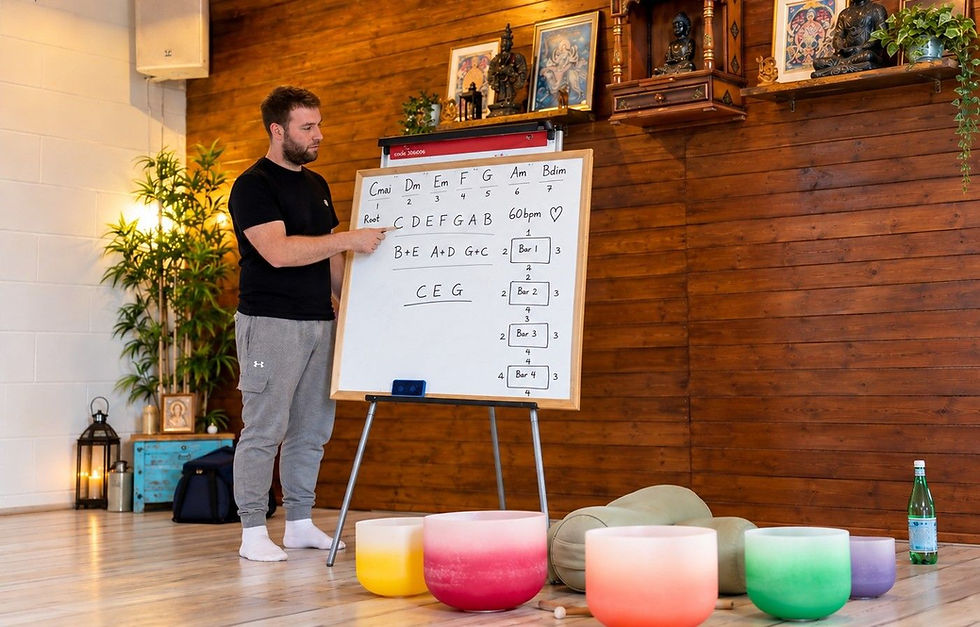
From a quiet childhood moment on a meditation cushion in Mexico to years spent walking barefoot as a monk through South America and India, this is the story of how I came to create my own meditation system. Neuro Vedanta Meditation was not born in a lab or a lineage – it was born in lived experience, through devotion, questioning, healing, and relentless curiosity. It’s a fusion of ancient mantra, elevated emotion, and modern neuroscience, designed to be practical, simple, and transformative. A path for real people with real lives – just like yours.

Roots in Mexico
Even though I am a world citizen, my roots lie in Mexican soil. My heart is a collection of experiences that have shaped my artistic process into the creation of my meditative system. How did it all start? When I was 11 years old, my family and I lived in a picturesque country house in Jalapa, east of Mexico. One day, my mom came to my bedroom with a black, thick meditation cushion and told me, "Andrés, meditation is an incredible tool for sensitive minds like yours. It brings calm, relaxation, and the possibility of observing your thoughts without identifying with them. Focus on your breath, and your breath only. If thoughts emerge, label them as ‘thought’ and come back to your breath. Sit up straight and stay at least 10 minutes practicing, my boy.”
At that time, I did not know how much this experience would benefit my life as a whole. So, first of all, gratitude to my mom, who introduced me to Tibetan meditation and Ashtanga yoga.
Pilgrim & monk
As a teenager, you go through so much in such a short time, and for me, meditation became a safe inner space I could visit every single time I needed it. Confusion and dizziness had no space when I meditated; instead of impulsively reacting to life issues, I could now observe them and calmly solve them. What a blessing for an HSP like me! (A highly sensitive person.) I gained the ability to see the biggest problems as small obstacles. As long as I kept meditating a few times per week, my mental state would have huge clarity and a sense of calm. So, every Monday, I would attend ‘Centro Dharma’ meditation sessions with my friend and teacher Patricio.
The meditative experience thus marked the beginning of a journey that would expand my consciousness, allowing me to ground and have clarity even in the most challenging circumstances. I’ve always liked adventures. I’m the type of guy who, if you invite me on an adventure, I’ll say yes, when do we start?! At that time, searching for my own inner truth marked the beginning of an ongoing adventure that made me travel the whole world: from Mexico to Argentina, from Europe to India, in search of spiritual wisdom. This eventually allowed me to be who I am and gave birth to my own meditation system, which I coined ‘Neuro Vedanta’ due to its roots in eastern wisdom and neuroscience.
My truth-seeking journey out of my home began when I was 18. After finishing high school, I did not hesitate to take a plane from Mexico City to Bogota, eager to learn about indigenous ancient traditions, spiritual wisdom, and a simple life in nature, away from my privileged city life in Mexico. During this year-long journey, I crossed paths with world travelers, hippies, artists, indigenous communities, yogis, monks, swamis, and gurus. One year later, I became a devoted monk in the Krishna Bhakti tradition, wearing saffron clothing and practicing spiritual disciplines such as mantra, meditation, Sanskrit philosophy, and Kirtan (devotional songs).
Long story short, due to being a hard-working and committed brahmachari (Vedic monk), six years later, I was directing a small ashram (monastic community) in the center of Buenos Aires City, Argentina. At that time, I was highly interested in sharing meditative experiences that could help people manage stress, anxiety, and depression in their daily lives to alleviate the suffering of living in a society that constantly pushes us toward consumerism, sense gratification, false needs, and stressful lifestyles.
The birth of Neuro Vedanta
By 2017, the beginning of an epiphanic summer season had just started. It was during an early morning sadhana practice, around 4 am, that I had this strong feeling of making spiritual wisdom a reachable practice for ‘non-monks’ through meditation. I felt I wanted to share my inner world and inspired states of peace and creativity with friends and society, in a way that could be easy, simple, non-pretentious, and respectful to all traditions.
At that time, I was a temple president, which means I was a very busy monk; still, I decided to give myself a few hours per day to research meditative systems in different religions. That is how I ended up reading valuable authors such as Daniel Goleman and Joe Dispenza. On the other hand, I saw a variety of ‘meditation schools’ that were actually more interested in preaching dogmatic religious practices or courses that would eventually initiate you into an institution, a Guru, or a sect, which I strongly disagree with. I’ve always felt everyone is free to choose their own path; meditation teachers should teach students about freedom and joy, about reaching inner resources to feel self-satisfaction and alignment with their feelings and heart, not indoctrination towards religious structures to end up needing a Guru to ‘fix you and heal you.’
One of those inspired early mornings, after my mantra meditation practice at the ashram, out of my heart, I became aware of something that would eventually become one of my main cornerstones in life: Acknowledging the difference between a spiritual process, a religion, and an institution. I had found something incredible within and had to express it. That morning, I called a dear friend and expressed, "Men, you know, in ashrams we shouldn’t mix up religious stuff with meditation. Meditation is a process to free your mind from structures and patterns. It should be free of dogma." And so, I began teaching my Meditation Courses free of dogma throughout South America and Europe, encouraging my students to pursue their spiritual aspirations regardless of the tradition, religion, or lineage.
With time, my meditation courses reached hundreds of students who enthusiastically became seasoned meditators, and their positive feedback stayed in my heart forever as proof that you can create something when you wrap your head and heart around it with passion and patience. Thus, I coined the term Neurovedanta. I would describe it as a balanced blend between neuroscience, positive self-transformation, and eastern meditative traditions that encompass universal perennial wisdom through simple practices such as mantra meditation, positive intentions, and elevated emotions, alongside a reliable scientific backup regarding the brain benefits of meditation. Thus, creating a system that fosters emotional resilience and a positive mindset, by directing our efforts toward freedom from fear and the fulfillment of our life dreams by following our deepest inner instincts, trusting our bodies, and connecting brain and heart.
I must admit I see my beloved mom and dad in this project of mine. Since my father, a PhD biologist, raised me with scientific skepticism by showing me how every phenomenon had an explanation in biology, and my mother, an artist, painter, and flamenco dancer, always showed me the value of emotions, spirituality, and love through our actions. Thus, I see how Neurovedanta has a constellar blueprint of my dad’s intellectual science and my mom’s sacred spirituality, secrets, and insights that ran through my family lineage generation after generation. It became a meditative tool that I teach with passion and great enthusiasm, as it fosters free spirituality, brain transformation, and the pursuit of your biggest dreams.
The three pillars of Neuro Vedanta
Let me explain the three core elements of my meditation system.
1. Elevated emotion
At the heart of Neuro Vedanta lies the cultivation of elevated emotions, gratitude, love, and compassion. These are not just fleeting feelings but powerful vibrational states that influence your biochemistry. By practicing daily gratitude, expressing genuine compassion, and radiating unconditional love, you actually create an internal atmosphere that supports neuroplasticity, the brain’s ability to rewire itself. Studies show that positive emotions broaden your awareness, build new mental resources, and strengthen resilience against stress.
2. Positive intention
The second cornerstone is positive intention. This means becoming crystal clear about your dreams, goals, and highest aspirations. Neurovedanta teaches you to visualize your desired future, hold it firmly in your mind’s eye, and feel the emotions of already having achieved it. Neuroscience calls this mental rehearsal. Research confirms that imagining an action activates the same brain regions as performing it, priming your neural circuits for success.
3. Root mantra
Finally, the Root Mantra brings ancient vibrational wisdom to this modern method. Beeja mantras, sacred seed sounds used in ancient Tantrik, Tibetan, and Indian meditation, carry the subtle energy of universal forces. Repeating these mental seeds activates the limbic system, calming the stress response while boosting focus and emotional regulation. Evidence proves positive brain effects on the human brain, specifically in the pre-frontal cortex, in creating brain coherence and reducing amygdala reactivity. Further research suggests that regular “OM” meditation activates brain regions, including the insula and cingulate cortex, representing vagal pathways, and increases theta and alpha band coherence.
From my experience and what I have seen in years of teaching with my students, I would say that, combined with elevated emotion and positive, clear intention, mantras act as gentle anchors, drawing scattered thoughts back into a centered, peaceful heart, aligned with higher purposes and life mission.
A unified practice for modern minds
Thus, by weaving Elevated Emotion, Positive Intention, and the Root Mantra together, Neuro Vedanta becomes more than a meditation, it is a daily ritual to align with the laws of nature as you become your most authentic self. As you hold a clear vision of your future, you activate the power of manifestation. You feel the joy, abundance, and success of your future self now, training your brain to build the same neural pathways that people who already live their dreams use daily. This is the living placebo effect – you become both the architect and the builder of your life.
The neuroscience of becoming
When you combine elevated emotions and positive intentions, you naturally stimulate your brain’s prefrontal cortex (responsible for decision-making and future planning) and your limbic system (regulating emotion and motivation). Neuroscience shows that sustained positive emotions like gratitude release dopamine and serotonin, neurotransmitters linked to happiness and mental well-being. Simultaneously, setting clear goals activates the brain’s reticular activating system (RAS), filtering your daily reality to spot opportunities that align with your dreams. Together, these brain systems create a feedback loop where your thoughts, emotions, and actions reinforce each other.
The science of self-transformation
In Neuro Vedanta, I invite you to become the captain of your boat, the healer of your emotional wounds, and the creative force behind your reality. By generating elevated emotions, you build resilience; by planting positive intentions, you direct your energy; and by chanting root mantras, you center your awareness. Research in neuroplasticity suggests that your brain does not know the difference between vividly imagined experiences and real ones. When you feel surrounded by success, harmony, and love, your brain fires and wires new circuits that make these inner states your outer reality. With every breath, you choose, build, and create the life of your dreams.
Real-life transformation: A student’s story
One of my students in Argentina, Eugenia, came to me during a difficult period in her life, battling burnout, anxiety, and a sense that her life had lost its deeper purpose. At that time, she took my 3-month meditation training and practiced small things each day, nothing complex, just beginning each morning by feeling deep gratitude for simple things, setting daily intentions for her dream career as a successful brand owner and creative designer, and chanting a simple mantra to steady her mind. Within months, Eugenia reported that she felt calmer and more inspired. Six months later, she opened her own design brand in Buenos Aires, a dream she once thought impossible. Today, she says,
“Meditation gave me the tools to rewire my mind and reach my goals. It didn’t just change how I think – it changed who I am.”
Easy, practical, and profound
The beauty of Neuro Vedanta is in its simplicity and daily practicality. You don’t need to retreat to a Himalayan cave or spend hours on the cushion. Just a few mindful minutes each day, feeling elevated emotions, setting clear intentions, and meditating on a mantra, can profoundly shift your mental patterns. This practice gently sculpts your neural pathways toward positivity, goal fulfillment, mental clarity, and emotional harmony. It reminds you that you are both the designer and builder of your life, a conscious creator who aligns with the laws of nature, manifests your dreams, and lives in tune with your highest self every single day.
My Neuro Vedanta Meditation Teacher Training is available on my website. It is 100% online and easy to follow. It will allow you to learn and teach meditation. Check it out; I would love to have you on board!
Read more from Andrés Galindo Gómez
Andrés Galindo Gómez, Neurosomatic Coach & Spiritual Teacher
Andrés Galindo Gómez is a Netherlands-based Neurosomatic Coach, spiritual teacher, and founder of the Andres Galindo learning platform. At 18, he felt an inner call to explore the world and embraced monastic life, spending 10 years in spiritual study across India, Austria, Brazil, and Argentina. Today, he bridges ancient wisdom with applied neuroscience to help individuals and organizations access emotional clarity, nervous system recovery, resilience, and conscious living. A global citizen and lifelong seeker, Andrés offers his meditation teacher trainings, courses, and embodied practices worldwide.