JonCarlo Oren – From Brooklyn Blocks to Construction Sites to the Page
An American story of public service, hands-on experience, professional responsibility, and the decision to turn years of observation into a larger conversation about accountability, government, and the future of human judgment.
A Brooklyn beginning
JonCarlo Oren grew up in Flatbush, Brooklyn, in an immigrant family with three sisters. Like many New York neighborhoods, Flatbush brought together people from different backgrounds, cultures, and walks of life. Its streets offered an early education in the realities of everyday life: people had responsibilities, families worked to make ends meet, and a person's reputation was often shaped less by what they said than by what they actually did.
Oren's early life did not come with a predetermined career plan. He did not set out to become a construction quality control manager, serve in public safety, or publish books examining government and artificial intelligence. Those pursuits developed over time, through different opportunities, responsibilities, and experiences that gradually shaped his interests.
What connects those chapters is not a carefully engineered path to success. It is a recurring willingness to learn, take on responsibility, and examine how things work in practice.
That distinction matters. Professional life rarely unfolds exactly as people expect. Careers change direction, opportunities emerge unexpectedly, and experience often teaches lessons that formal education alone cannot provide. Oren's path reflects that reality. Each stage introduced new challenges and gave him a different perspective on the relationship between rules, responsibility, and the people expected to uphold them.
The values he associates with his upbringing, family, perseverance, and service remained relevant as he moved into adulthood. They became part of the foundation for a career that would take him from public service into construction and, eventually, into writing.
Service before a professional title
Before construction drawings, inspection reports, and federal project meetings became part of his working life, Oren volunteered with the NYPD Auxiliary from 1998 to 2006. He later served as a State Constable in Pennsylvania.
These experiences introduced him to public service through direct participation rather than observation from a distance. Public-facing responsibilities require people to follow established procedures, communicate with others, respond to changing circumstances, and understand that their actions can affect people beyond themselves.
Such work also offers a practical view of institutions. Policies and procedures may establish the framework, but their effectiveness depends on how people carry them out. The individuals doing the day-to-day work often determine whether a process functions as intended, whether information is communicated clearly, and whether responsibilities are taken seriously.
Service does not always produce an immediate or visible result. Sometimes it means being present, following through, or completing a responsibility without receiving recognition. Those experiences can shape a person's understanding of accountability in ways that are difficult to learn from a job description alone.
For Oren, public service was an important chapter in his development, but it was not simply a stepping stone to a construction career. It was an experience in its own right – one that contributed to his interest in how organizations operate and what responsible conduct looks like in practice.
The transition from public service to construction would bring different technical demands, but it would also introduce a familiar question: when a responsibility has been assigned, how do you know it has actually been fulfilled?
That question would eventually become central to his work in quality control.
Building a Career in Construction
Learning the Field
Oren earned a Bachelor of Science in Construction Management and continued developing his professional knowledge through specialized training, certifications, and hands-on experience.
His qualifications include Project Management, Construction Quality Control Management, OSHA 500 Authorized Outreach Trainer, safety and environmental management, and erosion and sediment control inspection. Each area addresses a different part of the construction process, from worker protection and regulatory compliance to installation quality and environmental controls.
The value of this combination becomes clearer when considering how a construction project operates.
A project begins with plans, specifications, schedules, and contractual requirements. Those documents establish what must be built, the materials and systems to be used, the standards the work must meet, and the procedures that govern execution and acceptance. But the work itself takes place under real-world conditions that can differ from what the design team anticipated.
Existing infrastructure may present unexpected constraints. Equipment dimensions may not align with available space. Electrical schedules and mechanical requirements may need clarification. Different subcontractors may be working in the same area, creating coordination challenges. Weather, material availability, and sequencing can affect how the work progresses.
These are not unusual exceptions. They are part of the practical complexity of construction.
Quality management requires more than identifying whether an installation looks correct. It involves understanding the governing requirements, reviewing the relevant drawings and specifications, examining field conditions, coordinating inspections and tests, documenting deficiencies, and following corrective actions through completion.
Safety management adds another dimension. Work must be planned and performed with appropriate controls, training, hazard recognition, and compliance with applicable requirements. Environmental management requires attention to matters such as erosion, sediment, waste, and the protection of surrounding areas.
Oren's professional development reflects the reality that these responsibilities often intersect. A technically acceptable installation must also be executed safely, coordinated with other work, and documented accurately.
The credentials provide a foundation, but experience develops the judgment needed to apply that knowledge when conditions are complicated or the answer is not immediately obvious.
The difference between the drawing and the reality
One of the recurring challenges in construction is the gap that can emerge between what the documents indicate and what is happening in the field.
A drawing may show an equipment location, a pipe route, or a structural arrangement. The field team must determine whether the proposed installation fits the actual conditions and complies with the contract requirements. When something does not align, the discrepancy needs to be investigated rather than dismissed as a minor inconvenience.
That process can involve checking dimensions, comparing drawing revisions, reviewing approved submittals, consulting specifications, coordinating with subcontractors, and requesting clarification from the design team or government representative.
It also requires understanding the limits of one's authority. A quality control manager may identify a discrepancy and document its implications, but design changes and technical interpretations must be handled through the appropriate review and approval process.
The objective is not to make assumptions on behalf of the engineer. It is to identify the question early enough that the responsible parties can resolve it before the work advances.
This is where Oren's approach to quality control becomes particularly important. Good oversight is not about finding fault with every detail or slowing a project unnecessarily. It is about distinguishing between work that has been verified and work that merely appears ready to proceed.
A problem discovered before installation may require a conversation and a revised plan. The same problem discovered after concrete placement, equipment installation, or the closure of a wall can require demolition, replacement, additional inspections, and significant rework.
The technical details vary by project, but the principle remains consistent: verification is most valuable when it occurs before a decision becomes difficult or expensive to reverse.
Federal projects and mission-critical responsibilities
Working within complex organizations
Oren's professional career has included roles with Chenega Security International, The Building People, and Chugach Government Solutions, spanning safety, health, environmental compliance, quality management, and facilities operations.
His experience has included supporting federal construction and facilities projects associated with the U.S. Army Corps of Engineers and Naval Facilities Engineering Systems Command, as well as work at government and military installations where coordination, documentation, and adherence to established requirements are essential.
Federal projects operate within defined contractual and technical frameworks. Depending on the project, the work may involve detailed specifications, formal quality control procedures, government inspections, safety requirements, testing and commissioning, and multiple layers of contractor and government coordination.
A quality control professional must understand not only the physical work but also the documentation that establishes whether the work satisfies the contract.
That includes reviewing the applicable requirements, coordinating with subcontractors, monitoring construction activities, recording inspection results, identifying deficiencies, tracking corrective actions, and ensuring that unresolved issues receive appropriate attention.
When the work involves mechanical systems, electrical equipment, building infrastructure, or other interconnected components, a discrepancy in one area can affect several other trades. Resolving it may require coordination among engineers, equipment manufacturers, installers, electricians, controls technicians, and government personnel.
The challenge is to maintain a clear picture of what has been completed, what remains outstanding, what requires testing, and what must be resolved before the next phase can proceed.
This work is not always visible to the public. An installation that passes inspection may attract little attention, while a well-maintained record may be consulted only when someone needs to verify a requirement or investigate a later issue.
Yet these processes help protect the integrity of the finished project.
Leadership through accountability
Oren's progression through construction and facilities management has given him experience with both technical oversight and the operational responsibilities involved in coordinating people and work.
Leadership in these environments is not simply a matter of assigning tasks. It requires setting expectations, communicating priorities, recognizing when work is falling behind, addressing deficiencies, and ensuring that the right people have the information needed to make decisions.
It also requires balancing schedule demands with quality and safety requirements.
Construction teams work under pressure to meet milestones and manage costs. Those pressures are real, and unnecessary delays can affect the entire project. But the schedule cannot replace the technical requirements that define acceptable work.
Effective quality management means addressing issues proportionately and professionally: identify the discrepancy, establish the applicable requirement, document the condition, involve the appropriate personnel, and verify the resolution.
Oren has contributed to project teams whose work received Exceptional ratings for safety and quality through the federal contractor performance evaluation process. Such evaluations reflect project-team performance rather than an individual accomplishment in isolation. He recognizes that successful delivery depends on the combined efforts of field personnel, subcontractors, supervisors, engineers, and quality and safety professionals.
His contribution is part of that larger effort.
For Oren, professional credibility is built through consistency: understanding the work, communicating clearly, documenting accurately, and following issues through rather than assuming they will resolve themselves.
That approach may not always be the easiest route through a demanding project. It is, however, essential to maintaining confidence in the work and the people responsible for it.
From professional experience to two books
Construction and public service gave Oren direct experience with organizations, procedures, and accountability. Writing offered him another way to examine those subjects.
Rather than limiting his attention to the individual decisions made on a job site, he began exploring larger questions about the systems that shape public life: how authority is exercised, how institutions are held accountable, and how technological change may affect human judgment.
These interests became the foundation for two books that address different subjects but share an emphasis on responsibility.
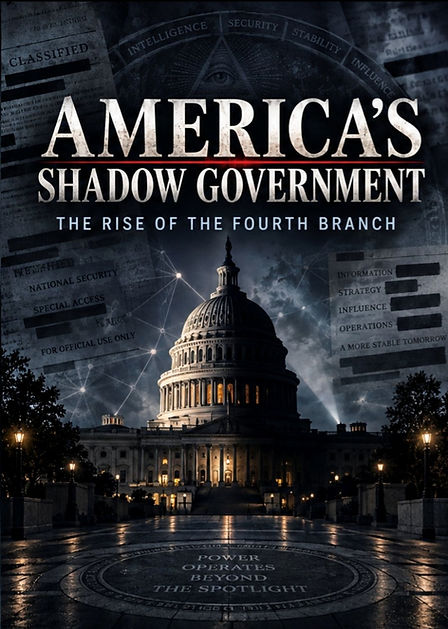
America's Shadow Government: The Rise of the Fourth Branch
Oren's first book examines government power, institutional authority, and accountability.
America's Shadow Government: The Rise of the Fourth Branch invites readers to look beyond the visible structure of government and consider how administrative institutions exercise authority, how decisions are made, and what meaningful oversight should look like.
The subject raises questions that are important to anyone interested in public institutions. How should authority be delegated? What mechanisms exist to review decisions? How can the public evaluate the actions of organizations whose work may be complex or difficult to follow? And what happens when the practical exercise of power becomes disconnected from clear accountability?
These are questions that require examination of institutions, their legal authorities, their procedures, and the evidence surrounding their actions.
Oren approaches the subject from an interest in how systems operate in practice. His experiences in public service and regulated professional environments have exposed him to the importance of procedures, defined responsibilities, and accurate records. Those experiences do not make government and construction interchangeable, but they provide a practical context for thinking about the relationship between formal rules and the people who implement them.
A procedure can establish what is supposed to happen. Effective oversight helps determine whether it actually happened, whether the decision was properly supported, and whether the responsible parties can explain their actions.
The book encourages readers to examine those questions for themselves and to think critically about the relationship between institutional authority, transparency, and public trust.
Its central subject is government, but its broader concern is accountability: how it is established, how it is maintained, and what can happen when oversight fails to keep pace with the exercise of power.
Not Without a Fight: Reclaiming Humanity in the Age of AI
Oren's second book turns toward artificial intelligence and the changing relationship between people and technology.
Not Without a Fight: Reclaiming Humanity in the Age of AI explores what happens when automated systems become increasingly involved in tasks that once depended primarily on human judgment, experience, and decision-making.
Artificial intelligence can help people analyze information, identify patterns, automate repetitive work, and improve efficiency. These capabilities offer real opportunities. But the growing use of AI also raises questions about the quality of decisions, the limits of automated systems, and the responsibilities that remain with the people and organizations using them.
The key question is not simply whether technology can perform a task. It is whether people understand the result well enough to evaluate it, recognize its limitations, and decide when additional verification is necessary.
Construction provides a practical illustration. Software can assist with design coordination, calculations, schedules, and documentation. Digital tools can help identify discrepancies and organize large amounts of information. But a recommendation still needs to be evaluated in the context of the actual installation, the applicable specifications, and the conditions present in the field.
A system may produce an answer without fully accounting for every relevant circumstance.
Someone must determine whether that answer is appropriate for the situation and whether the supporting information is reliable.
The same issue appears in other industries, including public administration, where automated systems may influence decisions affecting individuals and communities.
As technology advances, Oren encourages readers to consider the difference between using AI as a tool and surrendering independent judgment to it. Efficiency matters, but so do transparency, human agency, and the ability to question an outcome.
The book's central concern is preserving the human capacity to think, judge, question, and accept responsibility in a world where automated assistance is becoming increasingly common.
It is not simply a question of what technology can do. It is a question of what people must continue to do for themselves.
Two books, one continuing question
At first glance, government accountability and artificial intelligence may seem like separate subjects. One concerns institutions and authority; the other concerns technology and human agency.
For Oren, however, they intersect around a common challenge: the relationship between complex systems and the people responsible for their decisions.
In government, accountability requires understanding how authority is exercised, what rules apply, and whether decisions can be examined and challenged.
In technology, responsible use requires understanding what a system can and cannot establish, evaluating the information it produces, and ensuring that people remain accountable for consequential decisions.
In construction, the same general discipline appears in a more physical form. Plans, specifications, inspection records, and test results provide essential information, but they must be checked against actual conditions. A discrepancy cannot be resolved simply by assuming that the paperwork or the installation is correct.
The comparison is not that these fields operate identically. Each has its own standards, risks, and methods of oversight. The connection is the importance of verification and clearly assigned responsibility.
Oren's books extend that interest beyond the job site. They ask readers to consider what responsible oversight looks like when decisions are made within institutions or influenced by technologies that can be difficult to understand from the outside.
His writing reflects the belief that people should remain engaged participants in the systems that affect their lives, rather than assuming that a formal process, official explanation, or automated recommendation is necessarily beyond question.
Where the two paths meet
Oren continues to work in construction quality control while developing his writing. He lives in Stafford, Virginia, with his wife and three children.
His story is not a straight line from a childhood ambition to a carefully planned professional destination. It is a series of chapters, each with its own demands and lessons: growing up in Brooklyn, volunteering in public service, serving as a State Constable, studying construction management, developing technical expertise, and working on projects where accuracy and accountability matter.
Writing became another way to apply the habit of examining how things work and asking what happens when they do not.
The connection between his career and his books is not a claim that professional experience provides all the answers to questions about government or technology. Rather, it reflects how years of practical work can sharpen a person's appreciation for evidence, procedures, responsibility, and the consequences of decisions.
On a construction project, that perspective may mean asking for clarification before an installation proceeds. It may mean identifying an incomplete inspection, reconciling conflicting documents, or ensuring that a deficiency is corrected and documented.
In writing, it means examining larger questions, distinguishing assumptions from evidence, and inviting readers to think carefully about institutions and technologies that increasingly influence modern life.
The settings are different, but the underlying responsibility is familiar: do not confuse the appearance of completion with proof that the work is right.
A career still in progress
Oren's professional identity is not limited to a single title. Public service, construction management, quality control, and authorship represent different ways he has chosen to engage with the world around him.
His construction career demands attention to physical details, technical requirements, safety, and coordination. His books examine questions that operate on a broader scale, including institutional accountability and the future of human judgment.
Neither path offers simple answers to every problem. Both require continued learning, a willingness to examine information, and an understanding that responsibility does not end when a task appears complete.
That may be the most enduring lesson in Oren's journey. A career does not have to unfold according to an original plan to become meaningful. Different experiences can contribute to a broader perspective, and skills developed in one field can help inform the questions a person asks in another.
From Flatbush to public service, from construction sites to published books, Oren's path reflects a continuing interest in how systems function and how people can make them more accountable.
The hard hat and the written page may appear to represent different worlds. In his experience, both demand attention to detail, respect for evidence, and a willingness to look beyond appearances.
His story continues through the work he does, the questions he explores, and the lessons he hopes readers will consider for themselves.
About JonCarlo Oren
JonCarlo Oren is a construction quality control professional with BL Harbert International and the author of America's Shadow Government: The Rise of the Fourth Branch and Not Without a Fight: Reclaiming Humanity in the Age of AI. He holds a Bachelor of Science in Construction Management and has professional experience in construction quality control, safety, environmental management, and facilities operations. His career includes supporting federal construction and facilities projects associated with the U.S. Army Corps of Engineers and Naval Facilities Engineering Systems Command. Before entering the construction profession, he volunteered with the NYPD Auxiliary from 1998 to 2006 and later served as a State Constable in Pennsylvania. He lives in Stafford, Virginia, with his wife and three children.