

Is It Moral Decay, Deficit, or Disguise?
Updated: Aug 11
Veronica Powell, PhD, LPC, is a Licensed Clinician, Industrial-Organizational Psychologist, and Communication Coach. As the Founder and CEO of Measures4Success Academy, she empowers individuals, leaders, and organizations to master communication through Kendall’s Life Languages™ Framework, also known as Communication Intelligence (CIQ).

How do you rot what never grew? We use the phrase moral decay to describe conduct that shows no moral character, but decay is decomposition, and decomposition requires something that was once alive. Before we assign the word, it is worth asking what we are seeing. A person who abandoned their values and a person who never built any can behave identically. The behavior looks the same, yet the cause does not. The difference changes everything about what comes next.

What are we saying when we say moral decay?
Decay is a slow undoing. It describes something once whole breaking down over time. Rot assumes wood that was sound to begin with. Rust assumes metal that was solid before the corrosion set in. So, when we call a person morally decayed, the word carries a quiet assumption underneath it. It assumes there was moral health first, and that something wore it away.
That assumption is often wrong, and being wrong about it is not harmless. If a person never showed morality to be part of how they operate, the word is doing work it has not earned. Nothing can decompose that was never alive. Naming the failure correctly is not a matter of vocabulary. It is the first act of discernment, and discernment is where communication either succeeds or breaks down.
This matters because the word we choose shapes what we expect. Call it decay, and you imply a return is possible, that the person could go back to who they were. Call it something else, and the honest question becomes whether there was ever a there to return to. Get the name wrong, and every response that follows is built on a false narrative.
Why immorality and amorality are not the same thing
Here is the distinction the whole piece rests on. Immorality and amorality sound like cousins, but they describe opposite conditions, and treating them as interchangeable is where our judgment goes wrong.
Immorality means violating a moral standard the person holds or recognizes. The conscience is present but overridden. The person knew better and chose otherwise, which is why we hold immoral acts against the one who commits them.
Amorality means the standard was never internalized in the first place. There is no conscience being violated, because there is no operative moral framework to violate. This is not a person breaking a rule they believe in. It is a person who never built the rule.
The reason this separation matters is practical, not academic. Call an amoral person immoral, and you credit them with a moral compass they never developed. Call an immoral person amoral, and you excuse a violation they were fully equipped to avoid. Both misreadings distort what you can fairly expect, and both start you down the wrong path.
Lawrence Kohlberg gives us the map for the amoral case. His theory of moral development traces how people move through three levels of moral reasoning:
From preconventional, where right and wrong are defined by punishment and self-interest.
Through conventional, where social rules and approval govern behavior.
To postconventional, where conduct is guided by internalized ethical principles (McLeod, 2013).
The detail that matters most for our purposes is easy to miss. Kohlberg found that not everyone reaches every stage. Progression is not automatic, and many people settle at earlier levels rather than descend from higher ones (McLeod, 2013). A person arrested at the preconventional level is not decaying. They never developed the internal standard that decay would erode.
The whole vocabulary is guessing
Once you see the assumption buried inside moral decay, you start to notice it everywhere. We have a whole family of words for moral failure, and we swap them freely as if they mean the same thing. They do not. Moral decline, moral bankruptcy, moral corruption, moral deficit- each one carries a hidden claim about what happened, and most of the time we reach for whichever sounds heaviest rather than whichever is true.
The table below sorts the terms we use most. Notice what they share and where one of them breaks from the rest.
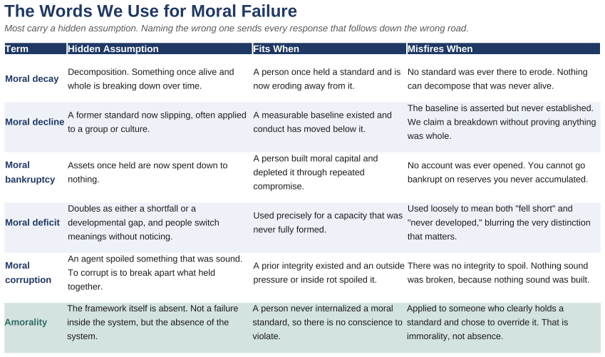
Note. The amorality and deficit distinctions draw on Kohlberg’s stages of moral development (McLeod, 2013) and Bandura’s work on moral disengagement (Bandura, 1999). The remaining terms are examined by their common usage and root meaning.
Five of these words assume a prior state that is now gone. Decay, decline, bankruptcy, and corruption all point backward to a standard that was supposedly there and has since broken down, slipped, drained away, or been spoiled. Only one, amorality, makes the opposite claim that there was never a standard to lose. When we describe a person, we usually choose one of these words without checking whether its buried assumption fits the person in front of us.
How the misuse shows up in real time
Gallup finds that 80% of Americans think the nation's moral values are getting worse (Gallup, 2026). Yet when Mastroianni and Gilbert (2023) examined more than 12 million responses across at least 60 nations, they found people have believed morality is declining for roughly 70 years, while their reports of how their own contemporaries behave have stayed flat. The decline everyone names, no one can locate.
That gap is where the misuse lives, and it shows up daily in news commentary, cultural criticism, and opinion writing. Watch how the phrase travels, and you see the same blurring the table warns against, repeated and rarely questioned.
The most common pattern is the blanket diagnosis. A writer declares that society is in moral decay, then points to a scattered list: rising crime, materialism, declining trust, social media, as though these unrelated things add up to one measurable condition. The claim assumes a former soundness, a time when the culture was whole, but that baseline is almost never named. We are told something broke down. However, we are seldom shown what was whole to begin with.
The second pattern is term swapping. In a single passage, a writer slides between decadence, decline, decay, and depravity as if they were one word. Decadence suggests indulgence. Decline suggests a slow slipping. Depravity suggests a settled, present badness rather than a fall at all. Sliding between them leaves the reader alarmed without a clear idea of what is being claimed.
The third pattern is the most revealing. Commentary on moral decay will sometimes invoke moral disengagement in the same breath, treating Bandura's precise mechanism as one more symptom of general rot. But moral disengagement is not decay. It describes a conscience being switched off, which is disguise, not deficit and not decay. Folding it in erases the very distinction a reader needs.
None of this belongs to one outlet or one side. The misuse runs across the spectrum, secular and faith-based alike, because it is a habit of language, not a partisan tactic. When a word this heavy is used this loosely, it stops describing reality and starts manufacturing a mood. A mood is a poor foundation for how we judge one another.
Three failures that wear the same face
When people reach for moral decay to describe someone whose conduct never reflected moral character, they are usually pointing at one of three different conditions. The conditions look alike on the surface. They are not alike underneath, and they do not call for the same response.
Decay: The standard was held and then abandoned
This is the only case where the word fits. The person held a moral standard and has since let it go. There was a real prior commitment, and it eroded, whether through compromise, exhaustion, corruption, or slow rationalization. This is regression in the true sense. Something that existed was lost. When we see a person who once acted with integrity now cutting corners they would have refused years ago, decay is the accurate name. The standard was real, and its breakdown is real.
Deficit: The capacity never developed
This is the case most often misnamed. The moral capacity was never built. As Kohlberg’s stages show, a person can settle at the level of self-interest and never internalize the principles that make certain choices unthinkable (McLeod, 2013). Failing to build something is not the same as tearing it down. The accurate word here is amorality, not decay. A person operating from pure self-interest is not betraying a code. They show you there was no code to betray. In Communication Intelligence™ (CIQ) terms, this is not a Shaper who has lost their principles or a Responder whose empathy has hardened. It is a pattern that never included those capacities in the first place.
Disguise: The capacity exists but is switched off
This is the most deceptive of the three, because the moral capacity is genuinely present. It is simply disengaged when convenient. Albert Bandura called this moral disengagement. He observed that our moral self-sanctions, the internal restraints that stop us from harming others, do not operate automatically. They must be activated, and there are many psychological maneuvers by which people selectively switch them off while still harming others (Bandura, 1999).
Bandura identified specific mechanisms for this. People reframe harmful conduct as serving a worthy cause through moral justification. They soften it with sanitizing language. They diffuse or displace responsibility, so no single person feels accountable. They minimize the damage or blame and dehumanize the very people they harm (Bandura, 1999). None of these are signs of a missing conscience. They are signs of a conscience being managed, muted, and worked around. This is closer to hypocrisy than to decay, and closer to concealment than to absence. The person has the standard. They have simply built machinery for stepping around it.
Why the same behavior tells you nothing on its own
The absence of visible morality is underdetermined evidence. On its own, it cannot tell you whether you are seeing decay, deficit, or disguise. Only the cause underneath tells you what, if anything, can reasonably change, and that is exactly what we skip past when we default to decay.
This is why leaping to moral decay is not just imprecise. It is a communication failure with consequences. It assigns a story to a person, and that story determines how we speak to them, what we ask of them, and whether we waste years waiting for a return that was never on the table. I explored a related cost in why we keep doing good when it feels like evil is winning, where measuring the wrong thing quietly drains the people who are holding the line.
How to read the difference before you name it
None of this helps until it meets a real person in front of you. The distinction is easy to nod at and hard to apply when you are hurt, frustrated, or trying to decide whether to keep investing in someone. Here is what discernment looks like in practice.
Look at the history before you name the present. Decay requires something that was once alive and well, so the first question is whether it ever existed. Was there a season when this person consistently acted on a standard they now violate? If yes, you may be watching decay. If you cannot find that season anywhere in their record, you are probably not watching something break down. You are looking at ground where nothing was ever planted. The evidence is in the pattern over time, not the offense in front of you.
Separate the act from the apparatus around it. Bandura's insight gives you a test for disguise. Listen to the machinery. When a person harms and then reaches for justification, softened language, shifted blame, or minimized consequences, you are hearing a conscience being managed rather than a conscience that is absent (Bandura, 1999). The amoral person does not usually bother to justify. They see no violation to explain. The disguised person builds an elaborate case, because the standard is still in there, and it still needs to be quieted.
Read the pattern, not the person's potential. It is tempting to name someone by who you hope they could become. Discernment asks you to name them by the pattern they run. CIQ teaches that how a person responds reveals who they are, not who you are, and the same holds for moral conduct. A pattern that has never once included an internalized standard is telling you something, and honoring that signal is not cynicism. It is the clarity that lets you respond to the person in front of you rather than the one you wish were there.
Match your response to the cause, not the surface. If it is decay, accountability and a path back may both be appropriate, because there is something to return to. If it is deficit, the honest work is building capacity from a low stage, which is slow and may not succeed, and expecting overnight moral recovery only sets everyone up for failure. If it is disguise, the response is to name the mechanism plainly and refuse the euphemism, because the person already has the standard and the cover is the whole problem. One diagnosis, one direction. Three diagnoses, three directions.
Hold discernment and compassion together. Naming a deficit is not condemnation, and naming a disguise is not cruelty. Seek first to understand, then to be understood (Stephen R. Covey). Understanding includes understanding what a person is made of, without inflating it and without erasing it. Compassion that refuses to see clearly is not compassion. It is avoidance wearing a kind face, and it helps no one, least of all the person you are trying to reach.
Why naming it right is the first act of care
We return to the question that opened this. How do you rot what never grew? You do not. Pretending otherwise costs more than a misused word. It costs the years, the energy, and the trust we pour into a story that was never true.
Moral decay is a real thing. It happens to real people, and when it does, the word is right, and the grief is earned. But it is one of three, not the default name for every failure that offends us. Decay is a loss. Deficit is an absence. Disguise is a concealment. They are not the same, and the discernment to tell them apart is not coldness. It is the beginning of an honest response.
Communication was always meant to restore our shared humanity, and restoration begins with seeing accurately. Before we condemn, we owe one another the discernment to name what is there. That kind of moral clarity, the willingness to see truthfully in a world that rewards easy labels, is the same courage I wrote about in finding faith, truth, and moral courage in a world on fire. Naming a failure rightly is not a lowering of the standard. It is what the standard requires.
Your next step
The path to better communication begins with one honest step- learning how you are wired to connect and how you read the people around you. Start by exploring your primary language through the Free Life Languages™ Mini Profile.
Take that step today, join a community devoted to the craft of communication, and help build a world where every message is not just heard but truly understood. The power to change how we communicate, and with it, our world, rests with you.
Thank you, dear readers, for walking this road with me. Your support fuels a movement to cultivate effective communicators for humanity and global peace. Let us continue fostering understanding and harmony on this shared journey. Raise your Communication IQ to raise humanity, one conversation at a time.
Key takeaways
Decay is decomposition. Calling a person morally decayed assumes moral health came first, and that assumption is often unearned. Nothing can decompose that was never alive.
Immorality and amorality are opposites, not cousins. Immorality violates a standard the person holds. Amorality reflects a standard that was never built.
Kohlberg found that not everyone reaches every stage of moral reasoning. A person arrested at an early stage is not decaying. They never developed the standard that decay would erode.
Bandura showed that moral self-sanctions must be activated and can be selectively switched off. Disguise is a present conscience being managed, not a missing one.
The same behavior can come from decay, deficit, or disguise. The surface is identical. The cause is not, and only the cause tells you what can reasonably change.
Naming the failure correctly is the first act of care. Get the name wrong, and every response built on it stands on a false narrative.
Follow Dr. Powell on Facebook, LinkedIn, Instagram, and visit her website and BlueSky handle for more insights and updates.
Read more from Dr. Veronica Powell
Veronica Powell, PhD, LPC, PC, Founder and CEO
Veronica Powell, PhD, LPC, is a Licensed Clinician, Industrial-Organizational Psychologist, and Communication Coach. As the Founder and CEO of Measures4Success Academy, she empowers individuals, leaders, and organizations to master communication through Kendall’s Life Languages™ Framework, also known as Communication Intelligence (CIQ). Dr. Powell is a Senior Executive Contributor for Brainz Magazine and the creator of the Communication Matters Global Movement, where she teaches professionals how to build trust, empathy, and relational intelligence in every conversation.
References:
Bandura, A. (1999). Moral disengagement in the perpetration of inhumanities. Personality and Social Psychology Review, 3(3), 193–209.
Gallup. (2026). Americans' rating of moral values hits new low. Gallup.
Kohlberg, L. (1984). The psychology of moral development: The nature and validity of moral stages. Harper & Row.
McLeod, S. A. (2013). Kohlberg’s stages of moral development. Simply Psychology.


