In the Age of AI – How Forest Therapy Helps You Stand Firmer
Written by Juna Ting-Wei Chang, Forest Therapy Guide
Juna Ting-Wei Chang is a forest therapy guide and founder of Shinrin-Yoku Taiwan, specialising in evidence-based forest therapy and Shinrin-yoku. She supports individuals and organisations in slowing down and gently returning their attention to themselves and the more-than-human world through nature.

AI is speeding up our work and blurring what is real. We can’t slow the wave of AI, but we can learn how to stand firmer on the ground. Scroll for five minutes, and you may encounter a photo that never existed, a voice that was never recorded, and news that never happened. Some people are struggling to distinguish truth from falsehood, while others are proving that the news is fake. The world is moving ever faster, yet happiness arrives more slowly and lasts for a shorter time. Welcome to the wave.
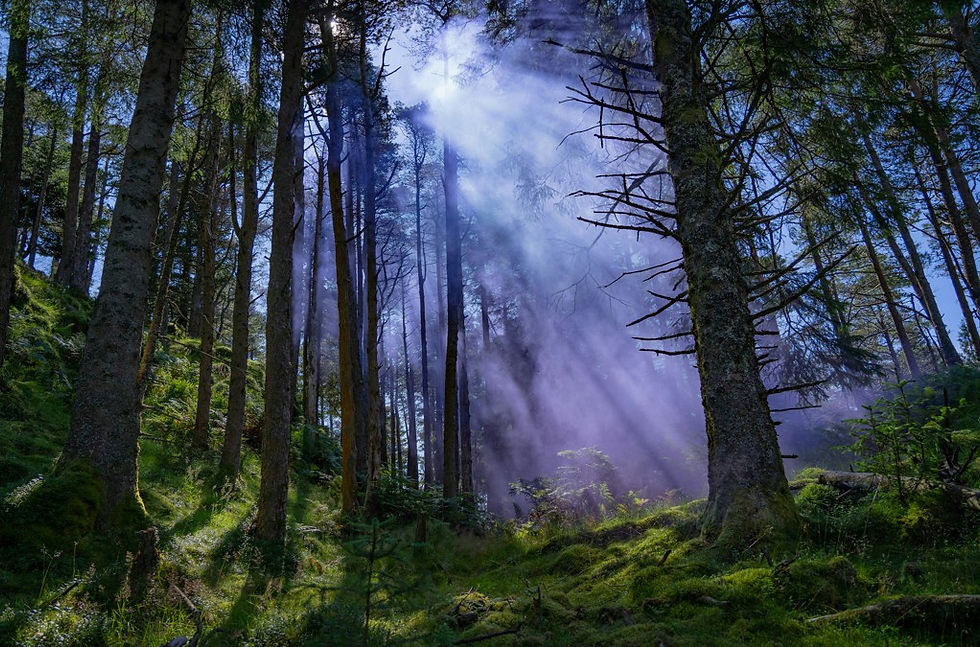
Like many of you, I spend most of my working time at a computer, surrounded by the same tools and the same pace. What keeps my own life in balance is leading forest therapy walks in the forest. More and more of the people who join me are riding that wave too: tired, stretched, and unsure what to trust. Over time, I have come to believe that the forest offers something AI cannot, and that is firm ground.
The wave brings more than speed
AI can save time, but it also brings new pressures. In a 2025 interview study of 15 young professionals, researchers found that not only did classic technostress affect them, but generative AI also introduced new stressors, such as regulatory uncertainty, dependency on AI tools, and the need to control and validate AI-generated output, alongside real benefits like efficiency and new learning opportunities (Högemann et al., 2025).
That strain lands on top of an older one. The World Health Organization (WHO) describes burnout as a syndrome resulting from chronic workplace stress that has not been successfully managed, marked by exhaustion, growing mental distance from one’s job, and reduced professional efficacy (WHO, 2019). Faster tools do not automatically mean calmer days.
When real and fake blur, firmer ground is under your feet
Then comes a quieter problem: What can we trust? In an experiment by Microsoft’s AI for Good Lab, more than 12,500 people made about 287,000 judgments on whether images were real or AI-generated. Their overall success rate was 62%, only modestly better than chance (Roca et al., 2025). If our eyes struggle online, where do we find a reference point?
My answer is the body, in a place that cannot be generated. Wind on the skin, uneven ground underfoot, the smell of wet soil: forest therapy invites us back to direct, unmediated experience. A forest doesn’t respond to prompts or optimize anything for us. It is simply there, and in the slowness of being there, our body and heart remember what real feels like.
It also gives our attention a rest it rarely gets. Researchers distinguish between hard fascination, which forcefully grabs our attention, and soft fascination, which holds it gently and leaves the mind room to rest (Basu et al., 2019). A feed, an inbox, and a chat window are built to pull us from one thing to the next. Moving leaves and running water ask for nothing, and that is exactly why they restore us.
To be clear, I am not claiming that a forest walk trains you to spot a deepfake. What it does is reanchor you, so that when you return to the screen, you carry a body and heart that remember the difference between being pulled and being present.
Using AI wisely, from firmer ground
From that steadier place, the choices about AI get simpler. These are the three habits I come back to–3 habits for living with AI:
Decide what to hand over: Let AI draft, sort, and summarize. Keep for yourself the judgment, relationships, and decisions that need your whole self.
Verify, then trust: Checking AI output is itself work (Högemann et al., 2025), so build that time into your day instead of pretending it is free.
Recover without a screen: In a study of 81 participants, a 15-minute break in a green space improved attention only when no laptop was used for leisure. With a device, the break was no better than none (Jiang et al., 2019).
That last habit is where a guide can help most. It sounds simple to put the device down and just be somewhere, and yet many of us find it surprisingly hard. A guide’s invitations make it easier to slow down, notice, and let the forest do the holding.
Standing firmer
AI will keep getting faster. Our nervous systems will not. Forest therapy doesn’t ask us to reject the wave. It gives us somewhere solid to stand.
Read more from Juna Ting-Wei Chang
Juna Ting-Wei Chang, Forest Therapy Guide
Juna Ting-Wei Chang is a forest therapy guide and founder of Shinrin-Yoku Taiwan, now part of Green Shower. She is the first Taiwanese guide certified by the Association of Nature and Forest Therapy (ANFT) and also holds the Taiwan Forest Therapist Certificate. With a background in languages, cross-cultural experience, and landscape and recreation management, Juna brings science, tradition, and lived experience together in a warm, grounded way. Her work supports individuals, organisations, and international groups in cultivating emotional resilience, presence, and sustainable wellbeing through nature-based practices.
References: