How to Be Heard in a Room Full of Men
Yann Dang is known for her work in women’s leadership, helping accomplished women turn frustration into influence and impact in high-pressure, male-dominated environments. A former global finance leader, TEDx speaker, and Forbes contributor, she hosts The Balanced Leader Podcast.

You can be accomplished, confident, and completely prepared, then walk into one high-stakes meeting and become a different version of yourself. You overexplain, lead with data instead of clarity and confidence, soften your position, or say less than you intended. Then you leave wondering, “Why didn’t I just say what I wanted to say?” If you recognize yourself in that moment, the answer may not be that you need more confidence, better communication skills, or another script. Something else may be happening.

Why do women shrink around powerful people?
The women I work with don't lack confidence. They already lead teams, make consequential decisions, build businesses, advise executives, manage significant budgets, and carry enormous responsibility. That is precisely why these moments can be so confusing. You know who you are until, in one particular room, around one particular person, or with one particular thing at stake, you temporarily lose access to the woman you know yourself to be.
Imagine walking into a meeting knowing exactly what you want to say. You’ve done the work, you know the business, and you understand the numbers. Then a senior male leader pushes back. “Are you sure about that?” His tone is harsher than you expected, and something in you changes with it. It’s a subtle shift. You are still professional, but you are accessing less of your power. You start talking too much. You overexplain a point that was already clear. You reach for more data instead of trusting the recommendation you came into the room prepared to make.
Or maybe you do the opposite. You soften your position, agree when you don’t agree, or wait for the “right” moment. Then the meeting ends, and you know exactly what you wish you had said.
I know this experience personally. I spent two decades in global leadership, often as the only woman in rooms where high-stakes decisions were being made. Today, I coach accomplished women navigating power, visibility, pressure, identity, and what happens when leadership becomes deeply personal. I see the same contradiction again and again. A woman can advocate fiercely for her team and struggle to advocate for herself. She can confidently present a strategy and start overexplaining when someone more powerful challenges it. She can make multimillion-dollar business decisions and hesitate to ask for the compensation she wants.
We often call this a confidence problem. I don’t think that goes deep enough. The question I’m more interested in is: What happens to your relationship with your own authority when something feels at stake?
It’s not necessarily a confidence gap. Sometimes it’s a calibration gap. I often use the driving metaphor. You can be an exceptionally skilled and confident driver, but put yourself behind the wheel of a semi-truck and the conditions suddenly change. Your existing capability has not disappeared. You are being asked to operate at a different level.
Leadership works the same way. When women don’t recognize the new level and recalibrate, they often do more of what made them successful in the past. They work harder, prepare more, gather more data, or turn against themselves and conclude they must lack confidence. But just as an athlete trains for the race she is about to run, a woman has to recognize the new game she is playing and build the capacity to lead at that level.
What happens to us under pressure?
Imagine that senior leader pushes back aggressively. Intellectually, you know where you are. You are an accomplished adult sitting in a conference room. You have years, perhaps decades, of experience. You earned your seat, and you know your subject. But something about the interaction feels strangely familiar.
Maybe his tone reminds some part of you of sitting at the dining room table with your father when you were five years old and knew not to challenge him. You are not five, but suddenly the powerful woman who walked into the room becomes harder to access. You shrink, appease, start proving, bury your point under data, become defensive, shut down, or become much harder than you intended.
I have had women describe these moments afterward by saying, “I don’t even remember exactly what happened.” They knew what they wanted to say before the conversation, and they know what they wish they had said afterward. Something happened in between. That is the space I became fascinated by.
What is activation?
Under perceived threat, stress and self-monitoring can consume cognitive resources. When something is perceived as threatening, protective responses can become more dominant. Threat doesn't have to mean physical danger. In leadership, what feels at stake might be rejection, disapproval, status, reputation, being publicly wrong, being labeled “difficult,” losing an opportunity, or simply letting someone see how much you want something.
This does not mean every difficult interaction is rooted in childhood, or that every woman responds to pressure in the same way. It means there may be more happening in that moment than a lack of confidence.
Research on stereotype threat helps explain what may be happening. In a landmark review published in Psychological Review, researchers Toni Schmader, Michael Johns, and Chad Forbes found that stereotype threat can involve physiological stress, increased performance monitoring, and efforts to regulate unwanted thoughts and emotions. Together, these processes can consume executive resources needed for working memory and complex cognitive and social tasks. Read the peer-reviewed research: “An Integrated Process Model of Stereotype Threat Effects on Performance”.
One experiment reviewed in the paper is particularly striking. Women who were told they would take a math test as the only woman in a room of men subsequently showed significantly lower working memory capacity and poorer math performance than women in the control condition. The researchers found that the reduction in working memory helped account for the performance difference.
In other words, part of your cognitive capacity can become occupied with monitoring the threat instead of simply doing the thing you already know how to do.
That distinction matters because telling a woman to “speak up” when she already knows how to speak is not particularly useful. Neither is telling her to “be more confident” when she is already confident in most areas of her life.
The more interesting question is what happens to her access to that confidence and authority when something meaningful feels at stake.
What are Survival Masks?
I call the protective patterns that can emerge in these moments Survival Masks. They are not personality types. They are protective responses. Through my work with women leaders, I have identified six recurring Survival Masks: the Ghost, Good Girl, Lone Wolf, Fixer, Ball Buster, and Ice Queen.
When women first encounter the Survival Masks, they often have an immediate moment of recognition. “That’s why I start explaining.” “That’s why I become so agreeable around him.” “That’s why I suddenly feel like I have to prove everything.” “That’s why I shut down even though I know the answer.”
With that recognition can come relief. The behavior you have spent years judging may not mean you lack courage, confidence, or leadership ability. It may be a protective response.
What makes these patterns particularly difficult to recognize is that some of them may have contributed to your success. Overpreparing may have made you exceptional. Fixing may have made you indispensable. Being agreeable may have helped you navigate powerful people. Extreme independence may have earned you a reputation for competence. Hardness may have protected you in environments where vulnerability felt dangerous.
The strategy worked until the strategy started making decisions for you. Some of these protective strategies can make you overly passive. Others can make you overly aggressive. Neither is the same as being grounded in your power and leading from COMMAND State. In those moments, the protective response is leading. You aren’t accessing your best leadership.
Where does your power go?
One way I recognize these patterns is by listening for how the internal conversation changes. You enter the room thinking about your purpose: What do I believe? What do I want? What decision needs to be made?
Then something feels at stake, and the questions change. Do they think I’m competent? Was I too direct? Is he angry? Do I need more data? Should I explain it again? What if they say no? What if I’m wrong? What if they don’t like me? What if I make myself too visible?
Think about how much leadership capacity those questions consume. Your power isn’t necessarily missing. It may already be fully allocated toward proving, pleasing, protecting, reading the room, managing other people’s reactions, and trying to make yourself impossible to criticize.
For many women, it's a relief to see it differently. If your power has not disappeared, the question becomes how you regain access to it when you need it most.
What is executive presence?
Executive presence is often described by how someone appears to others: confidence, gravitas, communication, polish, or composure. I define it differently.
Executive presence is the capacity to be in the here and now, emotionally and mentally, while moving toward an intentional purpose.
Executive presence is not the absence of fear or emotion. It is not looking unbothered, and it is not having the perfect response ready. It is having enough access to yourself to remain present when the stakes rise, recognize what is happening, and choose how you want to lead. This is where something becomes available that can disappear when we move automatically into protection: choice.
What is a COMMAND State?
I call that return to intentional leadership the COMMAND State. It is not a script, and I don't teach women the “right” thing to say when someone challenges them, because leadership rarely works that way.
Sometimes leadership means speaking. Sometimes it means listening, holding a boundary, asking for help, or saying, “I don’t know.” Sometimes it means taking a calculated risk or moving before you feel completely ready. The intentional response depends on what the moment actually requires.
COMMAND State is about having enough access to yourself to discern what that moment requires, trust yourself enough to choose, and have your own back after you make that choice.
A Survival Mask is the automatic protective response. COMMAND State is the intentional leadership state. The work is learning to recognize the difference and developing the capacity to return.
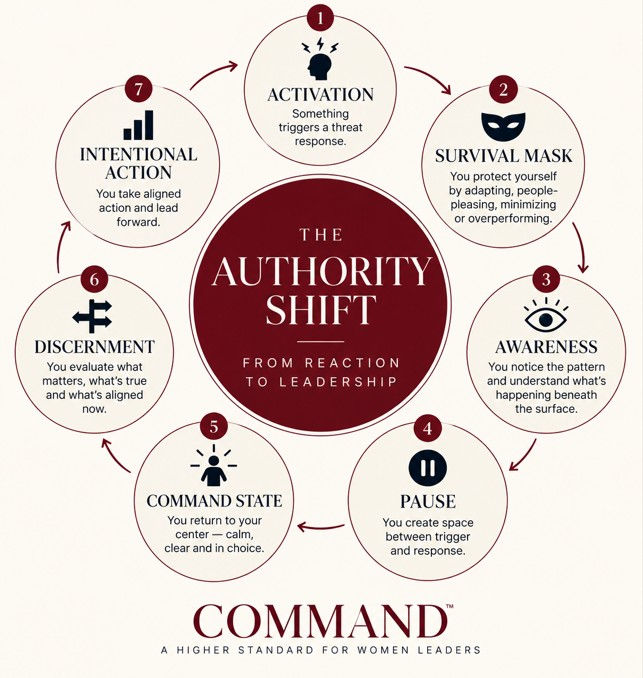
Seeing this pathway can shift how you understand yourself. But knowing a framework intellectually and being able to access it when your reputation, compensation, career, or relationships feel like they are on the line are two very different things. That is where practice matters.
What becomes possible when you stop abandoning your authority?
This is the part of the work that excites me most. Imagine walking into the same room and still feeling the activation, but no longer automatically surrendering the decision.
You notice the urge to overexplain and remain clear. You feel someone’s disappointment without immediately changing your answer. You do not have every piece of data, but you trust your judgment enough to make the recommendation. You hear “no” without interpreting it as evidence that you should never have asked. You make your ambition visible, hold the boundary, take the calculated risk, or move before you feel completely ready.
You do not become fearless. You become more practiced at staying with yourself. That is why I believe the next level of leadership doesn't just require the courage to step into your power. It requires the capacity to stay there.
Do women need to become less emotional to become more powerful?
Women are often taught, directly and indirectly, that becoming more powerful means becoming less emotional. I disagree. Emotion is information. I spent years working alongside senior male leaders, and they used emotion all the time. Some emotions are simply more accepted in leadership than others. Women, meanwhile, are often warned about being “too emotional,” which can lead us to judge our emotions or disconnect from them entirely. But emotion is part of leadership. As you rise, the stakes get higher. The conversations become more consequential. The reactions around you can become more intense. Developing the capacity to feel emotion, understand what it is telling you, and choose how to use it is part of executive maturity.
Anger may tell you a boundary has been crossed. Fear may tell you something matters. Discomfort may appear because you are moving beyond what is familiar. Vulnerability may show up precisely because you are finally allowing someone to see what you actually want.
The goal is not to eliminate those emotions. It is to develop enough capacity for emotion to give you information without automatically driving the leadership decision. You don’t stop feeling. You stop abandoning yourself when you do.
Why isn’t awareness enough?
I learned this personally. Earlier in my career, I was in a conversation about my expanding role and responsibilities. This was my opportunity to say, “My responsibilities have increased, and I want my compensation to reflect that.”
Instead, I asked for two contractors. I redirected the conversation toward what the business needed instead of asking for what I wanted. For years, I interpreted moments like that as something about my character. Why could I advocate for businesses, budgets, teams, and other people but struggle to advocate for myself?
Eventually, I understood the moment differently. I did not need another negotiation script. I knew what to say. What I had not developed was the capacity to hold what might happen after I said it: the exposure, the possibility of hearing no, the discomfort of making my ambition visible, and the uncertainty of what would happen once the ask left my mouth. It was easier in that moment to return to my Good Girl and Fixer Survival Masks than to stay with the discomfort of stepping more fully into my power.
I wasn’t incapable. I was unpracticed. There is enormous possibility in that distinction. Something you have not yet practiced is very different from something you are incapable of becoming.
Why am I sharing this now?
Until now, I have taught Survival Masks and COMMAND States through my paid leadership workshops and programs. I have watched what happens when accomplished women finally have language for something they have experienced for years but could not explain.
For the first time, I am opening this teaching publicly at no cost. I am doing that because I feel called to get this work into the hands of more women. I want more women heard in the rooms where decisions are being made. I want more women trusting themselves, backing themselves, making their ambition visible, asking for what they want, taking calculated risks, holding their boundaries, and moving before they're certain everything will work out.
Not by becoming louder or harder, and not by memorizing another script. By becoming more practiced at staying connected to yourself when something is at stake.
How can you learn more?
On September 24 at 12 PM ET, I am leading a free live masterclass, How to Be Heard in a Room Full of Men.
For the first time publicly, I will take you deeper into the Survival Masks and COMMAND States that I have historically taught through my paid leadership work. We will explore what may actually be happening when you know how to lead but lose access to your authority under pressure, and what becomes possible when those protective patterns no longer have to make the decision.
My intention is not for you to leave with another list of things you should be doing better. I want you to see yourself differently, recognize patterns you may have spent years judging, and begin to understand what becomes possible when you have greater access to your own authority.
If you can join me live, I would love to have you in the room. If you cannot attend live, register anyway. Everyone who registers will receive the replay.
If you recognized yourself anywhere in this article, I want you there. Register for the free live masterclass, How to Be Heard in a Room Full of Men.
Read more from Yann Dang
Yann Dang, Executive Leadership Coach for Women
Yann Dang is known for her work helping accomplished women turn frustration into influence and impact, especially in high-pressure, male-dominated environments. A former global finance leader, TEDx speaker, and Forbes contributor, she brings firsthand experience to her work on power, cultural conditioning, self-trust, and the hidden dynamics that shape how women lead. She created COMMAND™, a six-month leadership accelerator for women, and hosts The Balanced Leader Podcast. Her work challenges women to spend less power proving, pleasing, and managing perception, and more creating the influence and impact they want.