How Generational Trauma Shows Up in Your Parenting and Your Marriage
Updated: Sep 7
Markella Kaplani, Master of Arts (M.A.), is a licensed psychologist specializing in parenthood and relationship dynamics. With over 16 years of experience, she brings a holistic, compassionate approach to mental and emotional wellness, supporting parents in reconnecting with themselves, their partners, and their dreams so the entire family system can thrive.

You promised yourself you would not raise your children the way you were raised. Yet here you are, hearing your mother’s words come out of your mouth, feeling your father’s distance settle into your bones, reacting to your child’s tears with a tightness you cannot explain. Before you berate yourself and record this as a personal failure, remember that this did not start with you. This is generational trauma doing what it does, traveling through families like water through cracks, finding every opening you did not know existed.
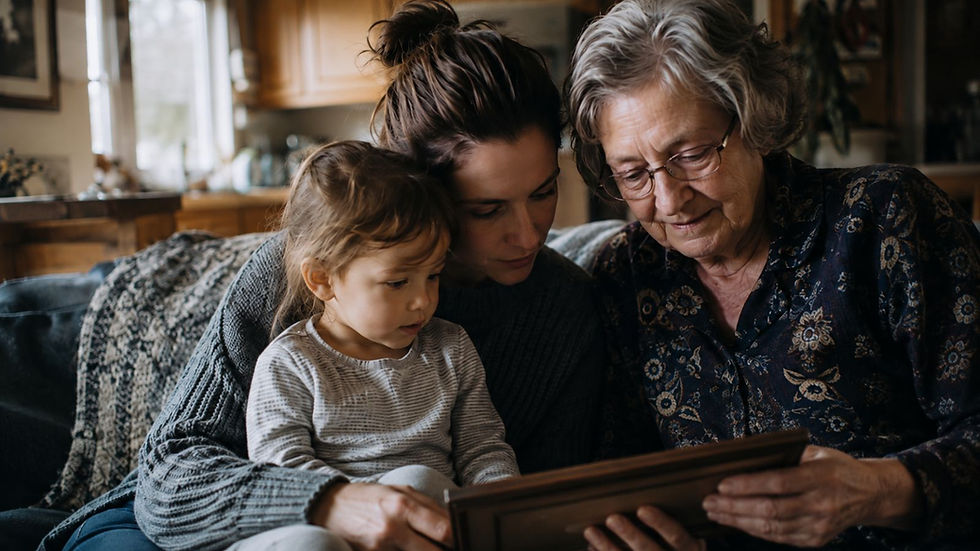
What most parents do not realize is that generational trauma does not just shape how you parent. It shapes how you partner. It is the invisible third presence in every argument about logistics, every shutdown during a hard conversation, and every moment you feel triggered by something your child or your partner does that seems disproportionate to the situation. In this article, you will learn what generational trauma actually is, how it shows up in both your parenting and your relationship, and what you can do to become the person who changes the direction of the cycle.
What is generational trauma?
Generational trauma, also referred to as intergenerational or transgenerational trauma, is the transmission of the effects of unresolved traumatic experiences from one generation to the next. This transmission happens through multiple channels simultaneously. It occurs through parenting behaviors and attachment patterns, through family narratives and silences, through nervous system co-regulation between parent and child, and, as recent research published in 2026 confirms, through epigenetic mechanisms that alter gene expression and influence how offspring respond to stress.
This means that generational trauma is not a metaphor. It is not simply a pattern of bad parenting passed down through imitation, although that is part of it. It is a biological and psychological inheritance that shapes the nervous system, attachment style, and emotional regulation of children before they have words for any of it.
The concept gained significant research attention through studies of Holocaust survivor descendants, which found elevated cortisol stress responses and higher rates of anxiety in the children and grandchildren of survivors who had never directly experienced the trauma themselves. Subsequent research on Adverse Childhood Experiences (ACEs) has documented similar patterns across populations, showing that a parent’s unresolved childhood adversity predicts difficulties in their own children’s emotional and behavioral development.
What makes this especially relevant for new parents is that the transition to parenthood is one of the most powerful activators of generational material, namely matrescence and patrescence. Nothing brings your own childhood to the surface like becoming responsible for a child. The coping strategies your parents used, the attachment patterns they modeled, the things that were said, and the things that were never spoken all resurface with startling force the moment you hold your own baby.
How generational trauma shows up in parenting
Generational trauma rarely announces itself. It does not arrive with a label or a clear origin story. Instead, it shows up in moments that feel confusing, disproportionate, or automatic, with reactions that seem to bypass your rational brain entirely.
It shows up as the rage that erupts when your toddler will not listen, a rage that feels far too big for the situation and leaves you shaking afterward, wondering where it came from. It shows up as an inability to tolerate your child’s crying, not because the sound is merely annoying, but because it activates something in your nervous system that feels like danger. It shows up as emotional shutdown when your child needs comfort because comfort was not something you received, and your body does not know how to produce it on demand.
It shows up as hypervigilance, the need to control every detail of your child’s environment because your own childhood taught you that safety could be taken away without warning. It shows up as permissiveness that looks like patience but is actually an inability to set boundaries because boundaries in your family of origin meant conflict, and conflict meant abandonment. It shows up as perfectionism disguised as good parenting, an obsessive need to get everything right because the cost of getting things wrong in the family you grew up in was unbearable.
Perhaps most painfully, it shows up in the gap between intention and action. You know what kind of parent you want to be. You have read the books. You have the insight. Yet, under stress, exhaustion, and the unrelenting pressure of caring for small human beings, the patterns you swore you would never repeat emerge as if they were coded into your muscles. While we want to do better and hold ourselves accountable, this is not a moral failing. It is a nervous system responding to a perceived threat with the only strategies it was ever taught.
How generational trauma shows up in your marriage
Here is what most people miss: generational trauma does not only travel vertically, from parent to child. It also moves horizontally, into your intimate relationship. The attachment style you developed in childhood becomes the template you bring to your partnership. The way conflict was handled in your family of origin becomes your default mode when you and your partner disagree. The emotional availability or unavailability you experienced as a child shapes what you expect, tolerate, and demand from your partner.
A 2025 study published in the Journal of Research on Adolescence found that aggressive conflict resolution patterns between intimate partners were transmitted intergenerationally. Parents who used aggression in their own relationships produced children who were more likely to use aggressive conflict resolution with their partners, which in turn predicted harsher and more inconsistent parenting. The cycle does not just repeat. It compounds.
In practical terms, this looks like the couple who cannot fight without one partner shutting down completely because, in their family, raised voices meant danger and silence was the only safe response. It looks like the partner who escalates every disagreement into a referendum on whether they are loved because, in their family, love was conditional and could be withdrawn at any moment. It looks like the couple who avoids conflict entirely, maintaining a surface-level peace that slowly erodes intimacy because both partners learned that honesty was punished.
When a baby arrives and amplifies every existing tension, these inherited patterns collide. You can read more about that here. One partner’s attachment wound activates the other’s. The fight about who does more around the house is really a fight about who will be abandoned if they stop performing. The fight about in-laws is really a fight about whose family’s dysfunction will be imported into the new one. The fight about parenting styles is really a fight between two different childhoods, each insisting that its version of survival is the correct one.
The role of family silence
One of the most powerful vehicles for generational trauma is not what was said in your family. It is what was never said. The subjects that were off limits. The emotions that were not allowed. The stories that were edited, minimized, or erased entirely.
Research on the lived experience of intergenerational trauma consistently identifies silence as a central mechanism of transmission. When a family does not speak about what happened, whether that is abuse, loss, addiction, or simply pervasive emotional neglect, the silence does not protect the next generation. It confuses them. Children absorb the emotional residue of unspoken pain without having any framework to understand it. They sense that something is wrong but cannot name it, which makes it impossible to process.
This silence often continues into adulthood and into marriage. A partner who grew up in a family where certain topics were forbidden will struggle to have vulnerable conversations about needs, fears, and pain, not because they are unwilling, but because they never learned how. Their silence in the relationship is not passive aggression or indifference. It is a survival strategy inherited from a family system that taught them that speaking up was not safe.
When two people with different inherited silences try to build a family together, the result is often a relationship full of unspoken assumptions, unasked questions, and mounting resentment. Each partner interprets the other’s silence through the lens of their own family history and misreads it accordingly. You can read more about the grief that comes with parenthood, which we rarely discuss, and how that silence also plays a key role in how we show up as individuals and as parents in this article.
How to break the cycle
Breaking a generational cycle does not mean you will never react from your inherited patterns. It means you develop the awareness to recognize when you are doing it, the capacity to pause, and the willingness to choose a different response. That is not a small thing. It may be the most important work a parent can do.
1. Name what was passed down
The first step is making the invisible visible. What were the unspoken rules in your family? What emotions were allowed, and which were forbidden? How was conflict handled? How was love expressed or withheld? How was vulnerability treated? You are not looking for someone to blame. You are looking for patterns to recognize. When you can name the pattern, you are no longer unconsciously living inside it.
2. Learn your triggers
Your most intense parenting and relationship moments, the ones that feel bigger than the situation warrants, are almost always connected to something older. The next time you feel a reaction that seems disproportionate, pause and ask: When have I felt this before? What does this remind me of? The answer is rarely about the present moment. It is about a wound that was never given language.
3. Understand your parts
Therapeutic frameworks like Internal Family Systems (IFS) are particularly powerful for this work. IFS teaches that we all carry different “parts,” such as the inner critic, the protector, the wounded child, and the perfectionist, and that many of these parts were formed in response to childhood experiences. When you lose your temper with your child, it is often a protective part reacting to a perceived threat that belongs to a different time and place. When you can approach that part with curiosity instead of shame, asking, “What are you protecting me from?” you create space for a different response.
4. Do your own work before or alongside couples work
One of the mistakes I see frequently in my practice is couples who go straight to couples therapy without either partner doing individual work on their own generational material. The result is two people trying to fix their relationship while standing on foundations neither has examined.
Understanding your own inherited patterns is not a prerequisite to being a good partner, but it radically changes what you bring to the table. You stop expecting your partner to heal wounds that predate the relationship. You also stop blaming them for activating pain they did not create. That is why I see couples both together and individually.
5. Create a new family narrative
Every family operates on a set of stories, spoken and unspoken, about who they are, what they value, and how the world works. Generational trauma embeds itself in those stories. Breaking the cycle means consciously choosing which stories to carry forward and which to set down.
This is not about disowning your family or pretending the past did not happen. It is about deciding, with intention, what kind of family you want to build. What will be spoken about in your home? What emotions will be allowed? What kind of conflict will your children witness between their parents? These are not abstract questions. They are the architecture of the next generation’s emotional life.
Why this matters now
We are living in a moment of unprecedented awareness about trauma and unprecedented confusion about what to do with that awareness. The language of trauma has entered mainstream culture, which is a good thing. But it has also been diluted into a vague descriptor for any discomfort, which makes it harder to take seriously when the stakes are genuinely high.
Generational trauma in the context of parenting and marriage is not trendy self-help. It is one of the most well-documented phenomena in developmental psychology and epigenetics. When a parent’s unresolved trauma shapes their child’s nervous system, attachment style, and emotional regulation, the cost is not abstract. It is measured in anxiety diagnoses, relationship difficulties, and parenting struggles that echo across decades.
But here is the part that matters most: research also indicates that the cycle can be interrupted. Nurturing, warm relationships and community support are protective factors that can help buffer the transmission of trauma. A parent who becomes aware of their inherited patterns and actively works to respond differently is not just helping themselves. They are changing the trajectory of their entire family line. That is not hyperbole. It is what the research suggests. It starts with one person – you, deciding that what was passed down does not have to be passed on.
Be the one who changes the story
If this article touched something you recognize in yourself, in your parenting, in your relationship, or in the family patterns you have spent your life trying to outrun, know that recognition is already the beginning of change. As a psychologist and parenthood and relationship expert, I work with individuals, parents, and couples who are ready to understand what was inherited, process what was never spoken, and build something different for their children.
This is deep work, and it is brave work, and you do not have to do it alone. Visit here or reach out to book a free discovery call. The cycle ends with the person who chooses to look.
Read more from Markella Kaplani
Markella Kaplani, Parenthood and Relationship Coach & Psychologist
Markella Kaplani, M.A., is a multi-passionate, restless soul passionate about discovering the depths of the psyche and what makes us whole. In her quest to support people along their journey to better mental and emotional health, Markella is a dedicated lifelong learner. She holds an M.A. in Clinical-Counseling Psychology and specializes in child psychology, special education, couples therapy, and motherhood psychology, giving her a holistic perspective on the family system, both internally and externally. With her non-judgmental, culturally sensitive, and compassionate approach, she combines facts with each person's unique experience to create interventions that speak to their individuality.