Google, ChatGPT, and the New Rules of Business Visibility Online
Steve O’Brien is CEO and Director of SEO at Woya Digital and founder of Fleet Street News. With 20 years of experience in Search Engine Optimisation (SEO) and digital marketing, he helps businesses build authority, trust and visibility across Google, AI search platforms and the wider digital ecosystem.

Google is no longer the only place where people discover, research, and choose businesses online. ChatGPT, Gemini, Claude, and Artificial Intelligence (AI)-powered Google Search are changing that journey, sometimes before a potential customer ever reaches a website. Drawing on 20 years in Search Engine Optimisation (SEO), Steve O’Brien explains why businesses do not need a separate strategy for every new platform, but one strong visibility strategy built to work across all of them.
Search has changed, but the foundations still matter
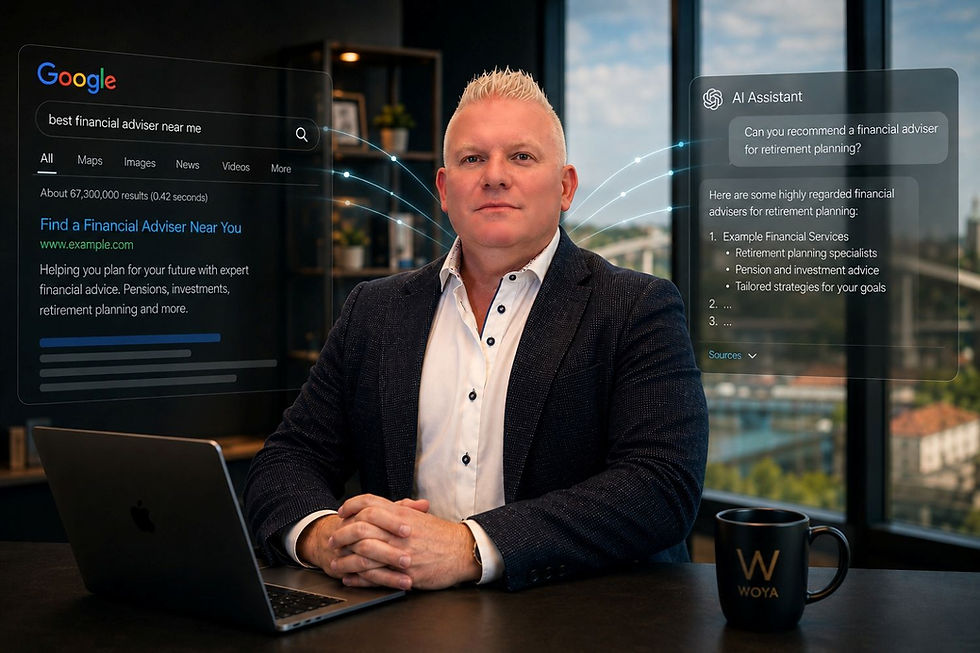
There is a lot of nervousness around AI search right now, and I understand why. Businesses have spent years investing in Google visibility, and suddenly their customers have entirely new ways to find information. Someone looking for a financial adviser might search Google, ask ChatGPT for three recommendations, use Gemini to compare them, or encounter an AI-generated answer directly within Google's search results.
The change is real, and it is happening quickly. But I think some businesses are responding to it in the wrong way.
Every week brings another AI optimisation tactic, tracking platform, or theory about how to appear in ChatGPT. The temptation is to react to all of it. In some cases, businesses are making significant changes without really knowing whether they will improve their visibility, damage existing performance, or make no meaningful difference at all.
My view is much simpler: do not start by building a separate AI strategy. Start by making sure your existing foundations are solid enough for the search environment we now operate in.
That does not mean SEO has somehow escaped change. Some technical elements that received relatively little attention a year or two ago deserve another look. Crawler accessibility, website architecture, structured data, entity clarity, and the way businesses connect their people, services, expertise, and locations online all warrant greater scrutiny.
Google itself continues to say that established SEO fundamentals apply to its AI search experiences. Pages still need to be accessible, indexed, and understood before they can become part of those experiences. AI has not removed the foundations. It has given us more reasons to make sure they are right.
The mistake is treating AI search as something separate
This is where our thinking at Woya has evolved. We use the term SEO 2.0 to describe our approach to search in 2026. It is not a replacement for SEO. It is an acknowledgement that what businesses expect SEO to achieve has expanded.
Our blueprint for delivering that is what we call the Woya Way. SEO provides the foundation. It makes a business technically accessible, relevant, and competitive for searches with genuine commercial value.
AEO, or Answer Engine Optimisation, builds on that by making expertise easier for search and AI systems to understand and surface as useful answers.
GEO, or Generative Engine Optimisation, takes the picture beyond the website itself. It considers the authority, credibility, and third-party signals that exist around a business across the wider internet.
The mistake is viewing these as three different marketing disciplines competing for budget. They should work together.
A technically excellent website with very little authority beyond its own domain has a weakness. Excellent media coverage pointing towards a poor website has a weakness too. Producing hundreds of carefully structured answers is unlikely to solve either problem if there is little genuine expertise behind them.
That is why I believe businesses need one visibility strategy rather than separate Google and AI strategies.
The platforms may be different, but many of the underlying signals that help a business become understandable and credible are connected.
Your website cannot be the only source saying you are good
This is perhaps the part of AI search I find most interesting. Businesses have always been able to control what appears on their own websites. You can say you are experienced, trusted, innovative, or one of the best businesses in your sector.
But you would say that. The wider internet provides something your own website cannot: independent corroboration.
Reviews, authoritative links, professional profiles, expert contributions, industry citations, and genuine editorial coverage all contribute to the wider picture of a business and the people behind it.
This is one reason Digital PR has become increasingly important within our SEO programmes. It is not simply about acquiring a backlink. Good Digital Public Relations (Digital PR) creates credible third-party evidence about who a business is, what it does, and where its expertise lies.
We have seen an interesting example of this with a financial services client. The business had solid SEO foundations and was starting to perform well organically. We then layered Digital PR into the programme, securing credible third-party coverage and building a much stronger independent footprint around the company and its expertise.
As that authority developed, it became one of the first clients in our portfolio that we observed being mentioned by ChatGPT for relevant searches.
Can I prove that a particular article or media mention caused ChatGPT to recommend that business? No, and I would be wary of anyone who claimed they could.
What we could observe was something more useful: improving organic performance, growing third-party authority, and emerging AI visibility developing alongside one another.
For me, that is a far more credible direction for AI search than chasing the latest supposed shortcut.
The platform matters less than the intent
There is another risk in the current fascination with AI. We can become so focused on where somebody searches that we forget why they are searching in the first place.
Someone asking ChatGPT to recommend a financial adviser has a need. Someone comparing care providers through Gemini has a need. Someone searching Google for a specialist medical service has a need.
The interface may change, and the language may become much more conversational, but there is still intent behind the search.
That matters commercially. Informational visibility is valuable. It can introduce a business, demonstrate expertise, and build trust earlier in the decision-making process. But most businesses are ultimately investing in SEO because they want more of the right people to take action.
That action could be a telephone call, enquiry, appointment, application, purchase, or visit. This is where I think some of the discussion around AI visibility is becoming distracted by another generation of vanity metrics.
A mention in ChatGPT is interesting. A citation within an AI Overview is interesting. A number-one Google ranking is interesting. But none of them, by themselves, is a business result.
AI visibility is measurable, but not perfectly
There is now an expanding market of tools promising to measure visibility across ChatGPT and other generative platforms. We use and test this technology at Woya because understanding how AI search is evolving is an important part of our work.
But businesses need to understand the limitations. Traditional keyword tracking is relatively controlled. You can define a keyword, device, and location and monitor what happens over time. AI conversations are fundamentally different.
One customer might ask ChatGPT a question and then refine it through several follow-up prompts. Another person might phrase the same requirement completely differently. Someone else could use Claude or Gemini, add different context, and receive another response.
The number of possible combinations becomes enormous. We can sample that environment. We can test important prompts, monitor citations, look for changes in brand visibility, and measure referral traffic. What we cannot realistically do is measure every possible AI conversation in which a business might appear.
Trying to do so would be enormously expensive and, ultimately, impossible. So while AI visibility is an important metric, I would not make it the ultimate measure of success. I would measure what happens at the end of the journey.
That means identifying the actions that matter commercially and making sure they are tracked properly. At Woya, that includes establishing meaningful conversion events and using tools such as Google Tag Manager to understand where enquiries, calls, appointments, purchases, and other valuable actions originated.
There are already encouraging indications that AI-driven visitors can demonstrate strong commercial intent. Adobe reported that traffic from generative AI sources to United States retail websites increased 393% year on year in the first quarter of 2026, with those visitors converting 42% better than non-AI traffic in March.
Those figures come from retail and should not simply be applied to every industry. But they illustrate why I am more interested in what an AI-referred visitor does than simply whether an AI platform mentioned a brand.
The endpoint of SEO investment is not visibility for visibility’s sake. It is the right visibility reaching someone with the right intent and contributing to a meaningful business outcome.
Consistency will matter more than panic
We are still relatively early in this change. ChatGPT will evolve. Gemini and Claude will evolve. Google AI Overviews and AI Mode will evolve. New platforms will emerge, and some of the tactics being enthusiastically promoted today will probably prove far less important than people currently believe.
At Woya, we are actively testing, learning, and developing our approach alongside that technology. SEO 2.0 represents our understanding of modern search in 2026, but it cannot simply be frozen in time while everything around it changes.
What experience has taught me, however, is not to confuse constant movement with progress. Businesses do not need to rebuild their marketing strategy every time the interface changes. They need strong enough foundations and a consistent enough strategy to evolve with the way their customers search.
For us, that means SEO at the foundation, useful answers built around genuine customer needs, independent authority across the wider web, and measurement connected to commercial outcomes.
Google may start the journey. ChatGPT might start it instead. Tomorrow, another platform may become part of it.
The objective remains remarkably consistent. Be findable. Be understandable. Be credible beyond your own website. Make sure that when the right person finds you, you can measure what happens next.
That is what we mean by SEO 2.0, and it is the thinking behind the Woya Way in 2026.
Read more from Steve O'Brien
Steve O’Brien, CEO & Director of SEO at Woya Digital
Steve O’Brien is CEO and Director of SEO at Woya Digital and founder of Fleet Street News. With 20 years of experience in Search Engine Optimisation (SEO) and digital marketing, he has worked through major shifts in search, from early algorithm updates and local SEO to Digital PR and AI-driven discovery. Steve helps businesses build online authority, improve visibility and strengthen trust across Google, AI platforms, media coverage and the wider digital ecosystem. His writing explores SEO, AI optimisation, Digital PR, reputation signals and how businesses can adapt as the way people search, compare and choose brands continues to change. His mission is to help businesses become more visible, more trusted and better positioned for growth in the AI era.