From Knowing How to Succeed to Knowing How to Belong
Written by Lindy Lelij, Founder of Mpowerme Coaching
Lindy Lelij is the founder of Mpowerme Coaching. With more than 30 years of leadership and international experience, she helps people navigate migration, cultural transitions, and identity to thrive personally and professionally.

Have you ever stood beneath an old tree and wondered what makes it so magnificent? Our eyes are usually drawn upward. We look at the broad canopy stretching towards the sky, the strong trunk weathered by time, and the branches that seem to move effortlessly with every changing season. We are in awe of what we see.

Yet the tree tells a different story.
Long before its branches reached towards the light, its roots were quietly reaching into the earth. Hidden from view, they searched for nourishment, stability, and connection. The roots receive no applause and are rarely photographed. Yet they are a fundamental reason the tree can weather a storm.
I sometimes wonder whether our lives are much the same. When we think about success, we tend to think about what is visible. We celebrate promotions, qualifications, thriving businesses, financial security, personal achievements, and dreams realised after years of hard work. These accomplishments reflect discipline, resilience, and commitment, and rightly so. They deserve recognition.
But what if they are only the branches? What if the real story is unfolding beneath the surface?
The success we can see
Take a moment to consider your own life. How would you define success? Is it the career you have built, the family you have raised, the challenges you have overcome, or the goals you have achieved?
Most of us have spent our lives learning how to succeed. We are encouraged to work hard, persevere, solve problems, and keep moving forward. Success is often described as arriving somewhere, a destination reached through determination and effort.
There is nothing wrong with this. In fact, our achievements often become opportunities to contribute, provide for others, and grow.
But I wonder whether success tells only part of our story.
When success does not feel like home
When I immigrated to New Zealand, I believed that my previous experience would naturally help me build a successful new life. After years of leadership, professional responsibility, and international experience, I assumed that hard work and determination would once again open doors for me.
In many ways, they did. But while I was rebuilding my career, learning new systems, and adapting to a different culture, another journey was quietly taking place.
I was beginning to understand that succeeding in a country and belonging in a country are two very different experiences. I had questions that no qualification or professional achievement could answer.
Who am I when the familiar markers of my identity have changed?
Can I embrace a different culture without losing myself?
Can I remain authentic while learning unfamiliar ways of thinking, communicating, and connecting?
These questions had very little to do with my résumé. They had everything to do with my roots.
Becoming an expert beginner
This experience is not unique to immigration. Think about the transitions in your own life:
A new leadership role
Becoming a parent
Starting over after redundancy, divorce, or perhaps retirement
A move to another city or another country
Every major transition has an external journey that others can observe and an internal journey that only we experience.
The external journey is about achievement. The internal journey is about identity. I would describe this experience as becoming an “expert beginner.”
Have you ever been there? You know your profession, your strengths, and your values. Then, suddenly, you find yourself in unfamiliar territory where expertise alone is not enough. Your professional knowledge comes with you, but the unspoken rules do not. Relationships must be rebuilt, trust must be earned, and confidence must be grounded in new “soil.”
Like a mature tree, you discover that survival depends not on the size of your branches, but on your willingness to grow new roots.
It is a humbling and often uncomfortable experience. Yet it may be one of life’s greatest invitations to grow.

Belonging begins where inner rootedness meets outer welcome
When we enter unfamiliar environments, our first instinct is usually to adapt. We observe, adjust, work harder, and learn how things are done. Adaptation is necessary. It helps us function and find our footing.
But adaptation alone can become exhausting if it is driven by a constant need to prove ourselves.
Belonging is something different. It does not ask us to pretend to fit in.
Growing roots through contribution
One of the greatest privileges I have experienced through coaching and working with volunteers at the hospital has been watching people discover belonging through contribution.
There comes a moment when the question changes. Instead of asking, “Will I ever fit in?” they begin asking, “How can I contribute here?” That subtle shift can be transformational.
Contribution has an undeniable way of growing roots. Whether through volunteering, mentoring, supporting a colleague, joining a local community, or simply extending kindness to a neighbour, we begin participating in the life around us rather than waiting for permission to belong.
When the compass begins to turn
As I have reflected on my own journey, I realise that success and belonging are not competing ideas. To me, they are partners.
For a long time, I believed that people found belonging once they felt more confident. But through my own experiences and the privilege of walking alongside others during times of change, I have come to believe something different.
Belonging does not begin when uncertainty disappears. It begins when uncertainty is no longer allowed to decide who we become. The circumstances may not change. The questions may remain. The future may still feel unclear. But something within us realigns.
Perhaps you have experienced it yourself. You pause before walking into a new workplace on your first day, or you sit in your car for a moment before entering a meeting where you know no one. Maybe you have just arrived in a new country, or you are returning to work after years away. Your heart beats a little faster. You wonder whether you will be accepted, whether you will fit in, and whether you are enough.
Then something shifts. Instead of asking, “What if I do not belong?” you begin asking, “How do I want to show up?”
When something within us realigns, we begin making different choices.
Purpose becomes more important than certainty. Instead of worrying about whether you will be accepted on your first day in a new role, you remind yourself that you are there to make a meaningful contribution and to learn. Purpose answers, “Why am I here?”
Values become stronger than fear. As you sit in your car before walking into a meeting where you know no one, you decide that kindness, integrity, and respect will guide your behaviour, regardless of how others respond. Values answer, “Who do I want to be?”
Curiosity becomes greater than the need to have every answer. Having just arrived in a new country, workplace, or community, you replace the pressure to know everything with a willingness to ask questions and listen carefully so that you can understand the culture around you. Curiosity answers, “What can I learn?”
Contribution becomes an expression of character rather than a reward for feeling confident. Rather than waiting until you feel that you belong, you look for one small way to make someone else’s day a little easier by offering help, sharing your experience, encouraging a colleague, or simply bringing warmth into the room. Contribution answers, “How can I serve?”
Uncertainty may still travel with us, but it no longer gets to choose the direction. This is where we begin to reclaim our agency, not by controlling our circumstances, but by choosing how we will meet them.
Our decisions no longer arise from uncertainty alone. They arise from our inner compass. So before you move on with your day, I invite you to pause for a moment. Ask yourself:
What is more important to me than certainty?
Which values do I want to carry into this situation?
Where is life inviting me to become an expert beginner once again?
What might change if I stopped waiting to feel ready and started growing where I am planted?
If these questions have stirred something within you, perhaps your own Cultural Compass is already pointing towards the next chapter of your journey.
I would love to continue the conversation with you. At MPowerMe Coaching, I help people explore their own Cultural Compass, not by giving them a map for life, but by helping them navigate change with clarity, dignity, and a growing sense of belonging.
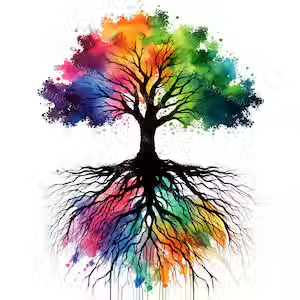
“The strongest trees are not recognised by the height of their branches, but by the depth of their roots.”
Read more from Lindy Lelij
Lindy Lelij, Founder of Mpowerme Coaching
With Māori and European heritage, Lindy knows firsthand what it means to live between cultures. She spent over four decades abroad before returning “home” to Aotearoa New Zealand. Today, as founder of Mpowerme Coaching, Lindy helps people navigate migration, cultural transition, and identity. Through positive psychology, deep journaling, energetic tuning, and narrative reframing, Lindy offers clients practical tools for growth and resilience. Backed by more than 30 years of leadership, governance, and business experience across Health, governance, and international trade, she brings both professional expertise and lived wisdom to her work.