Can a Solar Generator Power a Well Pump?
Yes, a solar generator can power a compatible well pump. The deciding factors are the pump’s voltage, motor-starting demand, controller requirements, and total operating time. A large battery does not compensate for the wrong voltage or an inverter that cannot start the motor.
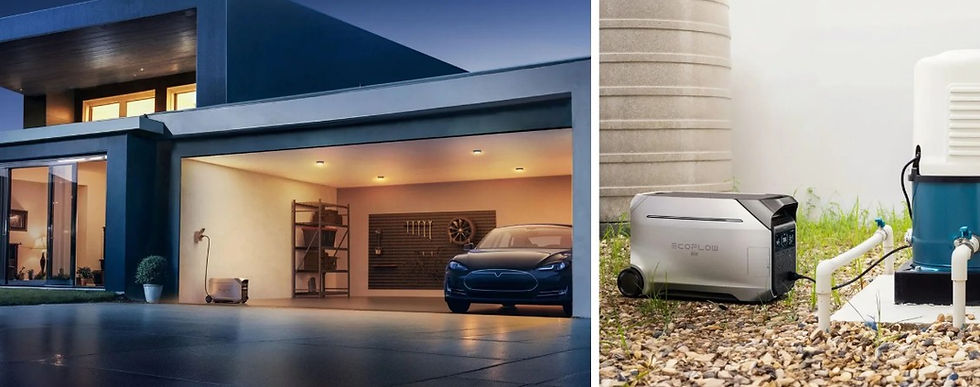
For a home supplied by a private well, this distinction matters immediately: restoring lights and phone charging does not restore running water. Before choosing equipment, identify the pump and its electrical requirements rather than starting with a generic household wattage estimate.
Identify your existing pump’s electrical requirements
Residential well systems vary. Some pumps operate on 120V, while others require a 240V supply. Pump and motor labels may use nominal ratings such as 115V or 230V; compatibility should be checked against the equipment’s specified supply requirements.
Start with the pump’s installation record, motor information, and controller specifications. The motor itself may be down the well, so its details are not always physically accessible.
Information to find | Why it matters |
Pump and motor model numbers | Allows the manufacturer or installer to identify actual requirements |
Voltage, frequency, and phase | Establishes whether the backup source provides the correct supply |
Running current or electrical input | Helps determine the continuous output requirement |
Starting-current requirements | Establishes the inverter’s required starting capability |
Control box or variable-speed controller model | Identifies additional compatibility conditions |
For submersible systems, the two-wire or three-wire motor arrangement can also affect starting requirements and controls. Do not infer compatibility from horsepower alone.
A 1HP motor is not automatically a 746W electrical load. Horsepower describes mechanical output; electrical input also reflects motor losses and operating conditions.
Similarly, a breaker’s amp rating does not tell you how much energy the pump consumes. It is part of the circuit’s protection, not a measurement of normal demand.
Check voltage before comparing wattage
A power station rated for several thousand watts may still provide only 120V AC.
That unit cannot supply a 240V well pump through a simple plug adapter. Adding battery capacity does not change its output voltage.
For a pump requiring 240V, investigate a source that explicitly supports the required supply, such as an appropriate 120/240V split-phase system. Some products achieve this through a manufacturer-approved paired arrangement. Two unrelated power stations cannot simply be combined to create it.
The connection must also suit the existing pump controls. A hardwired pump is not equivalent to a plug-in appliance that can be moved between outlets.
This is why the power station’s exact model matters more than the category description “large solar generator.”
Motor startup can be the main constraint
A pump may use manageable power once running but require substantially more current while starting.
There is no dependable universal multiplier for every well pump. Motor design, controls, supply conditions, and the starting method affect demand.
Ask the pump manufacturer or installer for suitable backup-source requirements. Then check the inverter’s continuous rating, starting capability, supported duration, and motor compatibility.
A headline surge figure is incomplete if it does not explain how long that output is available. Motor starting also involves apparent power, commonly expressed in volt-amperes, which is not interchangeable with running watts.
Manufacturer charts intended for engine-driven generators can provide useful context, but their generator-size recommendations should not automatically be treated as exact battery-inverter requirements. The two sources respond differently to starting loads.
If startup is the obstacle, do not assume that an inexpensive soft starter or variable-frequency drive will solve it. Such equipment must be compatible with the particular motor and controller.
Size battery capacity around pumping time
Once compatibility is established, estimate energy use from the time the pump actually operates.
Suppose measurements show a pump drawing 1,200W while running, with a total operating time of 30 minutes during a day:
1,200W × 0.5 hours = 600Wh
That is the pump’s illustrative operating energy for the day. It is not a claim that a particular horsepower or pump type always uses 1,200W.
The battery must also cover conversion losses, a reserve, and any other connected loads. If the inverter remains enabled all day while the pump runs intermittently, its own standby consumption can become relevant.
This explains how a pump can require strong starting capability without needing a huge amount of daily stored energy. A source may be unsuitable because it cannot start the motor, even though its battery could theoretically cover the pumping time.
Conversely, a source that starts the pump successfully may still run out of energy if demand is greater than expected.
Consider how the water system operates
A pressure tank allows the pump to operate intermittently as water is used. Its stated tank volume is not the same as the amount of usable water available between pump starts; that depends on the tank and pressure settings.
If your goal is occasional pumping to replenish water containers, estimate the actual pumping time needed for that task. If you want normal household water service throughout an outage, account for the pump’s repeated starts and the electricity needed by any essential booster, treatment, or control equipment.
A compatible solar generator can then be assessed against that defined job rather than an assumption that the pump runs continuously.
Solar charging must replace the energy consumed if the arrangement is intended for repeated use. Check production for the season when outages concern you, particularly if the available panel location is shaded. A suitable battery and inverter do not guarantee adequate daily solar recovery.
Arrange the connection and verify operation
For a hardwired well pump, have a qualified electrician establish a compatible transfer arrangement. The pump, controls, backup source, and household wiring need to work as one system.
After installation, verify more than a single successful start. Observe normal pumping, pressure-control operation, and repeated starts under the intended backup load. Confirm how the system behaves after an overload or depleted battery, including whether restoration requires manual intervention.
For an existing well, the best first step is to obtain the pump and controller details. Confirm that a proposed source can start and supply that exact equipment before spending money on additional battery capacity.