

A Complete Business Guide on Custom Software Development Services
Written by Adnan Ghaffar, AI-Driven Automation Expert
Adnan Ghaffar is an AI-driven automation expert and the CEO of CodeAutomation.ai. With over a decade of experience, he specializes in business process automation and custom tech solutions across industries like fintech, healthcare, and e-commerce.

All companies have different ways of doing things. Some deal with complicated internal procedures, others manage impressive amounts of customer information, and many can only sustain operations using digital tools. Off-the-shelf software, though able to meet simple needs, does not always fit the specific requirements of a growing company. This is why numerous organizations invest in custom software development services.
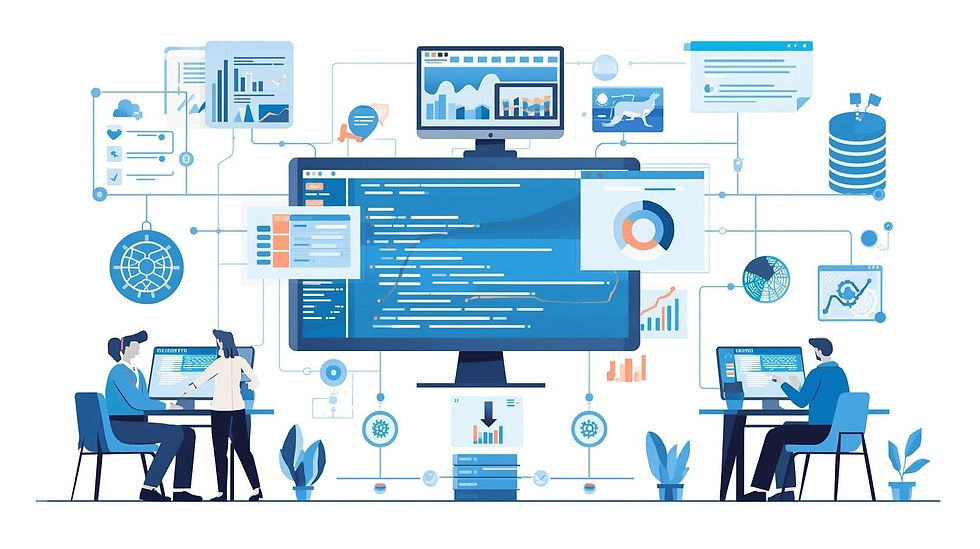
Custom software is developed to meet a business's needs rather than the broad market. It is designed to address specific issues and maintain special processes. Rather than forcing a company to adjust to the constraints of generic software, custom solutions conform to the business. Custom development can make a significant difference for companies that desire flexibility, efficiency, and control.
What are custom software development services?
Custom software development services involve designing, creating, and supporting applications that are unique to an organization’s needs. Companies collaborate with development teams to create software that supports their operations, internal processes, and long-term objectives.
The development process typically starts with understanding the challenges and needs of the company. Developers then design the system architecture, create the application, test it, and implement it within the organization. Many projects also involve ongoing updates and support to ensure the software continues to serve the business as it grows.
Custom software is used in companies for various purposes. Some develop internal applications to manage operations, while others create customer or partner platforms. In both cases, the goal is the same: to create software that suits the organization optimally.
The importance of bespoke software
Bespoke software is often used in connection with custom development. In simple terms, bespoke software is developed specifically for a business or organization. Unlike commercial software, which is aimed at satisfying thousands of users, bespoke systems are tailored to meet the requirements of one client.
This approach offers significant benefits. Employees don’t need to adapt their processes to fit a generic tool. Instead, the software supports existing workflows, enhancing efficiency and saving time otherwise spent on unnecessary or overly complex features.
For example, a logistics company may require a system to track shipments, manage warehouse operations, and issue delivery reports. These features can be integrated into a custom-built platform, which can seamlessly integrate with the company’s processes.
Tailored software solutions for growing businesses

As businesses grow, their operations become more complex. Ready-to-use software may work initially, but its limitations become apparent as the business scales. Features may be lacking, integrations may be inappropriate, or workflows may not align with the software’s design.
Custom software applications are ideal in such situations. Specific solutions can be designed to address the unique challenges of a business. Developers can create features that solve real problems rather than relying on generic functions.
Scalability is another major benefit. Custom software can grow with the company. New capabilities, integrations, and modules can be added over time without replacing the entire system. This allows businesses to adapt to new markets and emerging opportunities.
Security is also a key reason organizations opt for customized systems. Custom software can be designed with specific security features tailored to a company’s data and compliance needs. This level of control is often critical in industries such as finance, healthcare, and legal services.
Enterprise software and large-scale operations

Large organizations have more complex systems that are necessary to support their operations. This is where enterprise software plays a crucial role. Enterprise applications manage vast amounts of information, multiple departments, and link various business operations.
For instance, customer management tools, financial systems, inventory tracking, and analytics dashboards can all be integrated into a single enterprise platform. This integration enables teams within the organization to access the same information and coordinate their activities more efficiently.
Custom enterprise software also supports automation. Companies can automate repetitive tasks, enhance reporting, and gain deeper insights into their business. When properly formulated, enterprise systems provide a digital backbone for the company.
Since these platforms handle critical processes, reliability, performance, and scalability must be prioritized by developers. Enterprise software must be capable of supporting high workloads while maintaining security and stability.
The custom software development process
Custom software development must follow a planned process. Research and planning typically form the foundation of the project. Developers closely collaborate with business stakeholders to understand the company’s objectives, challenges, and technical needs.
Once this information is gathered, the development team designs the system architecture and user interface. The designs are user-centered to ensure the software is effectively used by employees.
The next phase is development. Engineers write the code and build the system’s features, databases, and integrations with external services. Agile development methods are often used in this phase, allowing teams to continuously test and refine the product.
Testing is a critical aspect of the process. During deployment, developers ensure the software is tested for performance, reliability, and security. Once the application is ready, it is implemented within the organization.
Development teams continue to update, maintain, and improve the system after it is deployed, ensuring it remains effective.
Final thoughts
In today’s business world, digital tools are essential. Off-the-shelf software may no longer be flexible enough to meet the needs of growing companies as their processes become more complex. This is where custom software development services come in.
By investing in tailor-made software, organizations can create systems that perfectly fit their operations. Custom development can be used to build internal applications, customer-facing solutions, or large-scale enterprise software, helping businesses drive efficiency and growth.
Custom software development offers an effective and viable solution for any company looking to enhance productivity, streamline workflows, and maintain full control over the technology they use.
Read more from Adnan Ghaffar
Adnan Ghaffar, AI-Driven Automation Expert
Adnan Ghaffar is a seasoned AI-driven automation expert and the CEO of CodeAutomation.ai, a company that specializes in custom tech solutions, AI automation, and business process automation. With over 10 years of experience, Adnan has worked with top-tier clients in fintech, healthcare, and e-commerce to streamline operations through advanced automation. Passionate about leveraging cutting-edge technologies like AI and machine learning, Adnan continuously seeks to innovate and optimize processes. When he’s not developing automation solutions, he’s exploring the latest in AI research and development, always pushing the boundaries of what’s possible.






