

Why We Fell in Love with Other People’s Clothes
Written by Alexandra Bronckaers, Independent Journalist
Alexandra Bronckaers, an independent journalist who blends fashion, technology, and culture into sharp, contemporary storytelling. Moving seamlessly from entertainment television to print publishing, she now writes globally on beauty-tech and the trends shaping creative industries.

There was a time when buying second-hand clothes was mostly a matter of necessity. You stepped into a thrift store to spend less, rummaged through endless racks and, with a little luck, walked out with a perfectly wearable jacket for a fraction of its original price. Those days are over.
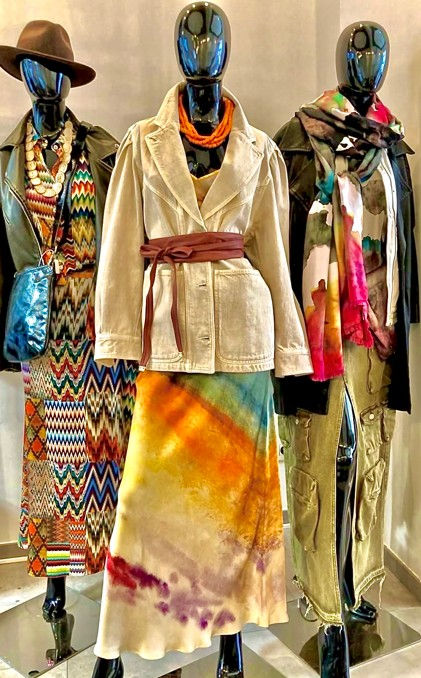
Today, walk into a second-hand boutique in Copenhagen, Paris, Brussels, Amsterdam or Berlin, and you might stumble upon a Balenciaga jacket from a long-gone collection, a perfectly worn-in pair of vintage Levi’s, an Isabel Marant dress worn twice, a 1990s bag or a coat with its original tags still attached.
Second-hand has become desirable. More importantly, its status has changed. We no longer buy pre-owned simply because it is cheaper. We buy second-hand because it feels more individual, smarter, more responsible. Sometimes, quite simply, because it is cooler. The numbers confirm that what was once considered a trend has become a serious market.
According to ThredUp’s 2026 Resale Report, conducted with GlobalData, the global second-hand apparel market could reach $393 billion by 2030 and grow at roughly twice the rate of the overall apparel market. In the United States, the second-hand market grew nearly four times faster than traditional clothing retail in 2025. More than 70% of the growth expected through 2030 is projected to be driven by Millennials and Gen Z.
Second-hand is no longer a small alternative market orbiting the fashion industry. It is starting to take a piece of it.
The luxury of paying less
The first reason is obvious: price. Buying pre-owned gives us access to brands, fabrics, and levels of quality we might not be able, or simply no longer be willing, to pay full price for. “Second-hand” no longer necessarily means “old clothes.”
Our wardrobes are full of shopping mistakes: something bought one size too small, a dress purchased for an evening and never worn, a jacket we adored in the fitting room only to forget about it for six months in the back of a closet.
Some pieces therefore enter the resale market virtually new. Sometimes, the tags are still attached. So why pay full retail when the same piece, or almost the same, is sitting a few streets away for considerably less?
The dopamine of the find
But price doesn’t explain everything. Traditional retail struggles to replicate something: serendipity. Walking into a second-hand store means never knowing exactly what you'll find.
An extraordinary size 38, naturally, when you are a 36. A bag you haven’t seen in ten years. A dress from a collection you thought had disappeared forever. Every now and then, the gem. The one you have been searching for for months. The one that is no longer made. The one nobody else is likely to be wearing at the next party. It is treasure hunting, fashion edition.
In a world where the same collections circulate from Stockholm to Madrid and Paris to New York, second-hand offers a luxury that has become surprisingly rare: not looking exactly like everyone else. Vintage's spectacular comeback is only amplifying the phenomenon. The 1990s and 2000s have reclaimed wardrobes and social media feeds alike. So why buy a copy of a 1998 jacket today when you might just find the original?
A store, but above all, an eye
This is also what makes physical stores relevant again. Online platforms democratized second-hand fashion. But the best boutiques have something else to sell: a point of view. Curation. The owner becomes retailer, buyer, stylist, and sometimes an unofficial personal shopper.
In a small town or neighbourhood, she knows her customers. She knows one is looking for beautiful Italian labels, another loves bohemian pieces, while a third will never resist a great early 2000s bag. So she doesn’t accept everything people bring in. She selects what fits her universe, and her customers’.
Ultimately, a great second-hand boutique looks less and less like a thrift store. It looks like the person who created it.
The new concept store
Some are taking the idea much further. Vintage clothing, contemporary second-hand pieces, jewelry, books, ceramics, curated furniture, and worlds begin to overlap. In one corner, a few armchairs and a tiny bar: matcha, cappuccino, a slice of cake.
You came in to look at a jacket. You stay another twenty minutes. Shopping meets lifestyle. The boutique becomes an atmosphere, almost an informal little club. A place where people share not only a certain way of dressing, but also a way of consuming, and sometimes, a way of looking at the world.
In smaller towns, that sense of community can become even stronger. One customer drops off a skirt she no longer wears. A few days later, another woman from the neighbourhood buys it. The boutique no longer simply circulates clothes. It circulates them within a community.
Green is the new black
Of course, you can't talk about second-hand fashion without talking about sustainability. Extending the life of what already exists rather than systematically producing something new makes sense. Behind something as simple as a pair of jeans lies a far greater environmental footprint than most of us imagine.
According to the European Environment Agency, average textile consumption in the European Union rose from 17 kilograms per person in 2019 to 19 kilograms in 2022, the equivalent of a large suitcase filled with new textiles every year.
Producing the clothes, shoes and household textiles purchased by Europeans that year required around 234 million tonnes of raw materials and 5.3 billion cubic metres of so-called “blue water”, surface water and groundwater. Around 85% of that water consumption takes place outside Europe, particularly in regions where fibres are produced and textiles manufactured. Growing, manufacturing, dyeing, washing, treating, transporting: a new garment has an environmental story long before it ever reaches the rack. Wearing existing clothes longer, reusing them, repairing them, and putting them back into circulation are therefore among the measures the European Environment Agency has identified to reduce the sector’s footprint.
But second-hand isn’t an environmental free pass either. Buying ten pre-owned pieces you don’t need isn’t necessarily more virtuous than buying one beautiful new piece and wearing it for fifteen years. Perhaps the real revolution isn’t simply about moving from new to pre-owned. It’s about moving from consuming more to consuming better.
A generation that wants something else
Young consumers have understood this perfectly. Price matters. So does the environment. But rarity, the story behind a piece, and the ability to express an individual sense of style have become just as important. Social media is accelerating the movement even further. According to the 2026 Resale Report, nearly half of the second-hand consumers surveyed now discover their next pieces through social media, content creators, and influencers rather than through traditional search.
The paradox is delicious. The internet has homogenized fashion on a scale we have never seen before. Partly thanks to the internet, an entire generation is now searching for what everybody else doesn’t have.
Fashion comes full circle
Second-hand once picked up the clothes fashion no longer wanted. Today, fashion is watching second-hand. Platforms are becoming more professional. Boutiques are turning into concept stores. Major brands are developing their own resale programmes. Clothes once considered outdated are becoming desirable precisely because they have disappeared.
But one thing remains that no algorithm can perfectly reproduce. Walking into a little boutique without looking for anything in particular. Sliding a few hangers along the rail. Stopping. Going back two hangers, and seeing it.
The right label. The right cut. The right size. From a collection that disappeared eight years ago. No one promised it would be there, and that is precisely why you want it.
Visit my website for more info!
Read more from Alexandra Bronckaers
Alexandra Bronckaers, Independent Journalist
Alexandra Bronckaers is a widely recognized independent journalist, former editor-in-chief and publisher, with 30+ years of expertise across fashion, beauty-tech, art, culture, and lifestyle. Her work blends sharp analysis with modern storytelling, exploring innovation, creative shifts, and industry transformation. Working internationally, she highlights the leaders, creators, disruptors, and cultural forces reshaping our era.


