Why SAMFCore Deserves a Closer Look After 4 Decades in Banking
Written by Kassem Lahham, Entrepreneur Guru
Mr. Kassem, as an entrepreneur, has contributed not only to the entertainment industry but also to the financial and banking industries and many more. He stands out with his radical client focus and broad experience with ultra-high-net-worth (UHNW) individuals and their wealth management needs, gained through his work as a senior private banker since 1987.

My career in banking and financial services began in 1987. Over nearly four decades, my professional experience has included Deutsche Bank, UBS, Pictet & Cie and the Emirates NBD Group, among other institutions and international financial environments. Working across markets and communicating fluently in German, English, French and Arabic has given me the opportunity to encounter a wide variety of financial technology systems, operational practices and client expectations.
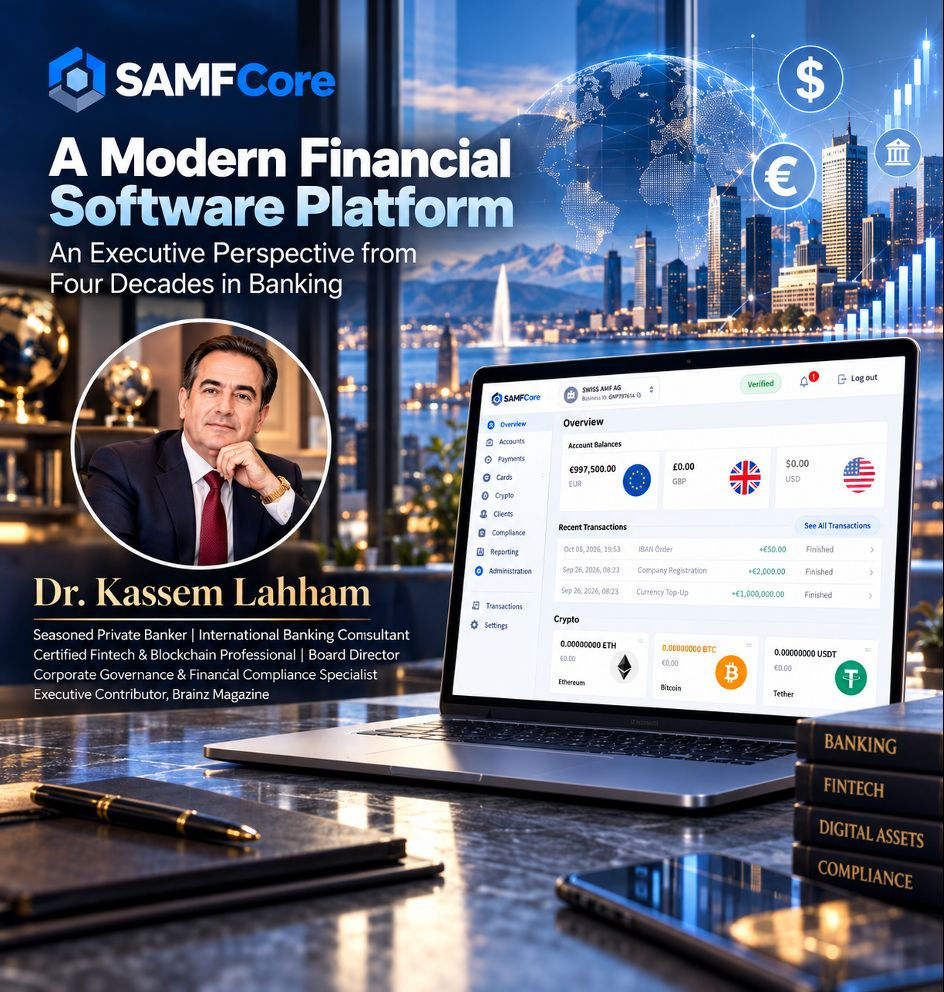
Editorial illustration featuring the SAMFCore interface and author portrait. Platform capabilities should be verified in the live environment.
That experience has taught me to value technology not for its novelty, but for its clarity, adaptability and usefulness in daily operations. One platform that has particularly caught my attention is SAMFCore, developed by Swiss AMF AG. Having followed its development and explored its customer and administrative environments, I would like to share why I believe it deserves consideration alongside the systems financial businesses already use.
The challenge of fragmented financial technology
The modern financial services operator rarely relies on a single tool. Customer onboarding, accounts, payments, cards, digital assets, transaction reviews and compliance records may sit in separate systems, each with its own interfaces, reporting conventions and dependencies. Fragmentation can make even routine questions difficult: What is the status of a customer? Which transaction requires attention? Which team owns the next action?
This is especially relevant to payment service providers (PSPs), electronic money institutions, fintech platforms, businesses dealing in digital assets and financial intermediaries operating under supervisory requirements or requirements imposed by self-regulatory bodies. Their technology must support commercial activity without weakening visibility, accountability or operational control.
What SAMFCore brings together
SAMFCore presents account views across multiple currencies, payment workflows, functions related to cards, interfaces for digital assets, onboarding, compliance processes and administrative functions in a modular environment. In the sandbox environments I examined, the navigation was coherent and the relationship between customer and administrative functions was relatively easy to follow.
What impressed me was not a single spectacular feature. It was the prospect of seeing several everyday activities within a consistent operational framework. For teams that currently move between disconnected applications, this is a meaningful area to explore. Of course, an attractive demonstration cannot establish production reliability, security, scalability or the suitability of a particular integration. Those require proper technical validation.
An important distinction is that SAMFCore supplies software and an integration framework, regulated banking, settlement, card issuing, screening, custody and other specialist services may still require separately contracted external providers. A financial institution must assess its own accounting, reconciliation and regulatory needs rather than assuming every function is included end to end.
Understanding the value of a long-term technology investment
When assessing a platform, I encourage those making decisions to look beyond the initial licence amount. The more revealing question is what the institution receives over five years: functionality, operational flexibility, integration capacity, maintenance obligations and the freedom to adapt as its business evolves.
SAMFCore publicly describes both annual and perpetual licence models, with optional full source code rights under specified packages. Its published terms state that SAMFCore itself does not impose a software fee for each customer transaction or share in transaction revenue. These are potentially interesting commercial characteristics, but they should be read together with the precise licence scope. Hosting, implementation, maintenance, external providers, development and other operational costs remain separate.
I would not suggest that a perpetual model is automatically preferable to a subscription. The answer depends on an institution’s capital position, technical capabilities, expected volumes and plans for the long term. A credible comparison requires actual proposals and a realistic analysis of the total cost of ownership over five years, not a simplified graphic or an assumption that one model always costs less.
Technology independence also means responsibility
The possibility of deployment controlled by the customer and, in selected licence packages, source code access deserves attention. Institutions may value the ability to appoint their own technical specialists or manage future changes within contractual limits. Yet source code rights do not automatically mean ownership of intellectual property, unrestricted redistribution rights or effortless independence.
Documentation, cybersecurity, disaster recovery, audit trails, data portability, integration testing and continuity arrangements are just as important. Any institution considering a change should test its actual onboarding, payments, transaction monitoring and reconciliation journeys before making a strategic decision.
My recommendation to financial services leaders
I have encountered many banking platforms during my career, and very few solutions suit every institution. Nevertheless, SAMFCore is among the platforms I find particularly interesting because it attempts to bring together functions that are often spread across multiple systems, while offering several approaches to licensing and technical control.
For fellow bankers, fintech founders, PSP executives and directors of regulated financial businesses, my recommendation is straightforward: include SAMFCore in your next serious technology comparison. Explore the interface, ask your operational and compliance teams to test real scenarios, and measure it against the strengths and limitations of your current environment. An informed comparison may reveal opportunities that are easy to overlook when familiar systems have been in place for years.
The objective is not change for its own sake. It is to ensure that the technology supporting a financial institution remains fit for its responsibilities, ambitions and clients. Software information here.
Editorial disclosure and scope
This article expresses my professional opinion, informed by my exploration of SAMFCore sandbox environments and review of product information. I have or have had close professional relationships with Swiss financial services companies using the platform, this perspective is therefore not wholly independent. I have not undertaken an audit of the source code, a penetration test or a benchmark of production performance. Product capabilities, commercial terms and regulatory suitability must be verified for each proposed deployment. The article is not an endorsement by any institution named in my professional biography.
Visit my website for more info!
Read more from Kassem Lahham
Kassem Lahham, Entrepreneur Guru
Mr. Kassem, as an entrepreneur, has contributed not only to the entertainment industry but also to the financial and banking industries and many more. He stands out with his radical client focus and broad experience with ultra-high-net-worth (UHNW) individuals and their wealth management needs, gained through his work as a senior private banker since 1987. He has also played a key role in helping young people develop a business mindset and financial knowledge. One of the ways he has done this is by serving as a guest lecturer at the Gulf University of Science and Technology (GUST) and the American University of Kuwait (AUK) in Kuwait, and at the American University in Amman, the Hashemite Kingdom of Jordan, giving lectures about wealth management.