Why Resilience is About More Than Enduring Pressure, and What We Miss When Endurance Becomes the Measure
Roxy Hops is an internationally recognized resilience coach, speaker, author, and social entrepreneur who helps leaders and changemakers transform adversity into agency. Through neuroscience-based frameworks, she bridges trauma healing, identity rewiring, and purpose-driven leadership to create lasting impact.

We know the person we tend to call resilient. They are the one who keeps going when circumstances become difficult. They absorb complexity, carry responsibility, remain composed and continue functioning. They may be leading through uncertainty, holding a family together through disruption, managing a profound personal transition, or simply becoming the person others rely on when things get hard.

From the outside, the evidence seems clear: they are still standing. Still delivering. Still managing. Very often, that capacity is real.
But it raises a question we do not ask often enough, "What exactly are we measuring when we call someone resilient?"
Resilience has become closely associated in our everyday language with endurance, the ability to withstand pressure, tolerate difficulty and return quickly to normal. Yet psychological research has long offered a more nuanced model. The American Psychological Association describes resilience as successful adaptation to challenging experiences, particularly through mental, emotional and behavioural flexibility and adjustment to internal and external demands.
The distinction matters because endurance can be an expression of resilience without being the whole of it.
When endurance becomes the evidence
There are periods in life when continuing is exactly what is required.
Persistence can be courageous. It can protect what matters during a crisis, preserve stability while circumstances are uncertain, and allow us to move through difficult periods that cannot simply be avoided. A more mature understanding of resilience should not diminish our capacity to endure.
The problem begins when endurance becomes the primary evidence by which we recognise resilience.
Human beings can remain remarkably functional under significant pressure. A person can meet deadlines while becoming increasingly depleted. A caregiver can remain dependable while having very little capacity left for themselves. A leader can continue making difficult decisions while privately carrying considerable strain.
None of this means that competent people are secretly unwell. Continued functioning can reflect genuine strength and healthy adaptation. It simply means that visible performance cannot tell us the whole story.
Capacity can conceal cost. When someone is still functioning, we tend to conclude that the existing response is working. But there is a difference between being capable of maintaining something and that thing remaining adaptive over time.
This distinction becomes particularly important for people with considerable capacity. The more reliably someone handles difficulty, the easier it is, for others and sometimes for the person themselves, to use continued performance as evidence that nothing needs to change.
Endurance matters. But our ability to tolerate pressure should not become the sole measure of how well we are responding to it.
Resilience is not only resistance, it is responsiveness
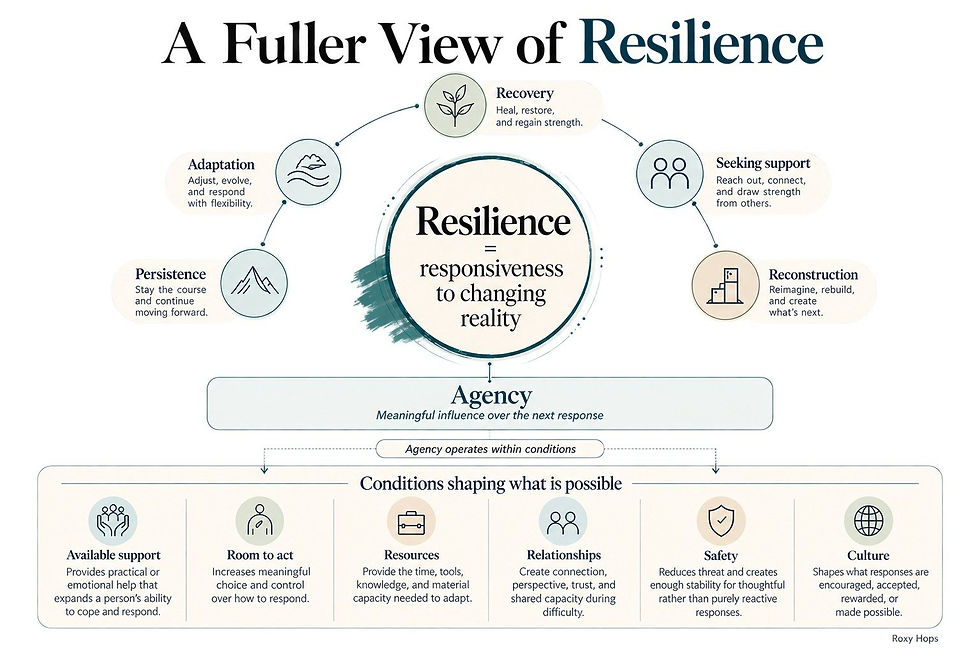
Perhaps a more useful way to think about resilience is through our capacity to respond to changing reality.
Research increasingly emphasises this flexibility. Psychologists George Bonanno and Maren Westphal, for example, have argued that resilient outcomes emerge through flexible self-regulation rather than any single defining trait: the ability to respond differently depending on what a particular situation requires. That idea has an important implication.
If circumstances change, the most adaptive response may need to change with them.
Sometimes resilience is persistence. There are situations in which we need to tolerate discomfort, stay the course and continue doing what matters despite difficulty. But sometimes persistence stops being the most intelligent response.
Resilience may then look like adapting a strategy that no longer fits the circumstances. It may involve recovering capacity before continuing, drawing on other people rather than handling everything alone, revising an expectation, or recognising that the direction itself needs to change.
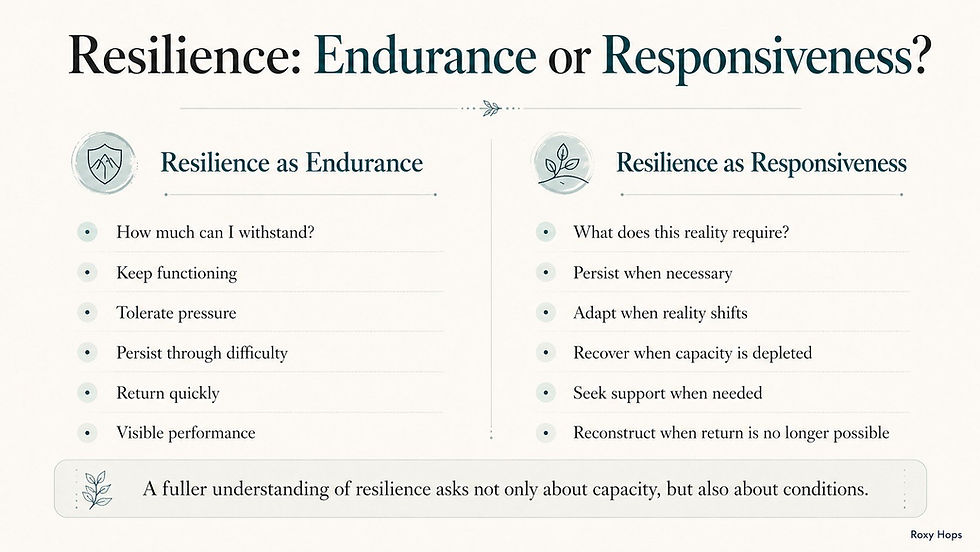
This is why I find it useful to think of resilience not only as resistance, but as responsiveness. Resistance asks, "Can I withstand this?" Responsiveness asks something broader, "What does this situation now require?"
The difference is not an argument for giving up whenever something becomes difficult. Quite the opposite. Responding intelligently to reality can demand considerable discipline. Sometimes the difficult decision is to persist. Sometimes it is to change.
Resilience lies partly in being able to tell the difference.
Recovery is not always return
Our common metaphor for resilience is to “bounce back.”
It is an appealing idea because it suggests restoration: something disrupts us, we absorb the impact, and eventually we return to where we were. Sometimes that is exactly what recovery looks like.
There are setbacks and stressful periods after which stability returns. A project fails; another opportunity emerges. A demanding period ends; capacity is restored. Circumstances settle and life resumes something close to its previous shape. But some forms of adversity alter the reference point itself.
A significant loss can change a family permanently. Illness may change what is physically possible. A major transition can reshape identity, priorities or relationships. A profound personal or professional disruption can make the previous version of life neither available nor desirable.
In circumstances like these, “getting back to normal” may be the wrong measure. Recovery is not always return. Sometimes resilient adaptation involves integrating what has happened into a reality that is now different.
The task may no longer be restoration alone. It may be reconstruction. That does not require romanticising adversity or pretending that every disruption produces growth. Some experiences simply involve loss. Some changes are painful rather than transformational.
But when the landscape has changed, resilience may mean learning how to live, decide and move meaningfully within the landscape that exists now, rather than attempting indefinitely to recreate the one that existed before.
Agency after disruption
This brings us to another dimension of resilience that deserves greater attention: agency.
Adversity often narrows choice. Sometimes that narrowing is very real. Circumstances beyond our control can reduce financial, professional, physical or relational options.
At other times, sustained pressure narrows what we can perceive. Our attention becomes organised around immediate demands. We focus on getting through the day, solving the next problem or preventing something else from going wrong. Possibilities that once seemed obvious become difficult even to see.
Agency does not mean controlling everything that happens to us. That is neither possible nor a credible model of human resilience. It means having some meaningful influence over what happens next.
What can I change? What cannot be changed? Where is support needed? Which response is still serving its purpose? Which one was necessary once but no longer is? What options remain available from here?
A resilient person, then, may not be the person capable of tolerating the greatest amount of pressure.
They may be the person who can recognise that circumstances have changed and retain or gradually rebuild enough agency to respond accordingly.
People exercise agency within conditions
But our capacity to exercise agency is also shaped by the conditions in which we are operating.
We do not respond to adversity from a neutral starting point. Our available choices are shaped by relationships, resources, safety, autonomy, culture, leadership and access to support.
Research supports this broader view. A 2024 umbrella review drawing on 44 reviews and more than 556,000 participants identified factors including social support, community cohesion and self-regulation among those associated with resilience after adversity.
This does not make resilience purely environmental any more than it makes it purely individual.
Individual capacities matter. Self-awareness matters. Decision-making matters. Coping skills matter. Our ability to act matters. Conditions matter too.
People exercise agency within environments that can expand or constrain the responses available to them.
Someone with strong relationships and meaningful support is navigating adversity from a different position than someone carrying the same disruption in isolation. A person with some autonomy has options that someone without it may not. Resources, trust and stability do not remove adversity, but they can alter what becomes possible in response to it.
That gives us two questions rather than one, "What capacities does this person need?" and "What conditions are they being asked to function within?"
We do not need to choose between the two.
A more useful question
Perhaps the problem is not that we value resilience too much. It is that we have sometimes learned to recognise it too narrowly.
We see the person who keeps performing and admire their endurance. We see someone return quickly after disruption and call it recovery. We notice composure because composure is visible.
What is harder to see is adaptation. The decision to change course because reality has changed. The recovery period that preserves future capacity. The willingness to use support. The acceptance that something cannot be restored. The gradual rebuilding of agency after circumstances have taken choices away.
These responses may look very different from one another because resilience is not a single behaviour.
One useful way to understand it is as the capacity to remain responsive as circumstances change: to persist when persistence is appropriate, adapt when reality shifts, recover when capacity has been depleted, draw on support when necessary, and rebuild meaningful agency when adversity has narrowed our choices.
That understanding changes the question. Instead of asking only, “How much can this person withstand?” we can ask, “What does this reality require, and what capacities and conditions make an adaptive response possible?” That is a larger conversation than resilience as endurance.
It asks us to strengthen human capacity without assuming that capacity is limitless. It asks us to value persistence without confusing it with permanent tolerance. It asks us to pay attention not only to how people respond to difficult circumstances, but also to the conditions within which that response must take place.
Because resilience should not be measured simply by how much pressure a person can absorb without stopping.
It should also be understood through their capacity to recognise when reality has changed and respond to it.
Continue the conversation
My work connects resilience, mental health, leadership and human systems to help people and organisations respond to pressure and change with greater clarity, agency and sustained effectiveness.
If this work is relevant to you or your organisation, connect with me on LinkedIn or visit my website to book a conversation to explore potential collaborations and how these ideas may apply to you, your team or your organisation.
Read more from Roxy Hops
Roxy Hops, Resilience Coach & Mental Health Advocate
Roxy is an internationally recognized resilience coach, speaker, author, and mental health advocate who helps leaders and changemakers rise from burnout and adversity into clarity, purpose, and authentic leadership. Combining evidence-based neuroscience with deep emotional work, she bridges brain science with soul, empowering others to rebuild from the inside out. Her transformative frameworks have inspired leaders and visionaries worldwide to redefine success on their own terms. She is the founder of Centro Gracia, a youth-focused movement in Chile that brings emotional intelligence and suicide-prevention programs into schools and communities. Her mission is clear: to make emotional resilience a cultural foundation, not a crisis response.
References:
American Psychological Association. Resilience. APA Dictionary of Psychology / Help Center. https://www.apa.org/helpcenter/resilience
Bonanno, G. A., & Westphal, M. (2024). The three axioms of resilience. Journal of Traumatic Stress, 37(5), 717–723. https://doi.org/10.1002/jts.23071
Abate, B. B., Sendekie, A. K., Tadesse, A. W., Engdaw, T., Mengesha, A., Zemariam, A. B., Alamaw, A. W., Abebe, G., & Azmeraw, M. (2024). Resilience after adversity: An umbrella review of adversity protective factors and resilience-promoting interventions. Frontiers in Psychiatry, 15, 1391312. https://doi.org/10.3389/fpsyt.2024.1391312