Why Great Leadership Begins When Certainty Ends
Dr Hussein H. Rifai is a global business leader, investor, and company chairman with more than four decades of experience across 85 countries. He writes on leadership, corporate governance, private equity, artificial intelligence, and international business.

There is a common misconception that great leaders are those who build successful companies, deliver exceptional financial results or collect impressive titles throughout their careers. I have never believed that. After more than forty years leading organisations, serving on boards, investing in businesses and working across five continents, I have come to a different conclusion.
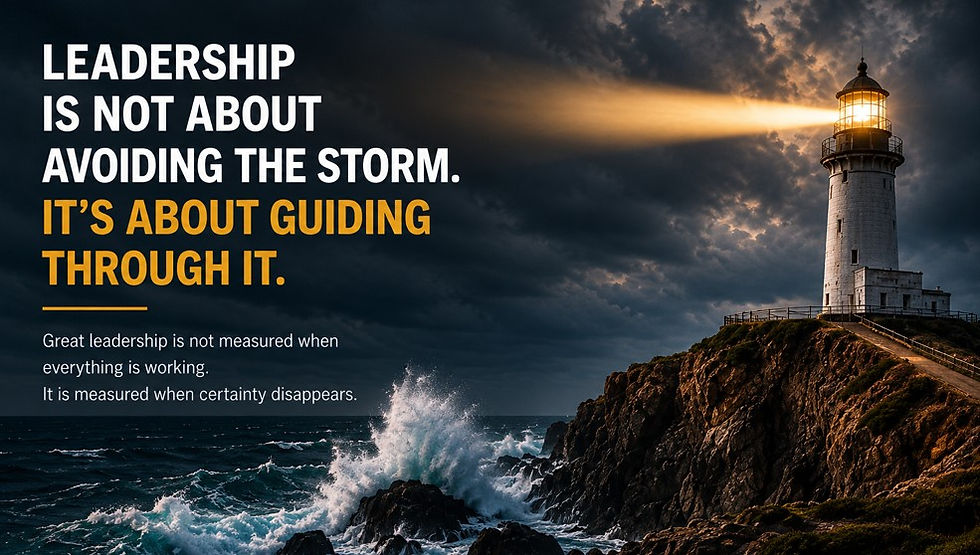
“Leadership is not defined by the position you hold. It is defined by the decisions you make when certainty disappears.”
Leadership is not measured when everything is working. It is measured when it isn't, when markets become uncertain, when customers disappear, when shareholders disagree, when cash becomes tight, when acquisitions fail to deliver what everyone expected, when people look at you and quietly ask themselves, "Does this person know where we're going?"
Those are the moments that define leadership. Looking back, I have been fortunate to experience far more successes than failures. Yet if I am honest, I learned more from the difficult periods than the comfortable ones. Success builds confidence. Failure builds judgment. Both are necessary. One without the other rarely produces exceptional leaders.
What I have learned above everything else is that there is no universal leadership style. Leadership is contextual. The style that transforms a struggling business may destroy a fast-growing one. The approach that works brilliantly in a multinational may fail completely in an entrepreneurial company. Good leaders understand this. Great leaders adapt to it.
Every organisation needs something different
Early in my career, I spent a great deal of time trying to understand what great leadership looked like. Eventually, I realised I was asking the wrong question. The better question is much simpler.
"What does this organisation need from me today?"
Leadership is not about finding one style and applying it everywhere. It is about understanding the environment, recognising what is required and adjusting your leadership accordingly. Some organisations need stability. Others need urgency. Some require discipline. Others require optimism. Sometimes the leader needs to inspire. Sometimes the leader simply needs to listen.
The greatest mistake leaders make is assuming yesterday's approach will solve tomorrow's problems. Business rarely works that way.
Success can become your greatest weakness
One lesson I have learned repeatedly is that success often creates complacency. The organisations performing well are usually the least likely to challenge themselves. Sales are growing. Customers are happy. Cash flow is healthy. The board is supportive. Everyone assumes tomorrow will look much like today.
History tells us otherwise. Markets change. Technology changes. Competitors emerge. Consumer behaviour evolves. The organisations that continue succeeding are not necessarily the smartest. They are the ones that remain curious.
When business is performing well, leadership becomes less about solving today's problems and more about preparing for tomorrow's. That means investing in people before they are needed. Strengthening systems before they break. Developing future leaders before succession becomes urgent. Questioning assumptions while success still makes those conversations uncomfortable. The best leaders never confuse today's performance with tomorrow's security.
Growth creates different problems
Many people assume growth makes leadership easier. My experience has been the opposite. Growth magnifies everything. Weak systems become obvious. Poor communication becomes expensive. Informal processes stop working. Culture becomes harder to protect. People who performed brilliantly in a fifty-person business sometimes struggle in a five hundred-person organisation, not because they became less capable, but because the organisation changed. Leadership changes with it.
One mistake I made earlier in my career was believing that committed people could simply work harder as the business expanded. Eventually, I realised that hard work does not scale. Systems do. Structure does. Delegation does. If leaders wait until they desperately need better systems, they have already waited too long.
Leadership depends on the resources around you
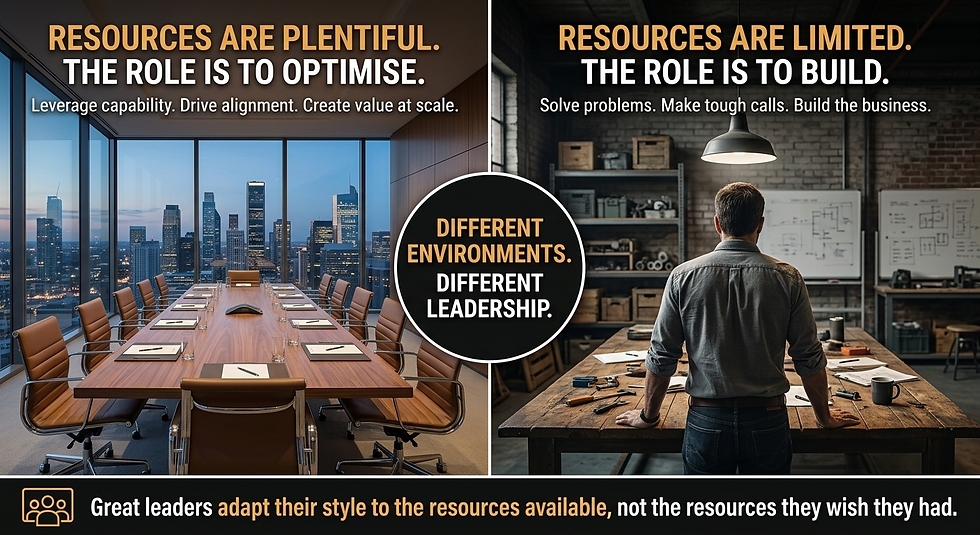
One of the biggest myths in business is that leadership success automatically transfers from one organisation to another. It doesn't. Throughout my career, I have watched outstanding executives leave global corporations convinced they would naturally succeed in smaller businesses. Many did. Many didn't. The difference had very little to do with intelligence. It had everything to do with context.
Large multinational organisations provide extraordinary resources that many people barely notice while they are there. There are finance teams, legal departments, Human Resources specialists, technology experts, dedicated procurement functions, marketing departments, communications teams, risk managers, compliance professionals and investor relations specialists. The infrastructure surrounding leaders is enormous.
The executive's role becomes one of coordinating exceptional resources. Smaller organisations operate very differently. Resources are limited. Cash matters every day. The leadership team wears multiple hats. The CEO may spend the morning negotiating with a bank, the afternoon resolving customer issues, and the evening reviewing payroll or meeting suppliers. Problems cannot simply be passed to another department because another department often doesn't exist.
That reality surprises many talented executives. I have also seen the same pattern among partners leaving large accounting firms to establish their own practices. Technical excellence brought them partnership. Running a successful business requires something different. Winning clients, managing cash flow, recruiting people, building systems, making investment decisions, and leading culture.
Being an outstanding accountant does not automatically prepare someone to become a successful business owner. Exactly the same lesson applies to executives moving from global FMCG companies into smaller manufacturers. Inside a multinational, they are supported by world-class brands, sophisticated research, specialist procurement teams, advanced planning systems and significant financial resources. In a smaller company, those advantages disappear overnight. Leadership becomes far more personal. Much more practical. Often much lonelier.
Neither environment is more difficult. They are simply different. The leaders who succeed in both understand that they are not changing jobs. They are changing leadership models.
Turnaround leadership requires honesty
When an organisation begins struggling, leadership changes again. Turnarounds do not begin with motivation. They begin with reality. People already know there is a problem. Pretending everything is fine only destroys credibility.
The first responsibility of a turnaround leader is honesty. Explain the situation. Set priorities. Make decisions. Communicate often. Hope without action is simply optimism. Leadership requires both.
One lesson I learned years ago is that difficult decisions almost never become easier by delaying them. Problems usually grow faster than courage.
Crisis leadership is different again
Emergencies create an environment unlike any other. Information is incomplete, events move quickly, and emotions become heightened. During those moments, people are not looking for perfection. They are looking for confidence.
Ironically, many leaders communicate less during crises because they are waiting for better information. Employees interpret that silence very differently. Silence creates anxiety. Rumours replace facts. Confidence begins to disappear.
One principle has guided me through every significant crisis I have faced. Communicate early. Communicate honestly. Communicate often.
It is perfectly acceptable to say, “This is what we know today. This is what we don’t yet know. This is what we are doing next.” People rarely expect certainty. They do expect leadership.
Judgment matters more than intelligence
Business schools teach analysis. Experience develops judgment. I have worked with extraordinarily intelligent people who struggled to lead organisations. I have also worked alongside people with modest academic backgrounds who consistently made exceptional decisions. The difference was rarely intelligence. It was judgment. Judgment is developed one decision at a time. Some decisions succeed. Some don't. The important part is learning quickly enough that each decision improves the next. Leadership is not avoiding mistakes. Leadership is reducing the likelihood of repeating them.
Leadership is ultimately about people
As my career has progressed, I have become convinced that leadership has far less to do with strategy than many people imagine. Strategy is important. Execution is more important. People are the most important of all. Businesses do not execute strategy. People do.
Technology can improve productivity. Capital can fund expansion. Systems create consistency. None of them replaces trust. People willingly follow leaders who are competent, honest, consistent and authentic. That has remained true in every country I have worked in, regardless of culture, industry or organisation. Leadership always begins with people. It always ends with people.
Looking back
If I could offer one piece of advice to the younger version of myself, it would be this. Stop trying to become the perfect leader. Instead, become the leader your organisation needs at that moment. Leadership is not static. It evolves. The leadership required to build a multinational is different from the leadership needed to rescue a family business. The leadership needed during rapid growth differs from the leadership required during a crisis. The principles remain remarkably constant. Integrity, humility, curiosity, courage. The application of those principles changes every day. Technology will continue to reshape industries. Artificial intelligence will transform many professions. Markets will become more volatile. Organisations will continue to evolve. Leadership must evolve with them. The leaders who thrive in the decades ahead will not necessarily be the smartest or the most experienced. They will be the ones who can adapt fastest without compromising the values that define them. That, in my experience, is what leadership during chaos is really about.

A question for discussion: Looking back over your own career, which environment taught you the most about leadership? Steady growth, rapid expansion, a turnaround, or a crisis? Why?
Read more from Dr. Hussein H. Rifai
Dr. Hussein H. Rifai, Thought Leader and Chairman
Dr Hussein H. Rifai is a global business leader, investor, company chairman, and thought leader with more than four decades of experience across 85 countries. His career spans multinational corporations, entrepreneurship, investment banking, private equity and corporate governance, advising boards and business leaders on strategy, mergers and acquisitions, capital raising, business transformation and international growth. Holding a PhD in Business Administration, Hussein writes on leadership, corporate governance, artificial intelligence, international business and global competitiveness, combining academic insight with practical experience gained at the highest levels of global business.