

Where is AI Innovation Heading Next? What I Saw at Berkeley SkyDeck Demo Day
Christopher Smith is an award-winning author and entrepreneur dedicated to protecting people from cybercrime. After being the target of a major cyberattack, he founded DFend, a digital safety platform, and wrote Privacy Pandemic, inspired by his real-life story.

From artificial intelligence (AI) coworkers to robotics, healthcare, and the infrastructure behind intelligent systems, Berkeley SkyDeck's latest founders offered a glimpse of where technology and venture capital may be heading.
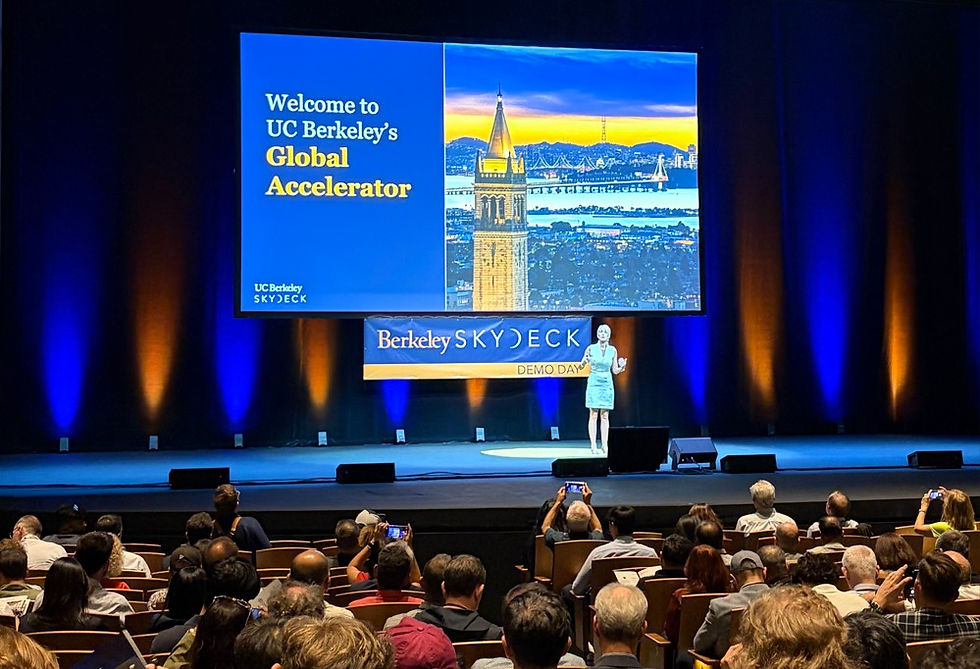
At the end of September, I sat in a packed theater at the University of California, Berkeley (UC Berkeley)'s Zellerbach Hall alongside more than a thousand investors, founders, and members of the startup community.
On stage, roughly 20 startups presented technologies ranging from AI-powered financial services to robotics, advanced computing, and life sciences.
One company was developing an AI-native commercial credit business. Another was building technology to monitor compliance while AI systems operate. One founder described how cameras connected to the company's platform had helped save a life in a swimming pool.
The range was impressive. But what interested me most wasn't any single product. It was what the companies collectively suggested about the next phase of AI innovation. The short version I shared afterward was more agents, more robots, more compute.
What is Berkeley SkyDeck Demo Day?
Berkeley SkyDeck is UC Berkeley's startup accelerator, connecting founders, investors, mentors, and industry experts to help early-stage companies develop and commercialize technologies. Its September 30 Demo Day featured Batch 22. According to SkyDeck, companies from its alumni network have collectively raised more than $3 billion.
I attended as an exited founder and strategic advisor to LvlUp Ventures, where I advise founders and early-stage companies on commercialization, go-to-market strategy, partnerships, and growth.
That role has changed some of the conversations I'm having. As a founder, you focus on building the business directly in front of you. As an advisor, you're also evaluating how technologies fit into markets and what separates an interesting product from a scalable company. Demo Day brings those questions into focus.
What were the startups building?
By my count, applied AI was the largest category, with six companies. AI infrastructure and tooling, hardware and chips, and robotics each had three. Two were in fintech and one in life sciences.
Nearly every company used AI, but their commercial ambitions differed. Some were automating business processes. Others were building the computing systems behind sophisticated AI applications, including an edge-native "nervous system" for physical AI and a platform that makes live video programmable.
Several were connecting software intelligence to physical environments. Others took on established problems. One startup focused on the wave of business owners preparing to retire and sell their companies. Another applied AI to commercial credit.
These aren't necessarily new markets. In many cases, they're established industries where AI may change how services are delivered. That distinction matters.
AI is moving from tool to teammate
One of the strongest themes was the shift from AI as an assistant to AI as an operational participant. Much of the AI conversation has focused on productivity, helping employees write, research, analyze, and develop software. The next phase increasingly involves systems performing more of the work themselves. An AI coworker might execute business tasks. An AI-native financial platform might automate processes that once required several employees.
A tool helps someone perform a task. An autonomous system may complete portions of that task independently. That changes how businesses evaluate the technology. Customers need to understand what decisions an AI system can make, what information it can access, and how its performance is measured.
It also changes commercialization. Selling a productivity tool is different from selling software that assumes responsibility for a business function. The latter requires greater attention to integration, accountability, and trust.
The venture capital numbers explain the momentum
According to Crunchbase, AI-focused startups raised $102 billion in the third quarter of 2026, or 64% of global venture funding. Total venture investment reached approximately $159 billion during the quarter.
That concentration is remarkable, but it doesn't mean every AI startup is finding it easier to raise capital. Large financing rounds account for a substantial portion of the total.
The more interesting question is where durable commercial value will accumulate. Some will belong to companies building models, chips, and infrastructure. Some will belong to companies integrating AI into established industries. Others may emerge from applications that solve specific problems better than existing alternatives. For founders, the challenge is determining which part of that market they can realistically own.
AI is leaving the screen
Robotics, intelligent cameras, and edge-computing systems were another notable theme. Physical AI presents different commercial challenges from traditional software. When intelligent systems interact with physical environments, mistakes can affect equipment, operations, and people. That makes reliability, safety, integration, and accountability especially important.
It also creates different go-to-market requirements. A robotics company may need manufacturing relationships, deployment partners, and customers willing to integrate equipment into existing operations. Partnerships and distribution matter more.
Healthcare and underserved markets
Life sciences offered another signal. Founders discussed using AI to improve research and address difficult medical problems, including rare diseases.
Public funding points the same way. In September, the Advanced Research Projects Agency for Health announced four awards totaling nearly $83 million to support AI-enabled research and earlier rare-disease diagnosis, according to BioCentury.
But promising technology still faces industry realities, including validation, regulatory requirements, and complex purchasing processes.
I was equally interested in the less glamorous opportunities. The startup focused on retiring business owners is a good example. AI isn't creating the opportunity. It already exists because of demographic change. AI may simply make it possible to serve that market differently. Those can be compelling opportunities: established problems where new technology changes a solution's economics.
Trust is becoming part of the product
One presentation involved technology designed to monitor compliance while AI systems operate. As businesses deploy increasingly autonomous systems, they need confidence that those systems are acting appropriately. Traditional compliance often involves periodic reviews and audits. Autonomous software may require more continuous oversight.
This connects to a broader industry conversation. In August, OpenAI published a collective call for stronger cyber defense, supported by well over 100 technology, financial, and cybersecurity organizations. Its recommendations included greater accountability and traceability for AI agents.
As AI becomes more capable, identity, permissions, and oversight may become commercial opportunities in their own right.
The commercialization question
After watching the presentations, I kept returning to a lesson from advising early-stage companies. Building a compelling product and building a sustainable business are not the same thing. AI allows small teams to develop sophisticated products faster. It also allows competitors to build similar capabilities. That increases the importance of commercialization.
Who is the customer? What problem matters enough for them to pay? How will the company reach them? What makes the product difficult to replace?
For some companies, the advantage will come from proprietary technology. For others, it may come from distribution, partnerships, industry specialization, or integration into customer workflows. Founders should consider those advantages much earlier. Go-to-market strategy shouldn't begin after the product is finished. It should help shape what gets built.
What I'm taking away
Batch 22 offered a snapshot of where founders are directing their attention. AI agents are moving toward operational responsibility. Intelligent systems are entering physical environments. New infrastructure is supporting more capable models. Established industries are finding new applications.
But the biggest question is what happens after the demonstration. Which technologies become products customers depend on? Which companies develop repeatable distribution? Which founders translate technical differentiation into commercial advantage?
Those are the questions I'm increasingly focused on in my advisory work. AI is changing how quickly companies can build. Commercialization will determine how far they can go.
So when you look at the next wave of AI companies, what will separate the ones that endure from the ones that reach the stage?
Read more from Christopher A. Smith
Christopher A. Smith, Author & Digital Safety Advocate
Christopher Smith is the award-winning author of Privacy Pandemic and the founder of DFend, a digital safety platform built to protect people from cybercrime. After being the target of a major cyberattack, he transformed his story of loss into one of purpose, turning a personal crisis into a global mission. His experience inspired him to develop technology that helps individuals safeguard their identity and privacy in the age of AI. Through his work and writing, Chris advocates for greater awareness, protection, and resilience online. He believes the future of digital safety is personal, because the threat already is.
References:
Berkeley SkyDeck, Batch 22 Demo Day (September 30, 2026)
Berkeley SkyDeck, Accelerator and Alumni Updates (July 15, 2026)
Crunchbase, Q3 2026 Global Venture Funding Report (October 5, 2026)
BioCentury, ARPA-H Envisions Faster Rare Disease Diagnosis With AI (September 9, 2026)
OpenAI, A Call for Collective Action on Cyber Defense (August 27, 2026)
Disclaimer: The views and interpretations above are based on my own personal experiences and reflect my interpretation of publicly available data and third-party articles. Any conclusions drawn are my perspective alone, not necessarily that of the source.







