When Beating the Competition Becomes the Goal
Ana Postigo is an airline pilot, former crew resource management (CRM) instructor, writer, and speaker working at the intersection of human factors, neuroscience, and human performance. Drawing on extensive experience in airline operations, she explores how cognition, behaviour, and the systems around us shape decision-making, performance, and safety in complex environments.

What happens when an organisation becomes so focused on beating its competitors that it stops questioning what it is actually building? Competition is usually considered a positive force. It encourages innovation, creates urgency and pushes organisations beyond what they thought possible. But competition can also influence the way leaders think, what they pay attention to and how they define success. Gradually, the question changes from whether they are building something that works to whether they can deliver it before somebody else. Few aviation stories illustrate this tension better than the extraordinary race between Concorde and the Soviet Tupolev Tu-144.
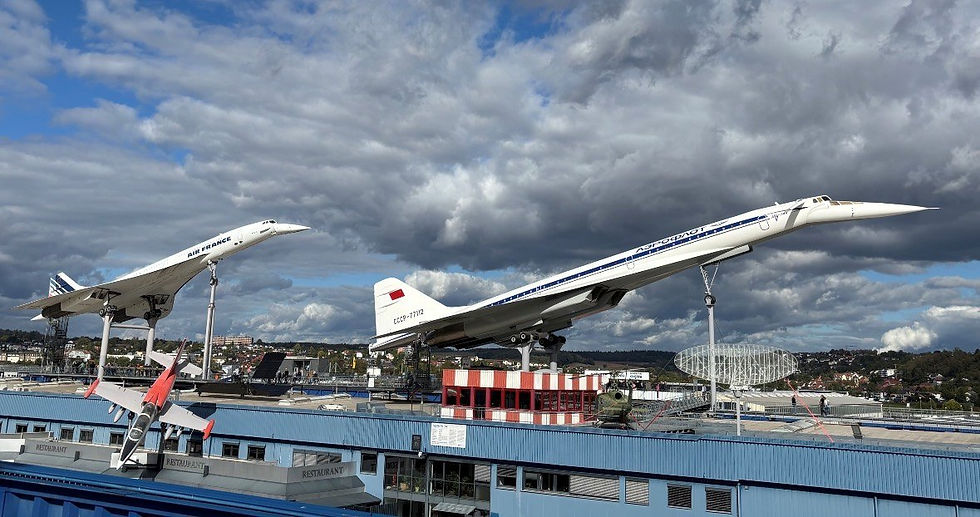
Two aircraft, one race, two very different stories
In the 1960s, supersonic passenger travel promised to transform aviation. Britain and France were developing Concorde, while the Soviet Union was working on the Tu 144. Both programmes represented extraordinary engineering ambition, prestige and the desire to demonstrate technological superiority.
On 31 December 1968, the Tu-144 made its maiden flight, beating Concorde into the air by just over two months. It also became the first passenger transport aircraft to exceed Mach 2.
Yet their operational histories were very different. Concorde entered commercial service in 1976 and continued carrying passengers until 2003. The Tu-144 began scheduled passenger operations in November 1977, but these ended in May 1978.
The Soviet aircraft faced serious operational challenges, including limited range, high fuel consumption, reliability concerns and excessive cabin noise. Its programme also suffered two major accidents.
This does not diminish the remarkable engineering achievement of the Tu-144, nor does it mean competition alone explains its difficulties. However, the contrast raises an interesting question: what happens when achieving the milestone becomes more important than developing the capability to sustain it?
When the milestone becomes the mission
In aviation, a successful takeoff does not mean a successful flight. The aircraft must still climb, cruise, navigate changing conditions, land safely and be capable of operating reliably again.
Organisations sometimes forget this distinction. A company rushes to launch a product because a competitor is about to release something similar. Another expands before developing the resources and experience needed to support that growth.
From the outside, these decisions may look like progress. Inside the organisation, people may be compensating for weaknesses, finding workarounds and postponing concerns because there is no time to address them.
The organisation is moving faster, but is it becoming more capable? Speed is valuable when supported by knowledge, experience and reliable systems. Without those foundations, moving faster may simply expose existing weaknesses sooner.
When competition changes our judgement
What does competition actually do to our thinking? Research in cognitive psychology shows that our decisions are influenced by expectations, previous experiences and cognitive biases. Under pressure, attention can narrow, and we may become more receptive to information that confirms what we already believe. Confirmation bias can make us overlook evidence that challenges our plans.
Imagine these processes operating in an organisation where national prestige, financial investment and public expectations are involved. A legitimate concern may begin to sound like resistance, while asking for more time may be interpreted as a lack of commitment.
Aviation has spent decades studying how experienced professionals make decisions under pressure, how authority influences communication and why people sometimes continue with a plan despite evidence that circumstances have changed. Technical expertise does not make us immune to cognitive bias, whether we are sitting in a cockpit or making decisions in a boardroom.
You can copy the result without copying the capability
The rivalry between Concorde and the Tu-144 had another fascinating dimension. During Concorde's development, Soviet intelligence sought technical information from the British and French programme. In 1965, Sergei Pavlov, the head of Aeroflot's Paris office, was found in possession of technical material related to Concorde.
But obtaining information is not the same as developing understanding. A technical drawing may show how an engineering problem was solved, but it cannot explain the failed experiments, difficult decisions and experience behind that solution.
Businesses face a similar temptation when copying successful competitors. They reproduce technologies, strategies and management systems because these are the visible parts of success, often without fully understanding the conditions that made them effective. Information can be copied. Experience and judgement have to be developed.
What are we actually building while trying to win?
Concorde should not be romanticised as the simple winner of this rivalry. Although it operated for 27 years and became an aviation icon, high operating costs, expensive fares, noise restrictions and a limited market constrained its future. Even extraordinary engineering must operate within a viable economic system.
For entrepreneurs and chief executive officers (CEOs), the question is what competition is doing to their organisations. Is it encouraging people to become more capable, or pushing them towards decisions they would otherwise question? Are concerns being examined, or dismissed because slowing down feels like falling behind?
Sometimes the most valuable contribution a leader can make is not another solution, but a question that helps everyone see the situation differently. Competition can inspire extraordinary achievements, but it should never replace the ability to learn, question assumptions and make sound decisions. Because getting there first and building something capable of staying there are two very different achievements.
Read more from Ana Postigo
Ana Postigo, Airline Pilot, Human Factors Writer & Speaker
Ana Postigo is an airline pilot, former CRM instructor, writer, and speaker working at the intersection of human factors, neuroscience, and human performance. Drawing on extensive experience in airline operations, she explores the factors that shape how people think, decide, communicate, and perform in complex and high-pressure environments. Her work brings together operational experience with research from neuroscience, psychology, and human factors to explore decision-making, cognitive performance, resilience, error, and safety. As a speaker, she has contributed to events and conversations with organisations including BAC and Instituto Cervantes, translating complex ideas about human performance into accessible and practical discussions. Alongside her aviation and human factors work, Ana is also a children’s author, encouraging young readers to remain curious, pursue their ambitions, and believe in what they can become.