This is Your Brain on Nutrients
Written by Julie Farnsworth, Trauma-Informed Grief Coach
Julie Farnsworth has spent her life helping others to live better lives. After 30 years working as a social worker, she founded "One Free Soul Grief Journey, LLC" in honor of her sister, Erica, who lost her life to cancer at the age of 40.

The famous 1980s U.S. commercial and slogan that referenced “this is your brain” and “this is your brain on drugs” was a powerful one to me as an impressionable young girl. It was meant to be a hard-core anti-drug campaign to bring awareness to what happens to your brain after taking drugs, and it used an egg being cracked open and fried in a pan to provide a visual.
Looking back, this might have been the start of my curiosity about what actually happens to our brains in various states and environments. Regardless, I know that it certainly made an impression on me and formed part of my desire to learn more about the brain. As a college student studying psychology, it became obvious to me that there are so many things that influence the operation of our brains. Overall, if we treat our bodies in healthy ways and surround ourselves with positive settings, our brains will respond and function optimally. Conversely, if we don’t care for ourselves in ways that involve more than just taking care of our basic functions, such as eating, drinking, and sleeping, our brains will stay dormant. They will continue to function, but they will not grow or make new connections, and, in turn, this influences our overall state of well-being. Taking this a step further, I learned that if we want to truly feel like the best version of ourselves, we need to start with our brains and what we are “feeding” them. We need to think of this in the same way as the food that we put into our bodies.
So, what is brain food? Our brains thrive when we feed them nutrients such as listening to music, reading, writing, creative art, and/or movement. We know that when we engage in these activities, we are helping our brains to “fire” and make new neural pathways and connections. Something else that I have come to learn is that our environments have a direct correlation to brain function. Sometimes, we have no choice in the environment that we are in, as we might have been born into an adverse one or made a choice to be in a relationship that ended up being a negative one. What I have come to realize as I’ve gotten older is that choosing to be in environments that bring us joy and happiness is the most important food that we can give to our brains. For me, I feel energized when I explore new places and learn about new cultures. I can literally feel my brain expanding to take in new information and experience life in different locations. Taking this a step further, traveling, whether it is to a new local spot or another country, can contribute to the release of different chemicals like serotonin and oxytocin that link directly to feelings of happiness and joy. If we are open and curious to learn, observe, and experience new things, our brains respond with the capacity to expand and thrive.
I want to go back to the visual of our brains being like eggs and expand on some thoughts about that. They are fragile in the sense that they can be harmed if contaminated by drugs or negative experiences, but much like an egg, the capacity to grow into something with the proper care is limitless. If we think of ourselves as beings controlled by the care and nourishment that we give to our brains on a daily basis, as much as by the foods we feed our bodies, we can make better choices about how we live our lives and the environments that we choose to be in. Sometimes, for this to happen, we need to force ourselves to change environments if we realize that our brains cannot thrive where we are. None of us really want to get into a cycle where we are just surviving life. It is easy to get stuck in this, however, and have the primitive part of the brain (the amygdala) take over. When this happens, we are not operating from the best parts of our brain. The amygdala’s sole purpose is to sense threats and keep us alive. We have the capability to change this, though, when we feel stuck, even if it requires us to do things to get out of our comfort zones. If we realize that this is our amygdala talking, it can help us to feel more in control of making changes. We can start with something small, like going to a new place to get coffee, taking a walk somewhere we have never been before, or taking a different route home from work. With repeated exposure and practice, our brains gradually start to respond, and we start to feel better.
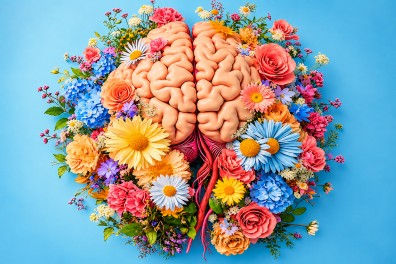
I recently experienced this in a more extreme scenario. I was feeling stuck, so I decided to travel to a new country for a week by myself. When I left for the trip, I felt “flat” and uninspired, in survival mode, going through the motions of life on autopilot. Halfway through the week, I was in a metro station and saw a sign with a picture of a brain that was growing flowers. I immediately thought of the “this is your brain on drugs” slogan and how negative that was, and how this was a much better visual than an egg being cracked and fried. In that moment, I realized that what I needed was to get out of my comfort zone by traveling and appreciating the beauty of my new surroundings, learning about a new culture, reading about it, trying new foods, and looking at the art of the buildings and nature there. All the things that my brain had been yearning for. I decided then that I would like to rebrand the negative “this is your brain” and “this is your brain on drugs” slogans of the 1980s as “this is your brain when it’s not nourished” and “this is your brain when it is nourished.” There is no need for the egg frying in a pan reference now. I think a better one is an unnourished, unwatered flower barely surviving and a nourished, beautiful flower blooming. As it makes new connections to new experiences, our brains grow, just like flowers do, with feelings of happiness and joy. In the end, isn’t that what we all long for in life?
My wish for everyone reading this is inspiration to care for and nourish your brain with nutrients so that you may have never-ending blooms.
Visit my website for more info!
Read more from Julie Farnsworth
Julie Farnsworth, Trauma-Informed Grief Coach
Julie Farnsworth is a Certified Trauma-Informed Grief Coach, Neuro-Change and Mind-Body Medicine Practitioner, Social Worker, and Mental Health Therapist. Since the age of 12, as a volunteer with the Red Cross, Julie has been called to help as many people as she can. She is the founder of "One Free Soul Grief Journey," which provides 1:1 healing journeys for anyone who needs help navigating the intricacies of grief and loss. Julie brings her years of experience walking alongside fellow grievers, as well as her own personal experience with grief and loss, to ignite her passion to help others to go from surviving to thriving.