

The One Thing Every Cancer Patient Deserves
Updated: Jul 24
Dee Mani is a holistic healing advocate and founder of My Way CBD, who transformed her life after overcoming an aggressive breast cancer diagnosis using natural remedies. She is an author, entrepreneur, and speaker dedicated to empowering others through the healing potential of cannabis and holistic wellness practices.

A cancer diagnosis has a way of dividing your life into two chapters: before cancer and after cancer. One moment you're making plans for the future, worrying about everyday life and thinking about everything you still want to do. Then, in a matter of minutes, you're sitting in a consultation room hearing words that stop you in your tracks. From that moment on, life doesn't quite feel the same.
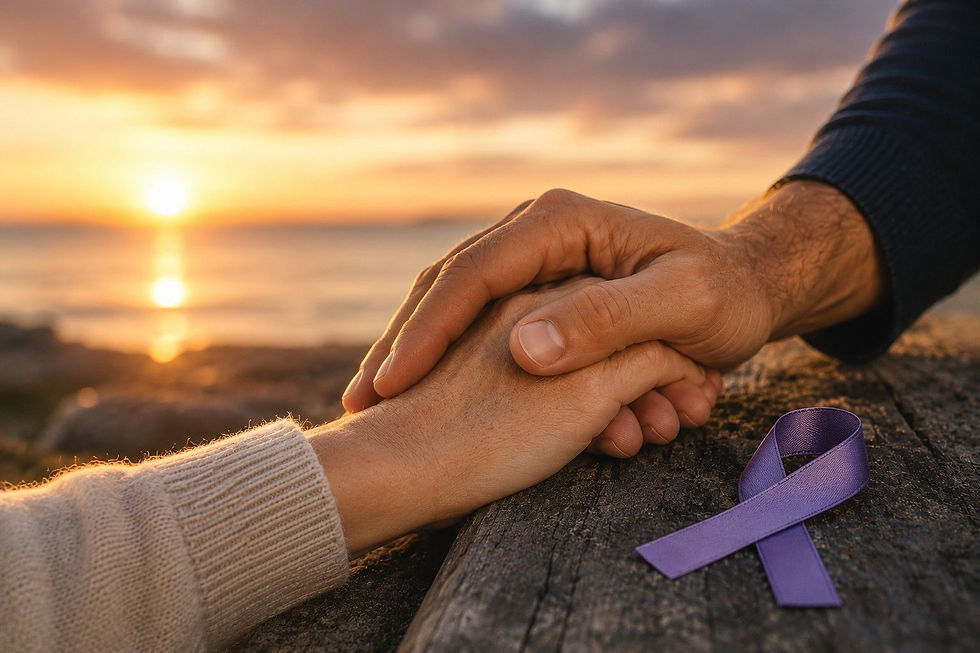
The day everything changes
People often ask me what it was like when I was diagnosed, and the honest answer is that it's almost impossible to describe. Unless you've heard the words, "You have cancer," you simply cannot fully understand the emotions that follow.
You can imagine how frightening it must be. You can love someone who's going through it with every fiber of your being. You can desperately wish you could take their place. But until it's your own body, your own life and your own future that's suddenly filled with uncertainty, there will always be part of that experience that you can't truly comprehend.
That isn't meant as criticism. It's simply the reality.
More than just a diagnosis
One of the greatest challenges isn't just hearing the diagnosis itself. It's what comes afterwards.
Within days, you're expected to absorb huge amounts of information, understand terminology you've probably never heard before and make decisions that could affect the rest of your life. At the very same time, you're trying to process fear, uncertainty and emotions that are changing by the hour.
For generations, cancer has been a word that has carried enormous emotional weight. Long before most of us ever receive a diagnosis ourselves, we've grown up hearing stories that naturally shape how we view it. It's hardly surprising that many people immediately fear the worst.
The reality is that every diagnosis is different, every person is different and every journey is different. Yet when you're first told you have cancer, your mind rarely thinks logically. It races ahead to every possible outcome, and that alone can feel overwhelming.
Don't let fear make your decisions for you
When you're told you have cancer, very little about the days and weeks that follow feels normal.
Your mind is racing, you're trying to make sense of information you've never had to think about before, and suddenly everyone seems to want an answer. What treatment are you having? When does it start? Have you made a decision yet?
The reality is most people haven't even had time to process the fact they have cancer, let alone decide what they want to do about it.
Fear has a way of clouding our thinking. It can make us feel rushed, vulnerable and desperate to find certainty in a situation where certainty simply doesn't exist. It can also make us more likely to hand our decision-making over to the loudest voice in the room, simply because we're overwhelmed.
That's why I believe every cancer patient deserves the time and space to pause. To breathe, to ask questions. To learn, to listen. Most importantly, to listen to themselves.
Whether you ultimately choose a conventional treatment, a holistic approach or a combination of both, the decision should never come from panic or pressure. It should come from careful thought, from understanding your options as fully as you can, and from making the choice that genuinely feels right for you.
Because once the opinions of family, friends and even complete strangers begin flooding in, it becomes very easy to lose sight of the one voice that matters most.
Your own.
When your diagnosis suddenly belongs to everyone else
Then something happens that very few people prepare you for. Your diagnosis somehow becomes everybody else's. Almost overnight, the opinions begin.
Family members tell you what they think you should do. Friends send articles they've found online. Someone tells you about a neighbour who had the same cancer. Another person insists there's only one sensible approach. Before long, you can find yourself surrounded by advice from every direction, often before you've even had the chance to understand how you feel yourself.
Most of those opinions do actually come from love. When someone we care about is diagnosed with cancer, we naturally want to help. We want to protect them. We want to believe that if we can just point them in what we think is the right direction, everything will somehow be okay.
But even the best intentions can sometimes create an enormous burden for the person living with the diagnosis.
If you're living with cancer, I want you to hear this
If you're reading this because you've recently been diagnosed, or you're somewhere along your own journey, I want to tell you something that I believe every cancer patient deserves to hear. This is your body, this is your life. Most importantly this is your decision.
That doesn't mean shutting out advice or refusing to listen to different perspectives. Quite the opposite. Life-changing decisions deserve careful thought. They deserve questions, conversations, research and, where appropriate, second and even third opinions.
But there is an important difference between being informed and being pressured. The final decision has to be one that you can live with.
Not your partner. Not your parents. Not your children. Not your friends. You. Because you are the one who will experience whatever comes next.
Nobody wants to stay alive more than you do
Over the years, I've spoken with countless people dealing with cancer, and one thing has become abundantly clear. Patients are often treated as though they don't fully understand the seriousness of their diagnosis.
Nothing could be further from the truth. Nobody wants to stay alive more than the person living with cancer.
Nobody spends more time questioning their decisions than they do. Nobody lies awake longer wondering whether they're making the right choice.
Nobody thinks more about the future, about the people they love, or about the life they desperately hope to continue living.
Every person facing cancer is trying to make the best decision they can with the information available to them, their personal beliefs, their circumstances and what feels right for them. Many people also begin learning about nutrition, lifestyle, inflammation and other factors that may influence their overall wellbeing, because they want to understand every option available to them.
Those decisions are never made lightly.
The pressure nobody warns you about
One of the saddest things I've witnessed isn't just the illness itself. It's watching patients begin to doubt themselves because of the constant pressure from those around them.
I've seen relationships become strained because partners couldn't agree on a treatment path. I've seen families become divided over decisions that were never theirs to make. I've spoken to people who no longer feel comfortable sharing updates because every conversation turns into another debate about what they should or shouldn't be doing.
Perhaps the most heartbreaking conversations are with people who tell me they feel completely alone, not because they don't have family around them, but because they no longer feel understood by the people they love most. Cancer is difficult enough.
Nobody should have to spend their energy defending decisions they've made after hours of thought, research, conversations and soul-searching. The people who love you are absolutely entitled to their opinions.
But they are not entitled to make your decisions for you.
When love starts feeling like pressure
If you're reading this as the partner, parent, child, sibling or friend of someone living with cancer, I'd like to ask you to pause for a moment and consider something that perhaps you've never thought about before.
The person you love isn't just living with cancer. They're living with uncertainty. They're living with fear. They're living with decisions that most people hope they'll never have to make. While you may be frightened too, your fear is very different from theirs.
Yours comes from the thought of losing someone you love. Theirs comes from wondering whether they're going to lose the life they know.
When we love someone deeply, it's only natural to want to protect them. We search for answers, read articles, ask questions and desperately hope we'll find something that convinces them to choose the path we believe is best.
But sometimes, without even realising it, love begins to sound like pressure. It sounds like, "You have to do this." Or, "I don't understand how you can even consider that." Sometimes it becomes, "If you really wanted to live, you'd..."
Those words are rarely spoken with bad intentions. More often than not, they're spoken through fear. But to the person living with cancer, they can feel like judgement, rejection or even abandonment.
I've lost count of the number of people who've told me they feel they have to defend themselves to the very people they hoped would simply hold their hand. That isn't support.
Support doesn't require agreement. Support means standing beside someone, even when you would have chosen differently yourself.
There are no perfect decisions
One thing I've learned, both through my own journey and through supporting others, is that cancer rarely presents people with simple choices.
Every option carries uncertainty. Every path comes with questions. Every decision asks you to weigh up potential benefits, possible risks and what matters most to you as an individual.
That is why I always encourage people to take the time, where possible, to understand their options, ask questions, seek more than one perspective and never feel rushed into making a decision before they feel ready.
There is nothing wrong with wanting to understand more. There is nothing wrong with seeking different opinions. There is nothing wrong with exploring approaches that resonate with your own beliefs and values.
At the end of that process, however, there comes a point where you have to stop listening to everybody else and listen to yourself.
No one else has to live with the consequences of your decision. You do.
Protecting your peace is part of healing
During my own journey, which I later shared in my book My Way, Following the Cancer Brick Road. I realised something that surprised me. Healing isn't only about looking after your physical health. It's also about reducing unnecessary stress, looking after your emotional wellbeing and supporting your body as a whole.
I found myself surrounded by people who cared about me, yet some conversations left me feeling stronger while others left me emotionally exhausted.
Every discussion seemed to come back to what I should be doing, what I shouldn't be doing, or why someone believed I was making the wrong choice.
I don't believe those people wanted to hurt me. I believe they loved me, and I believe they were frightened.
But I was the one carrying the diagnosis, and I couldn't carry everybody else's fear as well as my own.
There came a point where I had to create boundaries. That wasn't because I stopped loving people. It wasn't because I thought I knew everything. It was because I recognised that constant negativity, conflict and pressure were taking away the one thing I desperately needed.
Peace. Sometimes protecting your peace means stepping back from conversations that leave you feeling anxious. Sometimes it means politely saying, "Thank you, but I've made my decision." Sometimes it means surrounding yourself with people who may not agree with every choice you make but who respect your right to make it.
That isn't selfish, it's self-preservation.
To every cancer patient reading this
If there's one message I hope you take away from this article, it's this.
You are not selfish for wanting to understand your options. You are not selfish for asking questions. You are not selfish for seeking different perspectives. You are not selfish for taking the time to think. You are most certainly not selfish because your decision looks different from someone else's.
This is your life, and you have every right to understand as much as you possibly can before making one of the biggest decisions you'll ever face. Read widely, ask questions, seek different perspectives and never be afraid to continue learning. Whether that's understanding treatment options, learning more about gut health, nutrition or other aspects of wellbeing, knowledge gives you confidence, and confidence helps you make decisions that are truly your own.
Nobody wakes up hoping to make the wrong decision, and nobody cares more about your future than you do.
Whatever path you choose, let it be one you've reached through careful thought, honest reflection and a genuine belief that it's the right path for you.
Not because someone shouted the loudest. Not because someone made you feel guilty. Not because you were afraid of disappointing the people around you. But because, after listening, learning and reflecting, it felt right to you.
To every loved one reading this
If someone you love has cancer, I know this journey is affecting you too. You may feel frightened, helpless or desperate to protect them. Hear me when I say, those feelings are completely understandable.
But try to remember that the person sitting opposite you doesn't need reminding how serious cancer is.
They live with that reality every single day, they don't need another reason to be afraid.
What they need is to know that your love isn't conditional on whether they make the same decision you would have made.
You don't have to stop asking questions and you don't have to pretend you don't have concerns. Healthy conversations matter and honest discussions matter too.
But there comes a point where the conversation has to end and respect has to begin. Imagine how powerful it would be if, instead of saying, "I don't agree with your decision," you said, "I may not fully understand it, but I love you, I respect you, and I'll be here whatever happens."
Those words won't change a diagnosis, but they might completely change how someone feels as they face it.
The one thing every cancer patient deserves
Cancer changes many things. It changes priorities, it changes relationships and it changes the way you look at the future.
But it should never take away your dignity, your voice or your right to make informed decisions about your own body.
Every cancer patient deserves the opportunity to listen, to learn, to ask questions and to choose the path that feels right for them.
Every cancer patient deserves to be treated with kindness, even when others would have chosen differently.
Every cancer patient deserves to be supported without feeling they have to earn that support by agreeing with someone else's opinion.
Years from now, people may not remember every conversation they had about treatment. They may not remember every article that was shared or every opinion that was given.
But they will remember how they were made to feel. They will remember who stood beside them without judgement. Who listened instead of lecturing, who offered comfort instead of criticism. Who respected them enough to trust that they were doing everything they possibly could to fight for their own life.
Because nobody wants to live more than the person living with cancer. Sometimes, the greatest gift we can give them isn't another opinion.
It's the reassurance that, whatever road they choose, they will never have to walk it alone.
If this article has resonated with you, I've shared more of my thoughts and experiences through my health articles and resources for those looking to better understand the body, wellbeing and informed choice.
Read more from Dee Mani
Dee Mani, Natural Health Consultant, Best-Selling Author & Founder, My Way CBD
Dee Mani is a Natural Health Consultant, bestselling author and founder of the award-winning My Way CBD. With a professional background in pharmaceuticals and a personal journey that reshaped her approach to health following a breast cancer diagnosis in 2017, Dee is dedicated to educating and empowering others through nutrition, lifestyle and evidence-informed natural therapies.







