

The Loud Politician vs. The Quiet Performer and Why Visibility Can Beat Performance
Dr. Hussein H. Rifai is a global business leader, investor, and company chairman with more than four decades of experience across 85 countries. He writes on leadership, corporate governance, private equity, artificial intelligence, and international business.

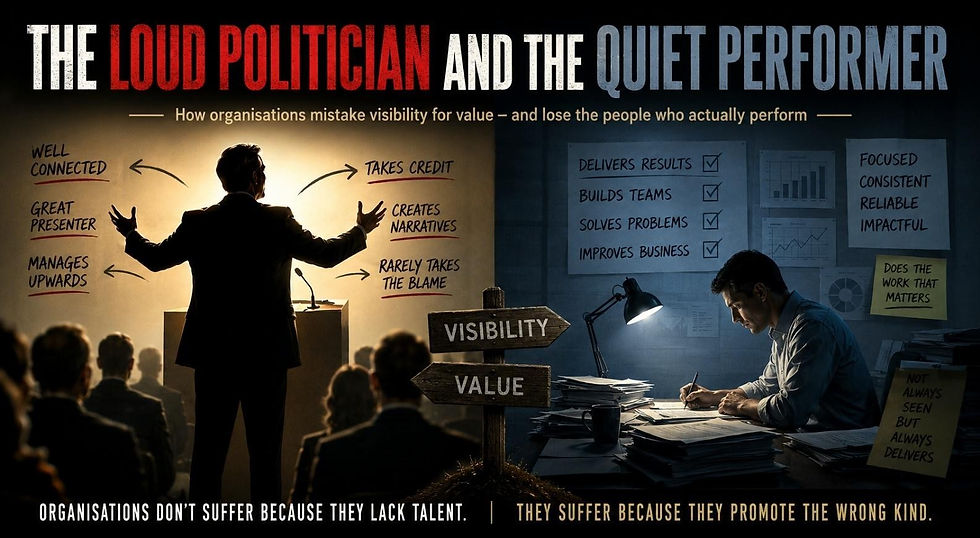
I have spent enough years in corporations, consulting firms, private businesses and boardrooms to recognise two very different kinds of executives. One is highly visible, highly articulate and very good at managing upwards. The other is usually somewhere inside the business solving problems, building teams and delivering results. Trouble begins when an organisation confuses the visibility of the first with the value of the second.
What is a corporate politician?
The corporate politician understands hierarchy, power and timing. When transformation becomes fashionable, they become the champion of transformation. When cost reduction becomes the priority, they become the cost-reduction expert. When innovation becomes the language of the month, suddenly everything they do is innovative.
That does not make visibility or communication bad. Senior executives need influence, relationships and the ability to explain what they are doing. The problem begins when the story becomes more valuable than the substance behind it.
There is even research suggesting why confidence can be so powerful. Studies led by Cameron Anderson and colleagues found that overconfident people can gain higher social status because others perceive them as more competent, even when the confidence exceeds their actual ability. In other words, organisations are not imagining the effect: confidence can look remarkably like competence from a distance.
Why quiet performers get overlooked
Quiet performers often make a fundamental career mistake: they assume performance speaks for itself. Unfortunately, performance does not always speak. Sometimes somebody else speaks for it.
The operator thinks the numbers will be enough. The politician understands that the story around the numbers can be almost as important as the numbers themselves. While one person has been fixing the customer problem, rebuilding the team or protecting the margin, another may be presenting the result to senior management.
I saw a memorable example during my consulting career. A senior principal made a roughly 40-minute trip across Sydney every Sunday to attend the same church as a senior US partner. There was only one small complication: neither he nor his family belonged to that denomination. Perhaps it was a genuine spiritual awakening; I cannot know. But after months of dedicated Sunday attendance, he was promoted ahead of colleagues who were bringing substantial revenue into the practice.
The commercial lesson was less amusing than the story. Several strong performers looked at the decision and concluded that relationships appeared to matter more than results. Some eventually left, and revenue left with them. Organisations teach people what they value through the people they reward.

How corporate politics changes the narrative
At senior levels, corporate politics is rarely as obvious as someone saying, “John is useless.” It is more sophisticated. A concern is raised softly: perhaps John is “not ready for the next level” or there are vague questions about whether he is “strategic enough.” No clear accusation is made, so there is nothing obvious to rebut.
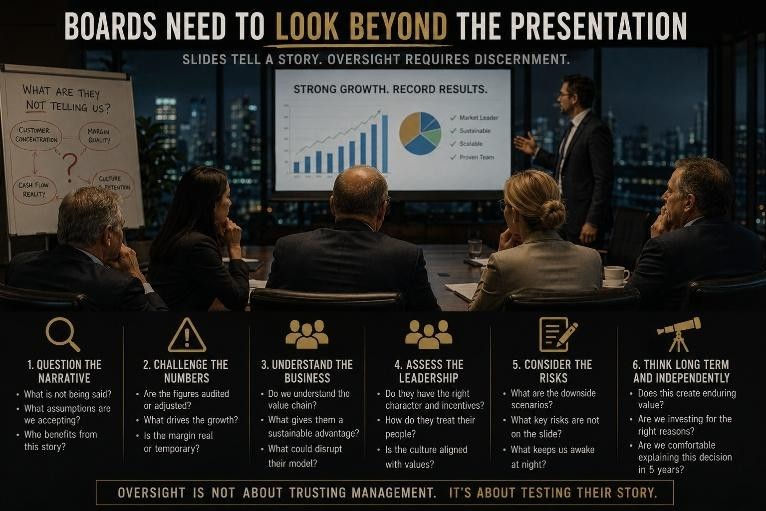
Repeat that process often enough and a strong executive can become a “concern” before they even realise a campaign exists. This is why governance matters. Boards and CEOs should be wary when criticism is vague, evidence is thin and the narrative seems to move faster than the facts.
I have also seen another version of the same technique: when a senior executive is asked difficult questions about performance, the conversation gradually shifts from the questions themselves to the person asking them. Oversight is recast as interference, while challenge becomes “lack of alignment.” The question changes from “Is management performing?” to “Why is this person causing trouble?”
That is precisely when leaders should become more curious, not less. Good governance is often uncomfortable because accountability is uncomfortable.
Why talented people become a threat
Strong leaders want talented people around them, while political leaders often prefer loyal people around them. There is an enormous difference. Independent performers ask questions, remember what was promised six months earlier and notice when numbers do not add up.
Their credibility comes from what they deliver rather than who they know, and that can make them difficult to control. Over time, these people may acquire familiar labels: “difficult,” “not collaborative,” “not strategic enough” or “not ready.” Some adapt, while others leave.
The organisation then suffers twice. It loses the person creating value and retains the system that helped drive them out.
When politics becomes culture
The real danger is not one political executive. It is what happens when political behaviour becomes the organisation’s promotion system. People watch who gets promoted, who gets access to the CEO, whose mistakes are forgiven, who receives credit and who gets blamed.
If promotions depend more on alliances, visibility and managing upwards than on delivery, behaviour changes quickly. Some people learn to play the game, while others decide the game is not worth playing.
After several cycles, management can become populated by people who are excellent at understanding what the boss wants but increasingly poor at telling the boss what the business needs. Meetings become more agreeable, presentations become better, bad news becomes softer and difficult questions disappear. Everyone seems aligned, and that apparent harmony should sometimes terrify a board.
What boards and CEOs should look for
Boards cannot see everything happening inside a company, so they should deliberately look beyond polished presentations. Ask which high performers are leaving and why. Look at which executives consistently develop talented people and which repeatedly seem to have “people problems.” Compare forecasts with outcomes, not simply with the latest explanation.
Most importantly, ask a simple question: what has this executive actually built? A genuine performer leaves behind stronger people, better systems, deeper customer relationships, improved economics and an organisation that is more capable than the one they inherited.
Quiet performers also have a responsibility. Doing the work is not enough if nobody understands what has been achieved. They should communicate, build relationships and make sure senior leaders understand the contribution of their teams. Visibility should amplify performance; it should never replace it.
Performance must ultimately win
Politics will always exist in organisations. Senior executives need emotional intelligence, influence and an understanding of organisational dynamics. Those skills should support performance, not substitute for it.
Organisations eventually become what they reward. Reward accountability and people take responsibility. Reward genuine performance and strong operators want to stay. Reward visibility, loyalty and political manoeuvring, and eventually you create an organisation full of people who know how to explain the business but too few who know how to run it.
The next time a promotion, succession decision or senior appointment is discussed, look beyond who presents best in the room. Ask what they built, who became better because they led them, and whether the organisation was stronger because they were there. That is usually where the real performer can be found.
Read more from Dr. Hussein H. Rifai
Dr. Hussein H. Rifai, Thought Leader and Chairman
Dr. Hussein H. Rifai is a global business leader, investor, company chairman, and thought leader with more than four decades of experience across 85 countries. His career spans multinational corporations, entrepreneurship, investment banking, private equity and corporate governance, advising boards and business leaders on strategy, mergers and acquisitions, capital raising, business transformation and international growth. Holding a Doctor of Philosophy (PhD) in Business Administration, Hussein writes on leadership, corporate governance, artificial intelligence, international business and global competitiveness, combining academic insight with practical experience gained at the highest levels of global business.


