The 4 Things You Want From Your Home and Never Say Out Loud
Written by Inbar Lee Hyams, Feng Shui Consultant
Inbar Lee Hyams is a BTB feng shui practitioner in Haifa, Israel, who reads clients' homes and writes Shui-ish, a newsletter that mashes up feng shui with the weekly portion of the Hebrew Bible. She spent twenty years as a copywriter in Israel's startup world and holds an MA in Creative Writing.

You want something from the place you live, and it's bigger than a place to keep your things. Most people never say what it is out loud. The ask gets made the day you choose the place, wordlessly, and then you hang the shelves, get busy living, and never go back to it.
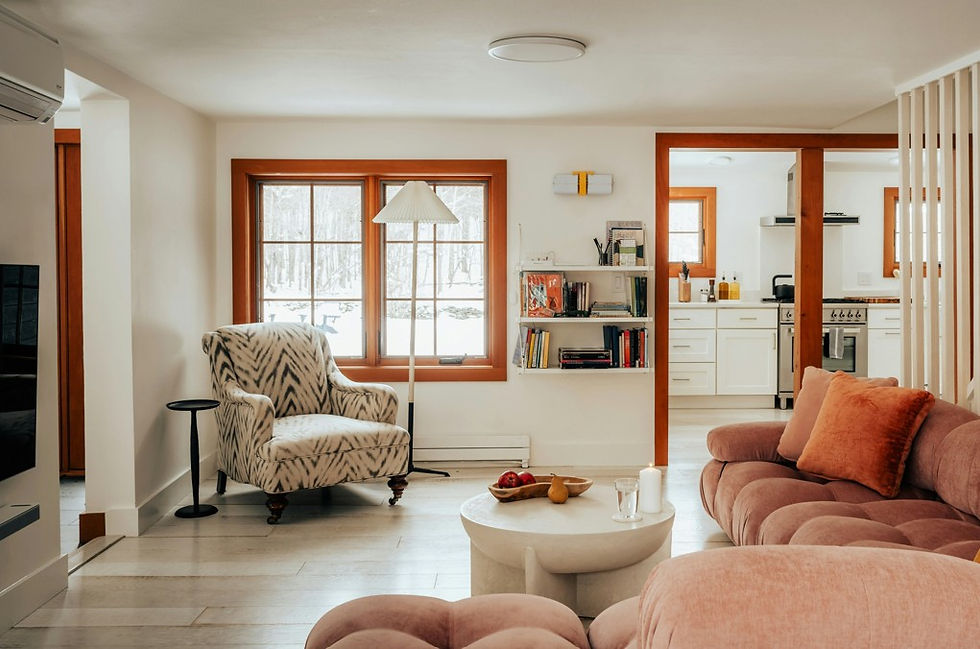
What is a home actually for?
I've lived in 27 homes across three states and two countries, which is 27 chances to notice what I wanted from a place before I finished unpacking. It took me most of them to work out that I was asking for the same four things every time.
Becoming. You chose the place as a bet on yourself. You thought you'd be calmer here, or more social, or more focused, closer to the person you mean to be. The desk in the corner was going to make you a writer. The long table was going to make you someone who hosts.
Witness. Your home sees the version of you that nobody else gets, at the hours when you've stopped performing. You don't dress for it, and you don't explain yourself to it. It knows how you actually eat dinner.
Provision. That there will be enough inside these rooms, and that you'll be taken care of here. This is the one people are least likely to name and most likely to feel, usually in the kitchen, usually at the end of a month.
Continuity. Jobs end, children grow, people leave, bodies change. The walls stay where they are. When my household went from one person to three humans, two dogs, a cat, and a bowl of fish in 860 square feet, I stopped asking the apartment to be beautiful. I needed it to hold still while everything else rearranged itself.
Why the ask changes while you're not looking
None of these is permanent. You might have wanted refuge when you arrived, worn out from whatever you were leaving, and now need those same rooms to let people in. The home doesn't know that. It faithfully keeps the promise you stopped needing, which is a strange kind of loyalty and easy to mistake for the place being wrong.
The person who chose this apartment is not the person living in it now, and won't be the one living in it next year either.
When I read houses professionally, I ask people what they want from the room we're standing in. Most of them have to think about it, and a fair number end up describing something they needed a while ago. Often the ask was never said out loud to begin with. The place picked it up anyway: which room got the good light and how many chairs stayed around the table.
What you have with your home is not a contract
Rabbi Jonathan Sacks returned to the difference between a contract and a covenant across decades of writing, using it for marriage and for national politics.
A contract is an exchange. Two parties each want something, both state their terms, both deliver, and once the terms are met, the thing is finished. It handles a purchase well and a life badly.
A covenant works differently. Sacks describes it as a bond of loyalty in which people come together "to do together what neither can achieve alone." Not an exchange of goods, but a joining of two parties who then find out together what it will require of them. He compared it to a marriage rather than a transaction.
That second one is what's running in your house. You never gave the place a list of terms. You moved in, and the two of you started doing something neither of you could have done alone, and neither of you signed anything.
Which is why the mismatch doesn't get solved by moving. You renegotiate a contract when the terms stop serving you. You renew a covenant, which is a different action, and it's the one almost nobody performs on a home.
One tradition scheduled the renewal
There's a scene near the end of Deuteronomy where an entire nation stops to renew a covenant that was already working. Leaders and elders and officials, and in the same list without a pause for rank, the person who chops the wood and the person who carries the water. Everyone, standing.
Nothing had gone wrong with the agreement. What had happened was that forty years had passed, and Moses was near the end of his life.
Sacks read this scene as the moment the initiative changes hands. God started every earlier covenant in the Torah. Here, Moses appears to start it himself, without being told to. Sacks traces the escalation: nothing was asked of Noah, a gesture was asked of Abraham, and at Sinai the people were asked for their consent before the terms were given, three separate times. By Nitzavim, the human side convenes.
The text then extends the covenant to those standing there and also to those who are not there that day (Deuteronomy 29:13-14). Jewish tradition has read that second group as the generations not yet born. An agreement written to bind people who weren't consulted, and renewal is the mechanism by which they get to say yes to it themselves.
The Hebrew word for how they're standing is nitzavim, which is not the ordinary word for standing around. It means positioned, placed on purpose, present deliberately.
I'm not a religious person, and I came to this the way most people do: sideways, through reading. What I keep taking from it is the design. Somebody understood that agreements go quiet without failing, that the person holding one is never the person who made it, and that the only fix is to stand up once a year and say the terms out loud again. So they put it in the calendar. This passage is read every autumn in the week before the Jewish New Year, which means the renewal isn't left to whenever someone notices it's needed.
An object only works while you're still meaning it
In the school of feng shui I practice, a cure is an object placed in a specific part of a home to shift something about how it functions. A plant, a mirror, a red envelope, a chime. The object matters and the placement matters, and there's a third thing that's easy to leave out, which is what you meant by it when you put it there. Two people can hang the same crystal in the same window, one meaning something by it and the other liking how it catches the light, and get different results from an identical object in an identical spot.
Which is why placement is only the start of the job. After you set a cure, you go back to it. Nine days, or twenty-seven. Nine is the number this school treats as complete, the point at which a thing has finished becoming itself, and twenty-seven is nine three times over, used when you want more weight behind it. You return to the object and repeat the intention, and the repetition is doing something plainer than the numbers suggest. It trains your attention to keep meeting the thing you put there, and your attention is a large part of what keeps it working.
Skip that, and the object stays exactly where you left it while your end of the arrangement quietly lapses. Every home has one. The wind chime nobody has heard in a decade. The plant in the corner that died and got replaced by a phone charger, which is now the thing sitting in the spot you chose for something else.
How to renew the agreement with your home
Twenty minutes, ideally when the house is empty, and nobody is going to ask you what you're doing. Start at the front door, standing inside, facing in. In this school, the front door is where chi enters, so it's the one place worth saying anything you want the whole house to hear. Then walk the rooms one at a time and say out loud what you're asking of each one this year.
Out loud is the part people want to skip, and it's the part that works. Something happens to a vague intention when you have to put it in a sentence and hear yourself say it.
What you're naming is a quality, not a chore. Not "keep the kitchen clean." Closer to:
This kitchen feeds people who are actually hungry, and I'm one of them.
This bedroom lets me put the day down at the door. Nothing that belongs to work comes in here.
This corner is where I do my own work, and it stops being where other people leave their things.
This living room can hold more people than it currently does. I want it used.
This entrance gives me thirty seconds to arrive before anyone needs anything from me.
Each one binds in both directions. You're telling the room what it's for, and you're agreeing to let it be that, which is the harder half. Naming the corner as yours means you have to stop putting the laundry there.
Then go back. For the next nine days, walk the same route and say the same words. Once you know them, it takes two minutes, and the return is the whole point. A promise made once is something you already have and have stopped noticing.
When a room won't hold it
Some homes have trouble keeping an intention no matter how clearly you name it. You can tell the bedroom it's for sleep and still not sleep in it. You can name the corner as yours and still find it collecting everyone else's things by Thursday.
That's usually the room and not you. Something about how the space is arranged is working against what you're asking of it, and no amount of saying it out loud will outargue a floor plan. Layout, light, what's directly across from the door, what you see first when you walk in, what the room is next to. These carry more weight than most people expect, which surprises new clients most.
Worth knowing the difference. An intention that fades is yours to renew. An intention the room keeps refusing is information about the room.
Before the year gets going
Whatever you're asking your home for, you're asking it whether or not you ever put it in words. The list is different for everyone, and it changes more often than the furniture does.
The agreement is already running. The only question is whether you'll say the terms out loud this year or let the house keep guessing.
Inbar Lee writes a weekly letter about what homes are actually doing here.
Visit my website for more info!
Read more from Inbar Lee Hyams
Inbar Lee Hyams, Feng Shui Consultant
Inbar Lee Hyams moved twenty-seven times before she turned thirty and got very good at making a space look and feel good, fast. Then came apartment #28, where life lived, and the chi didn't–a place she now describes as funk shui. She went looking for an explanation and found one in feng shui. She trained in the BTB tradition with Amanda Gibby Peters and now reads clients' spaces. Her weekly newsletter mashes up feng shui, the weekly portion of the Hebrew Bible, and whatever happened in her own house that week, so readers can learn to read their own homes and change what isn't working.