

Resilience Through Neurodivergence, Chronic Illness, and OT – Interview with Rebecca Rae-Hodgson
Updated: Jul 29
Rebecca, otherwise known as The Chronically Resilient OT, is a neurodivergent and chronically ill Occupational Therapist. She uses her clinical expertise and lived experience to support other neurodivergent and chronically ill health professionals through mentoring, supervision, training, and creating resources. In this interview, Rebecca explains the inspiration behind creating her business, her definition of the word resilience, and the importance of figuring out what lights you up and finding the structures and supports that will work for your individual circumstances and way of being in the world.
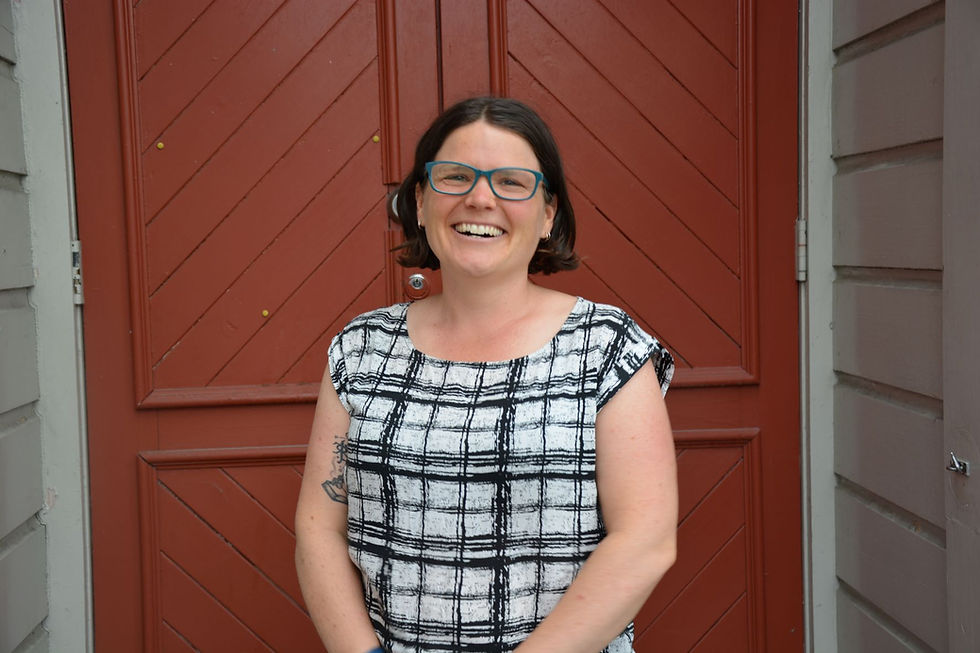
Rebecca Rae-Hodgson, Chronically Resilient Occupational Therapist
Can you share what inspired you to create The Chronically Resilient OT and how your personal experiences shaped your approach?
I started the business because working for someone else simply wasn't working for me. I couldn't fit myself into an employed role, and I tried. I really tried. So I started with a website, a Facebook page, and two clients, and very slowly began writing blogs, making graphics, and taking on a few more clients until I was eventually able to leave my employed role entirely.
"I couldn't fit myself into the shape of an employed role."
That was the beginning. What's evolved since then is a whole other layer. I started the business before I knew I was neurodivergent, and that's been a significant piece that's come in over the last three years. Looking back now, I can see clearly how my neurodivergence impacted my chronic illness, but I didn't know that at the time. What I did know was that I needed to build something around my fluctuating capacity and support needs, and that the traditional model of work just wasn't built for my brain and body. That realisation became the foundation of everything I do. I have built my business around fluctuating capacity, not despite it.
How would you describe your core philosophy around resilience and what it truly means to thrive while living with chronic illness?
The first blog I wrote was about why I chose the word resilience, Welcome to Chronic Resilience. I think about it as soft resilience. It's not about taking all the knocks and getting back up. It's not about pushing through. It's about understanding yourself, knowing your needs, and using that understanding to build a life that actually works for you.
"It's not about just being punched in the face and getting back up. It's about using supports, finding supports, and maybe there are external things you can access, to create your best life. Your version of a best life. Not the capitalist version of a best life."
I want to be honest about the fact that we are trying to live and work within systems that were not built for our brains and bodies. That is genuinely hard, and I don't want to cover over that difficulty with overly positive language. But it also doesn't mean we can't live a good life. It just means our version of a good life might look very different from what we were told it should look like, and that's okay. In fact, I think that redefining of what a good life looks like is often where the real freedom is.
For me, thriving means feeling safe in the place I live, being able to spend time in nature and with my dog. It means making a difference, that's one of my core values. It means doing that authentically, by sharing my story and my experience and using my skills to help other people. Things don't stay static with chronic illness, it's an ongoing, often repeated journey of adjusting and readjusting. Resilience, to me, is having the tools and the self-knowledge to keep doing that, pausing when needed and being kind to yourself.
How does your dual perspective as a clinician and someone living with neurodivergence and chronic illness influence the way you mentor and supervise other health professionals?
I think it gives me a level of insight that's hard to come by any other way. I'm not just drawing on theory, I'm drawing on lived experience. The supports and concepts I talk about aren’t just something I’ve learned about in a book, they are things I use and practice in daily life. I use my lived experience and clinical knowledge to explore with people what supports might work for them and help them to understand what they need, based on their own lived experience.
I think that's where bringing in the occupational therapy lens is genuinely powerful, because looking at the person, their environment, and how they spend their time allows me to be more flexible. I might share a personal story if it's relevant and I think it's helpful, because disclosure can be a really powerful tool. But it has to be done intentionally and for the right reason. It's not about me. It's always about what will serve the person in front of me.
What are the most common misconceptions about neurodiversity-affirming practice that you encounter among clinicians?
The biggest one is that being neurodiversity-affirming means throwing away diagnoses. It doesn't. The diagnostic labels we use sit within the pathology paradigm, that's the medical system we're working within, and we're not pretending otherwise. But what we can do is shift our language. Instead of symptoms, we might talk about experiences. That matters, because language shapes how people understand themselves. We can work on making that shift from medical model thinking that sees the individual as the problem, to more of a social model perspective, where the environment is the problem. You can learn more about what I mean by Neurodiversity-Affirming Practice for Mental Health in this blog.
The other thing I want to be really clear about is that changing the language is not about minimising support needs. Those needs are still very real and very valid. But if we get too fixated on the label and start putting people in boxes, we miss things. The freedom I have as an OT is that my role isn't to diagnose, it's to stay curious, explore, discover and find ways to support participation. Someone's personal experience is always more important to me than the label they might hold. I also want to name the very real challenge of trying to be neurodiversity-affirming within systems that are, at times, diametrically opposed to these ideas. That difficulty is real, and I don't want to gloss over it.
"We are working within medical model pathology paradigm systems that do not support these ideas, but that doesn't mean we shouldn't try."
How do you see occupational therapy evolving to better support neurodivergent adults and those managing chronic conditions?
We need to break down the silos. There are OTs working in the Autism and ADHD space, and there are OTs working in the chronic illness space, and the two worlds don't talk to each other nearly enough. It's still quite unusual to find practitioners working at that intersection, and that's the gap I was trying to fill working as an OT.
I am now focusing on supporting other health professionals who are working in this overlap space, as a lot of people working in that space have lived experience of these conditions. Support from someone like me, who also has lived experience, can be hugely useful.
There's also this big divide between physical and mental health OT, and I think that split does a disservice to the people we support. We're working with people who have complex, whole-person presentations. Someone's sensory processing affects whether they can get to the supermarket. Their executive functioning affects whether they can hold down a job. Their chronic illness affects their capacity to engage in every occupation that matters to them.
We can't keep separating these things out as if people are made up of discrete clinical categories. We are always, always coming back to occupation, how people spend their time, what gives their life meaning, and what they want to be able to do.
What practical strategies do you recommend for health professionals to balance resilience, self-compassion, and rest in demanding work environments?
Little moments count. That's the thing I come back to again and again. If you haven't taken a deep breath all day, pausing to take one is still something for your nervous system. Stepping outside and looking at a tree is still something.
We tend to think of rest and self-care as things that need to take up a lot of time, and they can if you have that time. But most of us don't. So I talk about what I call rest snacks, brief, intentional moments of rest woven through the day. If you can do those, you are still supporting your nervous system.
Rest is also so many things, not just lying still with your eyes closed. In fact, for some people, that is more distressing. So it’s about finding what is restful for you. I talk more about this concept in this blog on Different Kinds of Rest.
"Little moments count. Pausing to take one deep breath, if you haven't taken a deep breath all day, is still something for your nervous system."
The other piece is that what works for one person will be completely different from what works for another. There's no universal prescription here. That's actually the whole point of the work I do, it has to be individualised.
Part of that individualisation is understanding your values. When you know what actually matters to you, not what you think should matter, but what genuinely does, it becomes a lot easier to make decisions about where to put your limited energy.
How can clients incorporate sensory modulation, values exploration, and executive functioning techniques into their daily routines to build self-efficacy?
With sensory modulation, I often talk with clients about creating a sensory menu, which is a range of strategies they can draw on throughout the day. An important thing to understand is that sensory modulation isn't just about calming down. It's about matching your level of arousal to what you actually need to do.
First thing in the morning, you might need alerting strategies to get going. In the evening, around bedtime, you'll want calming ones. Having a portable sensory kit, mine lives in a pencil case in my bag, means those strategies are actually accessible when you need them. I write more about Sensory Processing Patterns in this blog.
With executive functioning, I start by breaking down what it actually is, because there are so many components, and people often have a vague sense that they're struggling without understanding why. We might look at some of the components, such as organisation, planning, prioritising, task initiation, and emotional regulation. Then we figure out what will work for that specific person in their specific context, taking into account their environment and roles, such as whether they're a parent, a partner, a carer, what their work demands are, and so on.
With values, I sometimes start there and sometimes I don't, because it can be confronting if someone realises how far away their life is from what they actually care about. But when the timing is right, it can be transformative.
I ask things like, "What gets you out of bed in the morning? What kind of person do you want to be? What are the driving forces in your life?" When motivation comes from meaning, and that meaning is self-directed, it works so much better than when someone else is trying to direct you. One of my first blogs was called Exploring Your Values, and I think it’s such an important topic.
In what ways do you help clients translate occupational therapy principles into meaningful, everyday life improvements?
A lot of what I do is what I call “helping people OT themselves.” We break tasks down, we look at where they’re getting stuck, and we ask why something is important to them. We look at the environment, the occupation, the task, and the person’s skills, and we figure out where the fit isn’t working and what needs to shift.
One of the models I use a lot is the Person-Environment-Occupation, PEO, model, because it’s accessible and most people can understand it intuitively. It helps people see that when something isn’t working, the problem isn’t necessarily them. It might be the environment, the task design, or the mismatch between the two.
When I’m working with supervisees or mentees who are OTs themselves, we might use the OT language directly. When I’m working with someone who isn’t an OT, I’ll translate it into whatever makes sense for them. The language matters less than the concept. It’s always about supporting people to figure out what works for them, where the barriers are, how to get to where they want to go, and what’s important to them.
What is one key takeaway you hope both professionals and clients gain from your work and approach to chronic resilience?
That there is no cookie-cutter approach. I would love to be able to hand people a list, like here are the ten sensory strategies, here are the executive functioning tips, but I don’t do content like that, because it doesn’t serve people. The work is too individualised for that.
I also think it’s important to work out where you can make an impact and how to make the most of limited energy while focusing on sustainability. I thought about this a lot when shifting my practice to focus on mentoring, supervision, and ways to create the biggest ripple effect from the work that I do. If I can only see four people in a week and those four people are health professionals who all hold caseloads, then my impact is exponentially bigger.
“If I can only see four people in a week and those four people are health professionals who all hold caseloads, then my impact is exponentially bigger.”
What I hope people take away is this, figure out what works for you. Figure out what’s getting in the way of where you want to go, and figure out what needs to change to get there. Then figure out what lights you up, what genuinely gives you energy and meaning, and follow that. That looks different for every single person. But it is always, always worth finding out.
“Figure out what it is that lights you up, and find those things and follow.”
If you’d like support figuring this out, you can find out more about me, what I offer, and how to book an appointment or contact me through my website.
Read more from Rebecca Rae-Hodgson


