Reclaiming Trust, Consent, and Physiological Birth in an Authoritarian Medical System
Anne Wallen is a respected figure in women’s health with over 30 years of experience and is a leading voice on global change in maternity care, particularly for those at greatest risk.

One of the most important questions in maternity care is rarely asked directly, "Who is in charge?" Many people assume the answer is obvious. Some believe it is the physician. Others point to hospital policy, clinical guidelines, or institutional protocols. Yet when we step back and examine the purpose of maternity care, the answer becomes much simpler. The woman giving birth is in charge.

Not because she possesses more medical knowledge than her care team. Not because expertise is unimportant. Not because every birth unfolds perfectly. But because it is her body, her baby, her experience, and her life. Every other person in the room is there in a supportive capacity.
This simple truth has profound implications for how we communicate, how we make decisions, and how we approach birth itself. Unfortunately, modern maternity care often operates from a different assumption. that birth is safest when managed, directed, controlled, monitored, regulated, and corrected at every turn.
Yet birth is not a machine that performs better under constant supervision. Birth is a physiological process, and physiological processes rarely improve when they are micromanaged.
The problem with control
Human bodies are remarkably intelligent. We trust the body to heal wounds. We trust the body to digest food. We trust the body to regulate temperature. We trust the body to fight infection. Yet when it comes to birth, many systems operate from the assumption that the body cannot be trusted to do what women have done since the beginning of human history.
The result is often a cascade of management strategies designed to control a process that was never intended to be controlled. Women are told when to push. How to breathe. When to move. When not to move. When to eat. When not to eat. When to make decisions. How much time they are allowed before a decision must be made. The message becomes subtle but clear, “We know better than your body.”
The irony is that many of the hormones responsible for effective labor function best in conditions that are incompatible with control. Oxytocin thrives in safety. Endorphins thrive in relaxation. Labor progress often improves when a woman feels secure, supported, and free to follow her instincts. This is why home is a preferred location for birth for many women around the world.
Fear, surveillance, pressure, conflict, and coercion activate entirely different physiological pathways. When we attempt to dominate physiology, physiology often responds by becoming less efficient. This is not because women are failing. It is because birth was never designed to perform on command.
The myth of compliance
Too often, communication in maternity care is aimed at achieving compliance rather than understanding. The goal becomes obtaining agreement rather than facilitating informed decision making. A recommendation is presented. A risk is emphasized. An alternative is minimized. A timeline is shortened. A policy is cited. Eventually, the woman says yes.
The chart reflects consent. But was it informed consent? Or was it compliance?
There is a meaningful difference between helping someone understand their options and persuading them toward a preferred outcome. True informed consent respects the possibility that an informed person may make a different choice than the provider would make. That can feel uncomfortable. But autonomy loses its meaning if it only exists when everyone agrees.
The CLEAR framework: A better way forward
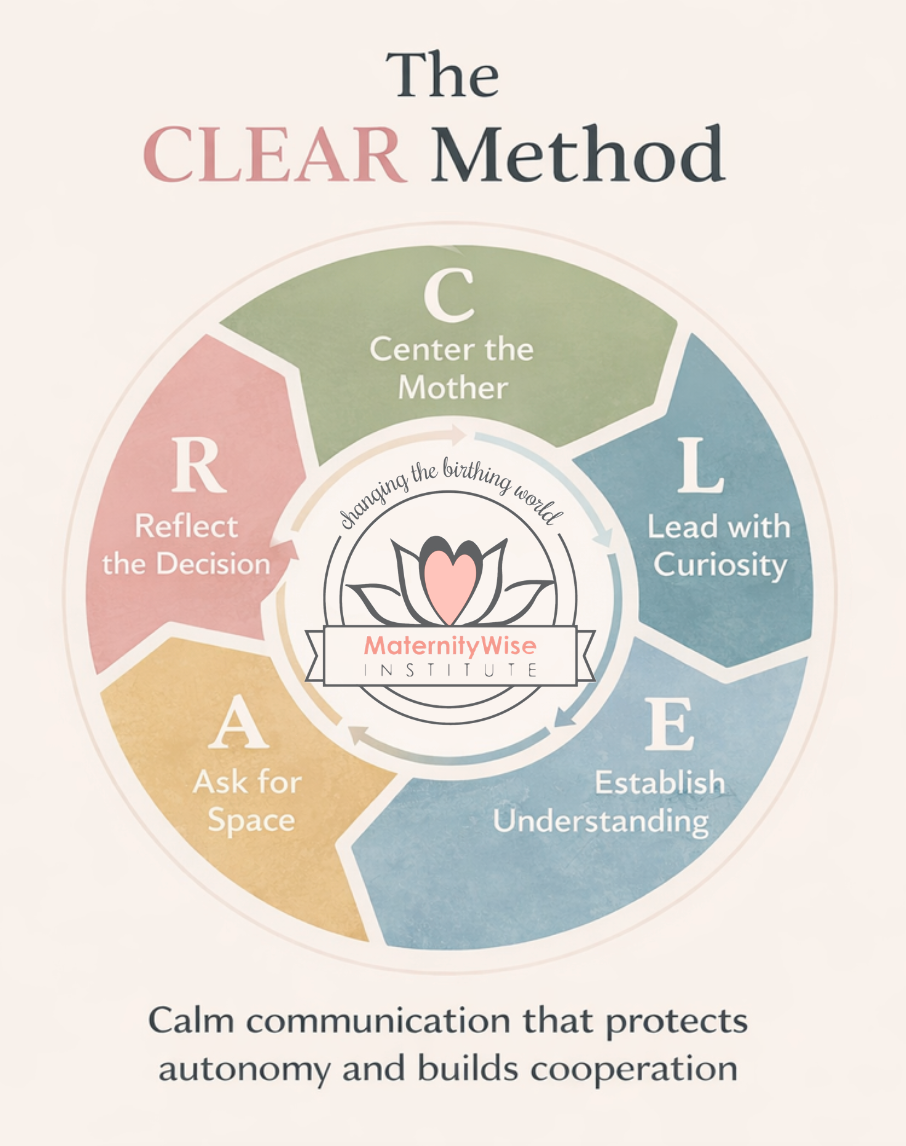
At MaternityWise, we teach the CLEAR Framework as a model for creating communication that preserves trust, autonomy, and collaboration.
CLEAR stands for:
Centering the birther: Collaborative attitudes
Lead with curiosity: Listening well
Establish understanding: Educate and discuss
Ask for space: Preserving autonomy, and reflect the decision
Respectful framing of the Patient’s Choice.
These principles shift the focus away from control and toward partnership.
Centering the birther: For collaboration
Birth is not a hierarchy. It is a team effort. The physician brings expertise. The midwife brings expertise. The nurse brings expertise. The doula brings expertise. The partner brings intimate knowledge of the mother. Most importantly, the mother brings something no one else possesses.
She is the only person living inside the experience. She can inform the rest of the team about things that are not measurable by devices and monitoring. Collaboration acknowledges that each perspective has value.
Lead with curiosity: Listening centered
Many providers are trained to talk. Far fewer are trained to listen. Listening centered care recognizes that information flows in both directions. Providers bring clinical knowledge. Women bring intuition, lived experience, personal values, cultural beliefs, and knowledge of their own bodies.
When listening disappears, consent becomes a lecture. When listening is present, consent becomes a conversation. Yes, conversation takes more time, but better outcomes show that it is worth it.
Establish understanding: Educational and conversational
The purpose of informed consent is education, not persuasion. Education presents risks, benefits, alternatives, and uncertainties honestly. Education empowers people to think. Persuasion attempts to direct what they think.
One creates autonomy. The other creates dependency.
Ask for space: Autonomy preserving
Giving time and space allows decisions to be made without pressure or feelings of duress. The mother’s right to choose must remain intact, even when her choice differs from the preferences of those around her. Autonomy is not something granted by a provider. It is something inherently possessed by every competent adult.
The role of the healthcare team is not to hand autonomy to women. The role of the healthcare team is to respect the autonomy women already have.
Reflect the decision: Respectful framing of the patient’s choice
Repeating the decision helps ensure that everyone understands it. Respect means honoring a woman’s humanity, regardless of whether she agrees with you. Respect means recognizing that disagreement is not defiance. Respect means understanding that questions are not challenges to authority. Respect means remembering that the person doing the work deserves dignity and agency throughout the process.
The doula as guardian of the consent process
The doula’s role is often misunderstood. Doulas do not control birth. They do not replace medical providers. They do not make clinical decisions. In many ways, the doula serves as a guardian of the consent process itself.
When fear enters the room, the doula helps restore calm. When emotions rise, the doula helps create balance. When communication becomes rushed, the doula helps slow it down. When information is incomplete, the doula encourages questions. When a mother feels unheard, the doula helps amplify her voice.
The doula is not there to tell a woman what to choose. The doula is there to help ensure that whatever choice she makes is genuinely her own.
Trusting women again
Perhaps the greatest challenge facing modern maternity care is not a lack of technology, training, or resources. Perhaps it is a lack of trust, a lack of trust in women, a lack of trust in physiology, and a lack of trust in the body’s innate wisdom.
Trust does not mean abandoning medical care. Trust does not mean ignoring complications. Trust does not mean pretending that intervention is never necessary. Trust means recognizing that intervention should serve physiology, not replace it. Trust means understanding that expertise should support women, not overpower them. Trust means acknowledging that birth is not a problem to solve, but a process to steward.
When we stop asking, “How can we control this birth?” and start asking, “How can we best support this woman?” everything changes. Communication improves. Consent becomes meaningful. Collaboration strengthens. Fear decreases. Women regain what should never have been taken from them in the first place, their rightful place at the center of their own birth experience.
The future of maternity care does not belong to greater control. It belongs to deeper trust, trust in women, trust in physiology, trust in informed decision-making, and trust in the extraordinary wisdom of the human body to do what it was designed to do.
If you’d like to be part of the difference-making movement in women’s medicine, take a look here for training and certification in doula care, midwifery, maternal health advocacy, childbirth education, and so much more!
Anne Wallen, Director and Founder of MaternityWise Intl
Anne Wallen is a respected figure in women’s health with over 30 years of experience and is a leading voice on global change in maternity care, particularly for those at greatest risk. She continues to educate and empower birth professionals in more than 20 countries, contributes to a variety of curricula, and shapes the future of maternal health through her impactful role as a speaker and mentor. Anne is the Director and co-founder of MaternityWise International, and her legacy lies in inspiring generational changes around and elevating women's healthcare worldwide.