Put Down the Phone, Pick Up Real Rest in Nature
Written by Juna Ting-Wei Chang, Forest Therapy Guide
Juna Ting-Wei Chang is a forest therapy guide and founder of Shinrin-Yoku Taiwan, specialising in evidence-based forest therapy and Shinrin-yoku. She supports individuals and organisations in slowing down and gently returning their attention to themselves and the more-than-human world through nature.

Rest should come naturally, yet asking for it can take courage. Here is why scrolling doesn’t always provide the rest we need, and a handful of easy ideas for resting in nature on your own, with friends, or with kids. Be honest: when did you last rest without feeling you had to earn it first? Rest should be one of the most natural things in the world. Nobody has to teach a cat to nap in a sunbeam. Yet for many of us, asking for rest takes courage, and we end up apologizing for needing it. So let’s start with a small rebellion.
Resting is not wasting time. It is a necessity for getting back into balance. Think of a phone you would never dream of running at 1% all week. Yet that is exactly how many of us treat ourselves. Rest is not a reward for finishing everything. It is how we come back into balance in the first place.
Why your evening show and scrolling don’t quite count
“But I rest every night,” people tell me. “I watch my soap opera. I scroll a little.” The body is still, so it feels like rest. The mind, though, may be working as hard as ever.
Psychologists describe two kinds of fascination. Hard fascination captures so much of our mental bandwidth that little is left to reflect or let the mind wander.[1] So when we watch a drama or scroll a feed, the body may relax, but the mind keeps working: following the plot, reacting, taking in the next thing, and the next. In everyday terms, it can feel like rest while still keeping the mind occupied, which may help explain why we can end a whole evening on the sofa feeling just as drained.
Soft fascination is different. It engages us without effort, so that the tired attention system can rest while we still feel gently interested.[1]
2 ways attention gets held
Hard fascination: a gripping drama, a thrilling video, an endless feed. Always pulling you to the next thing.
Soft fascination: clouds drifting, leaves moving, water flowing. Interesting enough to look at, quiet enough to let you rest.
Researchers tested what happens when a break involves a screen. In one study, 81 participants took a break of 15 minutes in a green space or a barren one, with or without a laptop for leisure use such as social media, YouTube, or games. Only those who rested in a green space without a laptop showed a significant improvement in attention afterward. The other groups showed no significant improvement.[2] The study didn’t test soap operas, but it raises a question: if something keeps your attention firmly hooked, how much rest is your attention getting?
Easy ideas: Rest in nature, your way
You don’t need special gear, a summit, or any experience. A park, a riverside, or even a few trees in a schoolyard will do. Leave the phone in your bag, and pick whichever idea sounds the least like hard work.
On your own
The sit for ten minutes: Choose a spot, sit down, and have no goal at all. Let whatever happens be the whole plan.
The curiosity walk: Stroll until something catches your eye, then stop. Stay with it for as long as it keeps you interested.
Count the sounds: Close your eyes and see how many layers of sound you can find, near, far, high, low.
Visit a tree: Pick one tree and return to it once a week. Notice how it changes, and how you do.
With friends
Silent first, talk later: Walk together without speaking for a while, then share one thing each of you noticed.
The picnic without phones: Everyone’s phones go in one bag. Bring snacks, sit on the grass, and see where the conversation goes.
Take turns leading: One person offers a gentle invitation, such as “find something that moves,” and everyone explores on their own before regrouping.
With kids
The snail walk: Move as slowly as a snail and see who notices the most things along the way.
Sensory treasure hunt: Find something soft, something rough, something that smells good, and something that makes a sound.
Cloud and leaf watching: Lie back on a blanket and tell each other what the clouds or the leaves look like.
Sit like a deer: Sit very still for a few minutes and count how many creatures, big or tiny, come into view.
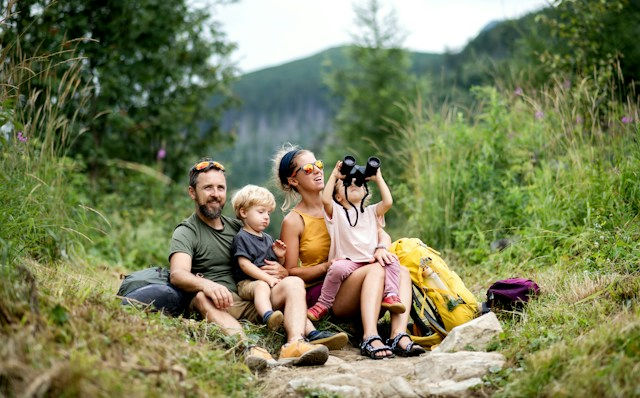
With little ones, choose a safe spot and keep watch as you normally would. The aim isn’t to teach them anything, and there is no right or wrong. It is simply to give everyone permission to slow down and “be.”
Start small
You don’t have to wait for a free weekend. Try ten minutes this week, and notice what it feels like to rest without earning it. If it turns out to be harder than it sounds, that is completely normal, and it is exactly why guided walks exist!
Read more from Juna Ting-Wei Chang
Juna Ting-Wei Chang, Forest Therapy Guide
Juna Ting-Wei Chang is a forest therapy guide and founder of Shinrin-Yoku Taiwan, now part of Green Shower. She is the first Taiwanese guide certified by the Association of Nature and Forest Therapy (ANFT) and also holds the Taiwan Forest Therapist Certificate. With a background in languages, cross-cultural experience, and landscape and recreation management, Juna brings science, tradition, and lived experience together in a warm, grounded way. Her work supports individuals, organisations, and international groups in cultivating emotional resilience, presence, and sustainable wellbeing through nature-based practices.
References:
[1] Basu, A., Duvall, J., & Kaplan, R. (2019). Attention restoration theory: Exploring the role of soft fascination and mental bandwidth. Environment and Behavior, 51(9, 10), 1055 to 1081.
[2] Jiang, B., Schmillen, R., & Sullivan, W. C. (2019). How to waste a break: Using portable electronic devices substantially counteracts attention enhancement effects of green spaces. Environment and Behavior, 51(9, 10), 1133 to 1160.