Parents & Feelings and Why Every Child’s Emotional World Deserves to Be Heard
Written by Marianne Van Oyen, Psychologist | Author
Marianne Van Oyen is a psychologist in private practice with over 30 years of experience. She is a published author with three books to offer those who wish to expand their knowledge and skills by implementing her tools and insights. Marianne brings a blend of intuition, creativity, and psychology to her work.

While on a recent car ride, I was listening to the radio, 92.5 FM to be exact, when I heard an alarming piece of news stating that the Kids Help Line was being used in the wee hours of the morning, with a distressed call reaching the help line every 90 seconds.
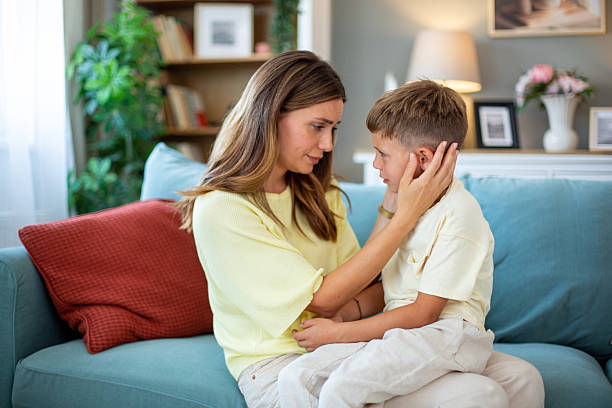
“Children don’t need parents who never make mistakes. They need parents who are willing to understand the feelings behind the behaviour.”
That is disturbing, and I guess many parents have no clue. Not because they don’t care, but because they may be too exhausted, stressed, distracted, or disconnected, or may not understand their child’s emotional needs and landscape. Some kids don’t want to alarm their parents, so a confidential help line feels safer. Some kids may feel that their parents don’t understand them or, worse, may ridicule them for being stressed and sensitive. The main reasons cited for the calls were the news and the pressure of social media and its content. Peer pressure and social influence have always been sources of stress for young people. However, they now have a global platform, making the impact more powerful. Hence, there is a need to educate and restrict who has access to social media.
Every child enters the world with feelings before they have words.
Before children can explain what they need, they communicate through crying, smiling, laughing, reaching, protesting, withdrawing, and seeking comfort. Emotions are a child’s first language. They are not signs of weakness, manipulation, or poor behaviour. They are messages.
As parents, we become the first interpreters of those messages.
The way we respond to our children’s emotions will influence not only their behaviour today but also how they see themselves, build relationships, manage stress, and navigate life for years to come. Yet, despite the importance of emotional development, many of us were never taught how to respond to feelings in a productive way, whether our own or our children’s.
Most parents deeply love their children. The challenge is that love alone does not automatically teach emotional intelligence. We parent largely based on what we experienced ourselves. If our feelings were ignored, criticized, or punished, we often repeat those patterns without realizing it.
The good news is that emotional awareness can be learned at any stage in life. When parents learn, children benefit.
Feelings are information, not inconveniences
Imagine driving a car with disconnected dashboard warning lights. The engine may be overheating. The oil may be dangerously low. The problem doesn’t disappear just because the warning light is covered. Our emotions work much the same way.
Feelings are our internal guiding system, along with our intuition and energetic messages from our bodies. They alert us to what is happening within and around us. Fear warns us of potential danger. Sadness tells us something valuable has been lost. Anger often signals that a boundary has been crossed. Joy reminds us of connection, meaning, and love.
Children feel these emotions just as intensely, and maybe even more intensely, than adults do because they have little life experience to draw on and no embedded defence mechanisms. They also don’t have the brain development or emotional vocabulary to make sense of what they are feeling. They borrow our nervous systems until they develop their own. That is why parents matter so profoundly.
Behaviour is the language, feelings are the message
One of the greatest mistakes we make in parenting is believing that behaviour is the problem. Usually, behaviour is simply the visible expression of an invisible emotional experience. A child who screams is overwhelmed. A child who refuses to cooperate may feel powerless. A child who withdraws may be anxious. A child who hits may lack the words to express frustration.
When we focus only on stopping a behaviour without understanding the feeling underneath, we may silence the symptom while leaving the real issue untouched. This is much like treating a fever without investigating the infection causing it.
Children need guidance for their behaviour. But first, they need someone willing to understand what the behaviour is trying to communicate.
When feelings are dismissed
Many well meaning adults unknowingly send messages such as, “You’re fine.” “Stop crying.” “Don’t be so sensitive.” “Big boys don’t cry.” “There’s nothing to be upset about.”
Although these statements are often intended to comfort, children may hear something different, “My feelings don’t matter.” “Something is wrong with me.” “I shouldn’t feel what I feel.” “If I express emotions, I lose connection.”
Some of these thoughts become internalized negative cognitions that become embedded in the psyche and nervous system, only to misguide children on their journey through life and haunt them in adulthood. They may not even realize this is happening, yet they wonder why they feel bad and think negatively about themselves, often finding themselves repeating negative patterns that they can’t seem to break.
Over time, children may begin suppressing rather than processing emotions. Unprocessed emotions rarely disappear. Instead, they can turn into negative thoughts about the self and be believed as true. These negative cognitions interfere with a healthy internal GPS. Often, these suppressed emotions and negative cognitions can reappear as anxiety, perfectionism, anger, depression, withdrawal, people pleasing, addictions, relationship difficulties, or physical symptoms. I know; I see this every day in my practice. The emotional pain changes form. It does not simply vanish.
Parents are emotional leaders
Children do not need perfect parents. They need emotionally available parents.
When children become overwhelmed, they are not looking for someone to solve every problem. They are looking for someone who can remain calm enough to help them feel safe. Calm is contagious. So is anxiety. Children constantly study our emotional responses. If we react with panic, they learn panic. If we react with anger, they learn anger. If we remain calm while acknowledging difficult feelings, they gradually learn that emotions, even intense ones, can be experienced safely without becoming overwhelming. This is how emotional resilience develops.
The difference between validation and permissiveness
One of the greatest misconceptions in parenting is that validating a child’s feelings means agreeing with their behaviour. These are two very different things. A child may feel furious because they cannot have another cookie. Their anger is real. Their demand doesn't have to be granted, but it can be understood and processed.
You might say, “I can see you're really disappointed. You wanted another cookie. It’s okay to feel angry. Let’s look at when you can have another cookie, or you can have something else. Would you like some cheese or watermelon? These are healthier options than a cookie if you're still hungry.”
Notice what happens. The feeling isn't shut down; it's validated. The boundary remains firm, and two other options are presented. Children need validation and options. Positive parenting offers both compassion and leadership.
Feelings need movement
Emotions are meant to move through us. Children naturally cry, laugh, seek comfort, play, and reconnect. Healthy emotional expression allows feelings to complete their cycle.
When children learn that emotions are safe, they recover more quickly from disappointment, frustration, and sadness. When emotions are repeatedly suppressed or mocked, they tend to accumulate. Eventually, they may emerge in unexpected ways, such as explosive anger, chronic worry, withdrawal, perfectionism, physical illness, or unhealthy coping behaviours later in life.
Helping children express emotions is not encouraging weakness. It is teaching health.
The CALM LEAD method
Throughout my years as a psychologist, I have found that emotionally healthy parenting often follows four simple principles as part of my CALM LEAD process.
L: Listen before you lead
Seek to understand your child’s emotional experience before correcting behaviour.
E: Empathize while setting limits
Children need to feel understood while still learning healthy limits.
A: Acknowledge and guide
Name the feeling, offer calm support, and teach healthier ways to express it.
D: Develop resilience
Every emotional moment becomes an opportunity to strengthen confidence, learn emotional regulation, and develop trust.
Children do not need us to eliminate difficult emotions. They need us to help them navigate those emotions with understanding and confidence.
Five simple ways to build emotional health every day
Identify your child’s feelings before solving the problem.
Listen more than you speak.
Stay calm, especially when your child cannot.
Separate the child’s behaviour from who they are as a person and from their worth.
Repair after difficult moments. Every parent loses patience sometimes. Repair teaches children that relationships can heal and that feelings come and go.
A final thought
One day, your child will become an adult. Long after they have forgotten the toys you bought or the vacations you took, they will remember something far more important. They and their nervous system will remember how they felt in your presence. Did they feel safe? Did they feel understood? Did they feel accepted? Did they feel that their voice and ideas mattered? These are questions that shape emotional health for a lifetime.
Parenting is not about raising perfectly behaved children. It is about raising emotionally healthy human beings who know that all feelings are welcome, that difficult emotions can be managed, and that love remains present even during life’s hardest moments. When children feel understood, they learn to connect with and understand themselves. That may be one of the greatest gifts a parent can ever give!
If you are struggling with your parenting journey, make it easier by reading my book, Calm Parenting: Effective Strategies to Improve Cooperation, Facilitate Clear Communication, Lessen Sibling Rivalry, Avoid Meltdowns, and Promote Positive Behaviour. This book is available on Amazon.
You can also check out my four-night Reset UnYell course here. Please reach out if you have any questions or would like to book a session. Happy calm parenting.
Read more from Marianne Van Oyen
Marianne Van Oyen, Psychologist | Author
Marianne Van Oyen answered her call to serve others at the age of 21 and to help make the world a better place, one person at a time. She works primarily with adolescents, adults, and couples in person and virtually. Marianne has spent money, time, and energy in many professional development programs, learning many modalities of therapy to offer her clients the best service and results possible. She has also taken the same path to develop her skills as a writer, author, and publisher so that she can expand her reach.