Mirroring Divine Beauty – Admiring Creation Without Losing Sight of the Creator
Motise Miles is a mental wellness advocate, holistic coach, and doula who guides people through healing with intuitive wisdom, spiritual alignment, and HIPAA-informed care. She blends nurturing gardening principles, witty insight, and grounded confidence while encouraging others to water the mind and bloom with intention.

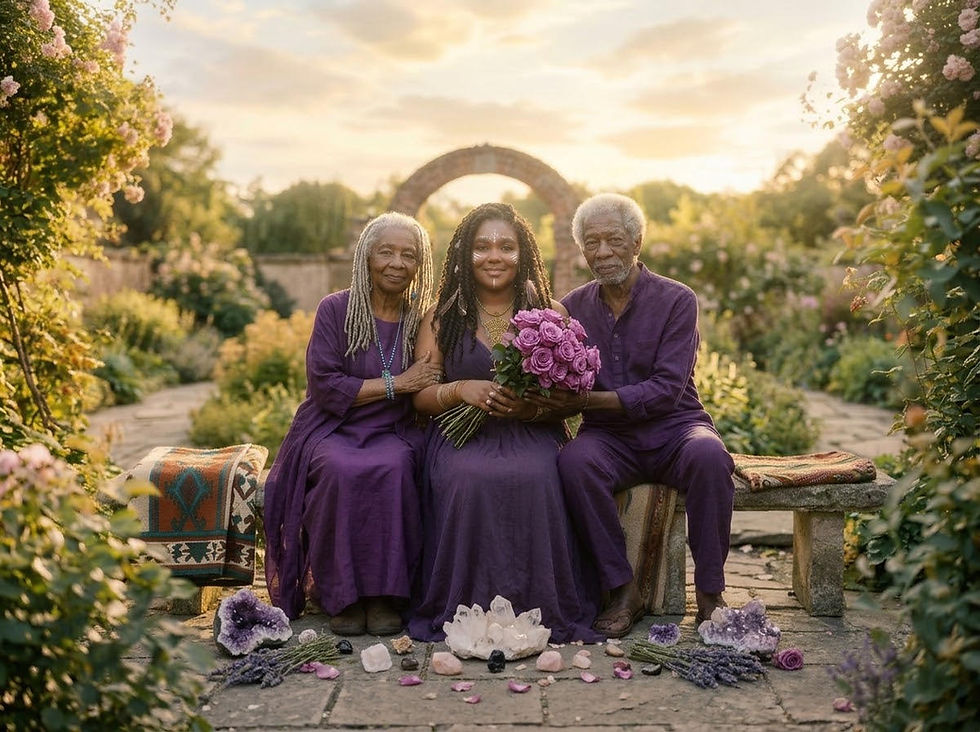
Amethyst catches the light in pale lilac and deep violet. How did a stone formed in God’s earth become something to fear rather than marvel at? What might the stars that guided Black ancestors toward freedom teach us about receiving direction from creation without making it the Source of Power? Beginning with the roots of sacred names, this reflection explores gemstones in Scripture, particular Indigenous teachings about sage and feathers, and our relationship with Earth. The image of Earth as a mother, with us as offspring of her womb, poetically expresses that belonging. Through these different stories, one question remains. How do we honor what God made while keeping our faith in the Maker?
Sacred names across languages
Before turning to creation, we pause over the names through which we speak of the Creator. Their linguistic roots offer a deeper understanding of the familiar English words we use.
The name Jesus, familiar in English prayer and worship, carries a history that reaches back to Yeshua, a shortened form of the Hebrew name Yehoshua, known in English as Joshua. Yeshua was a common Jewish name in the world surrounding His life. As the name traveled across languages, it took the Greek form Iēsous and the Latin form Iesus before reaching English as Iesu and Jesus. Each language shaped its sounds and spelling according to its own conventions. Looking back to Yeshua invites us to remember those roots while leaving room for care rather than certainty about every detail of His original pronunciation.
With God and Yahweh, the story unfolds differently. The Hebrew Scriptures preserve the personal divine name YHWH, known as the Tetragrammaton, or “four letters.” Yahweh is a widely used scholarly reconstruction of its pronunciation, though the exact ancient sound remains uncertain. Out of reverence for the sacred name, Jewish readers came to say Adonai, meaning “My Lord,” in its place. That practice helped shape the use of “Lord” in Greek and “LORD” in many English Bibles. The Hebrew word Elohim, commonly translated as “God,” belongs to a different part of this linguistic story. God is therefore not simply Yahweh reshaped into English. Understanding the distinction makes room to honor the sacred name without losing sight of what our familiar words express.
These linguistic roots remind us that familiar words carry histories worth knowing. The same attention matters when we consider creation, what something is, what it means to us, and where we place our faith. For crystals and gemstones, those questions can stir very different responses.
In wellness spaces, crystals and gemstones are often associated with peace, grounding, and inner alignment. In some circles of faith, their mention brings hesitation or concern. Between those responses, a question deserves room to breathe. Are we responding to the beauty of the mineral itself, or to the idolization people have attached to it over time?
Admiration and attribution are not the same. Recognizing the richness of what God made does not give it the authority that belongs to Him. This exploration asks no one to adopt a spiritual practice or dismiss their convictions. Scripture offers a starting point for seeing mineral beauty beyond the meanings attached to it today.
Beauty woven through Scripture
Gemstones appear in Scripture as part of sacred beauty and imagery. Their place in the biblical story offers another way of seeing them, apart from modern wellness practices.
In Exodus 28:15–21, twelve stones are set in the high priest’s breastpiece to represent the tribes of Israel. Their significance is woven into remembrance and belonging before God, rather than independent spiritual power. The stones are beautiful, but the relationship they point toward matters more than the stones themselves.
Revelation 21:19–20 describes the foundations of the New Jerusalem adorned with precious stones. Ezekiel 28:13 also brings gemstones into its imagery of Eden. In these passages, mineral beauty is not something to recoil from. It is part of the language used to convey splendor.
These scriptural images invite us to appreciate stones in more than one way.
As reminders, expressions of belonging, sacred memory, and covenant.
As beauty, color, texture, and detail that invite wonder at the Creator’s artistry.
As part of the Earth, physical materials with their own structures and uses.
Sage, feathers, and biblical reflection
That distinction between a material and the meaning it carries extends beyond gemstones to sage and feathers. Here, the conversation moves from scriptural imagery into particular cultural practices, which deserve to be understood on their own terms. Indigenous spiritual teachings differ among Nations, communities, and individuals. The examples here are particular perspectives, not a description of every Indigenous belief. Understanding that context allows reflection without reducing sacred practices to a trend or assuming that unfamiliarity means idolization. The question is not only what is held in the hand, but what relationship, intention, and belief surround it.
Sage, gratitude rooted in the land. In the Anishinaabe teachings explored here, sage carries meaning beyond its scent. It is a sacred medicine connected with renewal, cleansing, and preparation for ceremony. Giving thanks for the plant and leaving room for it to grow again are part of that relationship with the land. The language of medicine carries cultural and spiritual meaning. It is not a claim about medical effectiveness in every individual, which varies from case to case.
The Bible also brings fragrance into the language of prayer. Psalm 141:2 and Revelation 5:8 connect incense with prayer offered to God. That shared imagery creates room for reflection without making the traditions interchangeable. Sage is not identified in these passages, and smudging is not the same practice as biblical incense. This comparison invites attention to meaning within each tradition, a care that matters just as much when we turn from the plant to the feather.
Feathers, meaning beyond the material. A feather can be part of a ceremony without being understood as a deity. In the Cree practice described, a hand or feather guides the smoke during smudging, alongside prayer. Its place in the ceremony is understood through the community’s teachings. The Bible draws on feathers in another way. Psalm 91:4 pictures shelter beneath God’s wings, with His faithfulness as protection. This is an image of refuge in God, not an instruction to use a feather for protection. In both examples, the object alone reveals less than the full meaning. The place of faith within a community adds another layer to that understanding.
Faith expressed within a culture. For one Indigenous Christian community, smudging marks a call to worship the Triune Creator (the Trinity) and pray in Jesus’ name. Other communities may understand it differently, and participation in this community’s practice is a choice. That leaves room for thoughtful questions rather than quick assumptions. To whom is prayer directed? What does the ceremony mean to those taking part? What place does the plant or feather hold within it? These questions return the conversation to the relationship between creation and the Source of trust, without making different traditions interchangeable.
Many forms, a wider reflection of divine goodness. Beyond these particular practices lies a wider theological insight. No single creature can fully reflect God’s goodness. The variety of creation reveals more together than any one part alone. A tree, an animal, and a mineral need not be alike to invite wonder. Appreciating their differences does not require calling every created thing biologically alive or giving it divine authority. The world beyond these ceremonies offers still more to notice.
Looking more closely at what God made
That richness includes life beyond the human experience. Plants and trees grow and respond to their surroundings, as do insects and the animals that share the Earth. God’s artistry reaches from a small leaf to rare animals on land and remarkable creatures beneath the waves, from ocean depths to the waters of the Caribbean Sea. There is much to admire and much still to understand.
Rain, the sky, and distant galaxies widen that sense of wonder. Crystals and rare minerals belong to this vast creation, too. They do not share the life cycle of primates but belong to nature’s unfolding rhythms of formation and transformation. In a spiritual and poetic sense, their existence is woven into the Tree of Life, with Earth envisioned as a mother and us as offspring of her womb, held within the creation God has made. Aligned intention means receiving that richness with gratitude, honoring our connection to Earth while remembering the Giver.
Looking closely at individual minerals gives this sense of connection a tangible expression.
Clear quartz. Its clarity and structure can invite appreciation of the detail within even a small piece of the Earth. Admiring that design does not require a belief that the stone can realign a soul.
Lapis lazuli. Its deep blue color offers a moment of wonder. It can remind a person of beauty and majesty without becoming a source of spiritual guidance.
Amethyst. A purple variety of quartz whose shades range from soft lilac to deep violet, often with lighter and darker zones in the same crystal. Its six-sided columns and pointed ends offer a closer look at the order within its beauty. Alongside its place in Exodus 28:19, those features make room for learning as well as admiration.
For someone who enjoys wearing or holding a stone, gratitude can become a prayer of thanks for God’s artistry. The stone may serve as a reminder within that prayer, while trust remains in God. This brings us to the heart of discernment. When does a reminder become something we rely on in God’s place?
When admiration becomes idolization
Not every meaningful use of a stone is idolization. A crystal’s natural color, texture, and form can become part of a quiet moment of prayer or reflection. For someone who finds comfort in holding it, the stone may serve as a tangible reminder of God’s care within a holistic approach to well-being. The distinction is between a tool that directs attention toward God and an object treated as an independent source of divine power.
Christian devotion already makes room for material things within prayer. In traditions that use them, blessed olive oil and holy water accompany prayers of blessing, including blessings of a space, while a crucifix recalls Christ and can express trust in protection under God’s watchful care. Their meaning is not separate from faith, prayer, and the tradition in which they are used. This offers an analogy for understanding a stone dedicated to prayer and gratitude, not a claim that crystals have the same recognized place as these devotional signs.
A stone can be appreciated as a prayerful aid without becoming the foundation of faith. Its role in holistic well-being may be personal and reflective, a reminder to pause, give thanks, and bring the whole person–body, mind, and spirit–before God. Such comfort is different from proven treatment. Within this understanding of faith, God can work through a created element as an instrument of His care, guidance, or miraculous healing. Alignment of mind, body, and soul describes openness to Him, not a formula that guarantees a miracle or a measure of anyone’s worthiness to be healed. The power remains God’s, rather than an independent force within the stone. This belief is distinct from a medical claim. Crystal healing has not demonstrated an anxiety benefit beyond placebo in a controlled study, and a sentimental devotional object does not replace care from a primary physician.
The distinction between a created aid and the Source of trust extends beyond objects held in prayer. It also illuminates the opening’s question about the stars and the history of Black ancestors who sought freedom from enslavement. Some freedom seekers navigated by the North Star, locating it through the Big Dipper, the star pattern known as the Drinking Gourd. Within the infinite night sky, these recognizable stars offered a practical guide northward through dangerous journeys. The familiar song Follow the Drinking Gourd honors that connection between direction and freedom, preserving the legacy of those who read the heavens in their search for a way out of bondage.
Harriet Tubman’s trust in God adds another dimension to this history. Prayer was central to her pursuit of freedom, and accounts of her prayer life describe her reliance on Him for guidance. Through the lens of faith, the stars could show a direction while prayer expressed hope for God’s protection. Following a star did not have to mean worshiping it. This is not the same practice as the Indigenous ceremonies discussed earlier, but it brings the shared question into focus. How can creation carry meaning or offer guidance without becoming the Source of Power? A plant, a feather, a stone, and a star hold different places in these stories. Understanding those places makes room for reflection without erasing their differences.
For this article’s biblical perspective, Romans 1:25 brings that question back to worship, the exchange of devotion to the Creator for devotion to created things. The concern is misplaced trust, not beauty, cultural meaning, or practical guidance in themselves.
Proverbs 3:1–5 brings the conversation back to the heart. Love and faithfulness are pictured as something bound around the neck and written inwardly, on the heart’s tablet. The passage points toward trust in the Lord rather than reliance on our own understanding. That image leaves room to enjoy what is worn outwardly while considering what is carried within.
Admiration. Seeing creation as a reflection of God’s artistry, with gratitude directed toward Him.
Attribution. Treating a created object as an independent source of divine authority, rather than as a reminder or prayerful aid whose meaning remains rooted in God.
A flower is alive, and the rain it receives is part of the world in which it grows. Its life does not make it the Creator. Neither does its dependence make it less wondrous. There is room to honor the life and beauty around us without asking creation to take God’s place. Holding that distinction can help us meet unfamiliar practices with understanding rather than fear.
Making room for understanding
Concern about spiritual practices can come from sincere faith. It deserves a thoughtful response, not ridicule. At the same time, caution and fear are not identical. There is room to ask whether a concern is about the object itself, the practice surrounding it, or a meaning we have inherited without examining.
When caution becomes fear. A crystal, an essential oil, or another part of nature may become suspect simply because of an association. Genesis 1:31 offers a reason to pause before treating creation itself as the problem. God calls what He made very good.
When discernment makes room for understanding. Discernment looks beyond appearances to the beliefs beneath them and asks us to examine our own hearts as well. The question is not only “What is this object?” but also “What meaning is being attached to it, and where is trust being placed?”
A closer look at the heart
How we see the material world:
Room for wonder. Minerals, crystals, and plants can be appreciated for their beauty and physical design.
A different question. Recognizing life in nature, or finding spiritual meaning in its beauty, is not the same as treating a created thing as God.
Where we bring our longing:
A relationship. Prayer, silence, and Scripture offer a way to bring anxiety and longing before God. Psalm 121:1–2 places the source of help in the Maker of heaven and Earth.
A source of power. Seeking spiritual answers through rituals meant to draw energy from objects rests on a different understanding of where help comes from.
What we carry in our hearts:
Gratitude. Enjoying the beauty of divine creation without needing to fear it.
The tension. Fear can close us off from beauty, while misplaced trust can ask beauty to become something it is not.
Faith and wonder can share the same space
When gratitude takes the place of fear and trust remains with the Creator, faith and wonder can share the same space. Perhaps spiritual freedom includes the ability to look closely without feeling compelled either to reject or embrace every meaning attached to what we see. An unfamiliar part of creation can invite curiosity without requiring a spiritual commitment.
Handcrafted jewelry, a raw mineral on a shelf, or a stone admired for its color can be part of that ordinary enjoyment. Sometimes beauty is simply beauty. It can remind us that the Earth holds more detail than we often stop to notice.
Two distinctions bring this into focus:
Beauty and trust are not the same thing. Something may bring delight or serve as a reminder without becoming the foundation of our peace.
Appreciation can deepen gratitude. A sunflower, a mountain, a gemstone, or a sunset can turn our attention toward the One who made it. The canvas does not have to become the Artist.
Questions worth sitting with
To explore what appreciation and trust mean in our own lives, we can sit with a few questions, not as a test to pass, but as an invitation to reflection.
When something unfamiliar appears in nature, what shapes the first response, wonder, fear, experience, or someone else’s interpretation?
Where is the distinction between appreciating a created thing’s beauty and assigning it spiritual authority?
What might a closer look at creation reveal about God’s artistry?
Admiring the garden, trusting the Maker
What we call something, how we use it, and what we ask of it are different questions. Following the roots of sacred names, the stones of Scripture, and the meanings of sage and feathers invites us to look beyond an object’s appearance. The ancestral journeys guided by stars bring that distinction into lived experience. Direction from the heavens need not become worship of them.
Each story deserves its own context. Indigenous teachings cannot be reduced to a single practice, nor can they be made interchangeable with Christian devotion or the history of freedom seekers. Earth’s maternal image and the Tree of Life offer another kind of expression, a spiritual and poetic language for belonging within creation. We can cherish that connection without giving every part of nature the same life or authority.
There is room, then, to admire a stone, care for Earth, and read the stars without asking them to take the Creator’s place. A prayerful reminder can draw our attention toward God. It need not become the foundation of our peace. The invitation is not to abandon discernment, but to let it lead beyond fear into gratitude. Creation may guide our steps and awaken our wonder. God remains the Source of Power and the One in whom we place our trust.
Follow me on Instagram for more info!
Read more from Motise Miles
Motise Miles, Holistic Coach and HIPAA Compliance Analyst
Motise Miles is a mental wellness advocate, holistic coach, and doula who walks with the human race through healing, reminding individuals that balance, clarity, and Spiritual Alignment are birthrights. Rooted in nurturing gardening principles, she teaches others the power of grounding themselves like a flower while cultivating resilience. As a co-author of Mastering Mental Health Vol. 1, she shares insight on embracing sacred rarity through affirmations and reflective questions that support emotional processing and inner renewal. Known for her witty voice and grounded confidence, Motise encourages others to water the mind and bloom with intention.
References:
Aquinas, T. Summa Theologiae, I, question 47, article 1. The distinction of things in general. New Advent. Accessed November 7, 2026.
Bible Gateway. Psalm 141:2; Revelation 5:8; Revelation 8:3 and Psalm 91:4. New International Version. Accessed November 7, 2026.
Catholic Church. Catechism of the Catholic Church: Sacramentals, paragraphs 1667–1672. Accessed November 7, 2026.
Challies, T. (2007). The discipline of Spiritual discernment. Crossway.
CRC Canadian Indigenous Ministry Committee. Smudging as a Christian Aboriginal Ceremony. CRC Network. Accessed November 7, 2026.
Cree Board of Health and Social Services of James Bay. Traditional Medicine: Sage. Cultural description consulted. Accessed November 7, 2026.
Escolà-Gascón, Á., et al. (2025). Placebo effects in alternative medical treatments for anxiety: false hope or healing potential? CNS Spectrums. Abstract consulted. Accessed November 7, 2026.
Gemological Institute of America. (n.d.). Amethyst Description. Accessed November 7, 2026.
The Gord Downie & Chanie Wenjack Fund. Anishinaabe Teachings of the Four Sacred Medicines. Accessed November 7, 2026.
Holy Bible, New International Version. (2011). Zondervan. (Original work published 1978).
Mission of Divine Mercy. Sacramentals. Examples of Blessed olive oil, Holy water, and crucifixes in Catholic Devotion. Accessed November 7, 2026.
National Park Service. (2018). North Star to Freedom. Accessed November 7, 2026.
Pontifical Council for Culture, & Pontifical Council for Interreligious Dialogue. (2003). Jesus Christ the bearer of the water of life: A Christian reflection on the "New Age". Vatican Publishing House.
Taylor-Stinson, T. A. (2024). The Prayers of Harriet Tubman. Shalem Institute. Accessed November 7, 2026.
Encyclopaedia Britannica. Yahweh. Accessed November 8, 2026.
HarperCollins Bible Dictionary. Yahweh. Bible Odyssey. Accessed November 8, 2026.
Online Etymology Dictionary. Jesus. Accessed November 8, 2026.