Interview with Hugo Tobar on the Hidden Survival Patterns Behind Chronic Stress
Hugo Tobar is the founder of Neuroenergetic Kinesiology and NK Institute, an author, educator, and researcher whose work explores the complex relationships between the brain, body, emotions, and human consciousness. Drawing on a background in engineering, Eastern philosophy, and nearly three decades of exploring human stress responses, he has developed innovative frameworks for understanding how the human system adapts to stress and how these adaptations influence health, behaviour, and wellbeing.
In this exclusive interview, Hugo shares the journey behind Neuroenergetic Kinesiology, the development of his Defensive Depth Framework, and the insights that shaped his books The Four Stages of Stress and Principles of Energy Kinesiology. He also explores the hidden patterns of chronic stress, the relationship between neuroscience and traditional energetic approaches, and his guiding philosophy: “The power is making the unknown known.”
Hugo Orlando Tobar, Founder of Neuroenergetic Kinesiology & Author
What inspired you to develop Neuroenergetic Kinesiology, and how did your journey from engineering to studying Eastern philosophies shape that decision?
My journey began in 1982, when I moved to Ecuador at 20 and started studying civil engineering. I later continued my studies in Melbourne, where I became fascinated by Eastern philosophy through the teachings of Sathya Sai Baba. Eventually, I realised engineering wasn't my path. After travelling through Central and South America and running a tie-dye T-shirt business called Blue Meanies, I spent three years, from 1992 to 1995, living in Indian ashrams and Tibetan monasteries, studying philosophy, meditation, and healing.
I first encountered kinesiology in an ashram in Bangalore. Later, while staying in an ashram in Lucknow, I experienced what I can only describe as divine inspiration. A voice in my head clearly instructed me: “Go back to Australia and study kinesiology.”
I followed that instruction, completing a two-year diploma in Melbourne in 1996–1997. During my training, Dr Charles Krebs recognised an original technique I demonstrated as a major breakthrough, encouraging me to develop my own methods.
Interestingly, my engineering background ultimately became central to my approach. I describe NK's use of acupressure formatting as Human Energy Systems Engineering, applying systematic, structural thinking to the complex relationships within human energetic systems. This perspective continues to guide my international teaching and development work, particularly my collaboration with IAK in Germany.
In your book The Four Stages of Stress, you introduce the Defensive Depth Framework. What led you to identify these four stages?
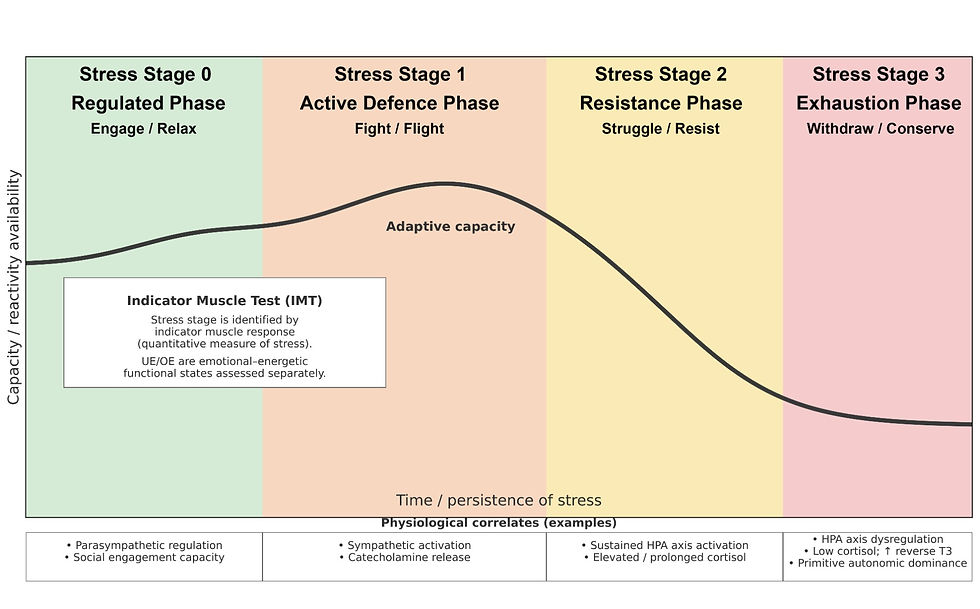
The Four Stages of Stress began as an expansion of Hans Selye's classic three-stage model, to which I added Stage 0, which I call “Defence on Demand.” This represents a state where our defensive mechanisms are available when needed, rather than being continuously activated.
The original insight came from recognising a correspondence between the four stages of stress and the four possible responses of Indicator Muscle Testing (IMT), drawing on the pioneering work of George Goodheart and Richard Utt. I first published this concept in 2010 in my introductory workshop manual, Principles of Kinesiology.
I see kinesiology fundamentally as a stress management system, where a kinesiology balance is a process of revealing stress and diffusing stress. IMT provides a way of exploring these stress responses within the kinesiology framework.
Years later, while writing my textbook Principles of Energy Kinesiology, I realised that understanding stress had become central to my life's work. This inspired me to write The Four Stages of Stress.
During the writing process, I developed the Defensive Depth Framework into a coherent physiological model, integrating autonomic nervous system responses, the defensive functions of the periaqueductal grey (PAG) columns, and progressive levels of defensive activation. What began as an observation in IMT evolved into a much broader understanding of how we respond to stress.
How does Neuroenergetic Kinesiology approach the connection between the brain, body, and emotions differently from other kinesiology methods?
One of my most important contributions over the past 20 years has been exploring the relationship between energetic states and emotions, or more precisely, behaviours. In Neuroenergetic Kinesiology, we recognise that energy structures, such as meridians, chakras, and the Five Elements, can exist in balanced, under-energy, or over-energy states, each associated with different emotional and behavioural patterns. For example, the Liver meridian has distinct behavioural associations depending on its energetic state.
Another major development has been my Neuroemotional Pathways work, integrating Jaak Panksepp's affective neuroscience and survival-emotion circuits into kinesiology. I began developing acupressure techniques based on these circuits in 1999, and subsequent case studies have reported changes in heart rate variability.
I see kinesiology fundamentally as a system for revealing and diffusing stress. The energetic structures involved in a balance provide information about the quality of that stress. For example, working with the FEAR system suggests a fear-related stress pattern, while the throat chakra may indicate communication-related stress.
This qualitative understanding complements my Defensive Depth Framework, which identifies the depth of defensive activation through four distinct survival strategies, from Engage / Relax to Withdraw / Conserve. Together, these approaches explore both the nature of stress and the defensive strategies associated with it.
What do you believe is most commonly misunderstood about how the human body responds to prolonged stress?
I think the greatest misunderstanding is that prolonged stress is simply an accumulation of tension or exhaustion that can be reversed through rest. In reality, the body undergoes complex physiological adaptations, and some of these can make recovery particularly difficult.
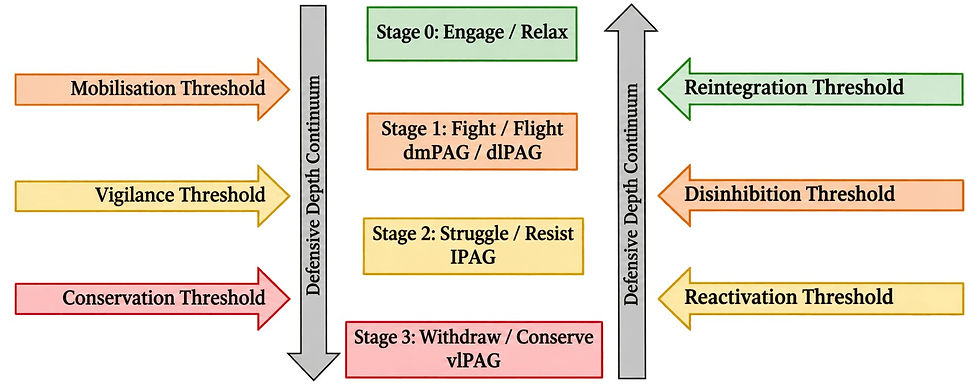
In my Defensive Depth Framework, the transition from Stage 2 (Resistance) to Stage 3 (Exhaustion) occurs across what I call the Conservation Threshold. At this point, the dominant survival strategy shifts from Struggle / Resist to Withdraw / Conserve. Returning requires crossing the Reactivation Threshold, which can be considerably more difficult.
This is closely related to allostasis, the body's process of adapting to challenges, and allostatic load, the cumulative physiological burden of prolonged adaptation.
Stress hormones such as adrenaline and cortisol are important, but thyroid hormone metabolism is another area worth investigating. In particular, changes in the relationship between active T3 and reverse T3 may offer insights into metabolic adaptation, although their clinical interpretation remains debated.
Understanding these transitions, along with interoceptive stability and recovery capacity, helps explain why people experiencing burnout or prolonged trauma may struggle to recover even after the original stressors have diminished.
Where do you see the greatest opportunities and challenges in bringing together neuroscience and traditional energetic approaches to wellbeing?
The greatest challenge is that kinesiology and energetic approaches are frequently dismissed as pseudoscience. I believe we need to move beyond this debate and investigate their underlying mechanisms scientifically.
One of the central ideas in both my books is that “muscle testing is a neurological event.” Manual Muscle Testing originated in physiotherapy and orthopaedics before George Goodheart incorporated it into Applied Kinesiology. Later, approaches such as Touch for Health and Applied Physiology developed, incorporating traditional energetic concepts.
My work proposes that Indicator Muscle Testing can be understood through neurological mechanisms involving Jaak Panksepp's affective circuits, the periaqueductal grey (PAG) columns, and my Defensive Depth Framework. This remains a proposed model requiring empirical validation.
Medical Acupuncture offers an interesting parallel. Research has demonstrated neurological mechanisms involving the amygdala, while studies of acupuncture analgesia have identified the role of adenosine A1 receptors and shown that inhibiting adenosine breakdown can prolong pain relief in animal models.
Together with my colleague Daria Kovalchuk, we've proposed Neuro Kinesiology, grounded in these neurological hypotheses. We've published research examining anxiety in wartime Ukraine, with further research investigating NK interventions using validated psychological questionnaires on the way.
For me, the opportunity lies in replacing assumptions with testable hypotheses and rigorous research.
What early signs might suggest that someone is moving from everyday stress into a more persistent state of dysregulation?
Everyday stress is a normal part of life. In my Defensive Depth Framework, Stage 0, the Regulated Phase, represents “Defence on Demand,” where we can activate defensive responses when needed and return to regulation once the stressor has passed. Moving temporarily into Stage 1, the Active Defence Phase, is therefore a healthy adaptive response.
The warning signs emerge when we begin crossing what I call the Vigilance Threshold, the transition from Stage 1 to Stage 2 (Resistance). Rather than responding to immediate challenges, the nervous system increasingly operates with an expectation of persistent threat.
This can manifest in several ways. Our autonomic organisation may shift towards sustained vigilance, with difficulty relaxing or recovering. Motor organisation may change, producing persistent muscular tension, restlessness, or defensive postures. Social engagement can become more difficult, with changes in facial expression, vocal tone, communication, and our capacity to connect comfortably with others.
An important concept here is neuroception, introduced by Stephen Porges in Polyvagal Theory. It describes how the nervous system evaluates safety and threat without conscious awareness. Within my Defensive Depth Framework, I propose that when the expectation of threat becomes persistent, the nervous system increasingly organises itself around defensive responses, even in situations that may be relatively safe.
The key warning sign is not simply experiencing stress, but progressively losing the flexibility to return to a regulated state.
How can someone begin to recognise and change stress patterns that have become part of their daily life?
Recognising our own stress patterns can be surprisingly difficult, particularly when they have become deeply embedded survival strategies. In my Defensive Depth Framework, this becomes more challenging after crossing the Vigilance Threshold into Stage 2 (Resistance), and even more so after crossing the Conservation Threshold into Stage 3 (Exhaustion).
Under prolonged stress, access to prefrontal cortical functions, including executive functioning, cognitive flexibility, and self-reflection, can become compromised. This means the very neurological resources we need to recognise and change our behaviour may be less available when we need them most.
This is where my concept of the Survival Mechanisms of the Psyche becomes important. I view archetypes as patterns of behaviour that can develop into strategies for managing perceived threats.
A useful starting point is to explore three aspects of these patterns: impressions, how we perceive and interpret our experiences; compensations, the behaviours we adopt to manage perceived threats; and payoffs, the often-unconscious benefits that reinforce those behaviours.
By making these patterns conscious, we can begin to recognise when a survival strategy that once served us has become an obstacle to adaptation, wellbeing, and personal growth.
Your philosophy includes the expression “The power is making the unknown known.” What has this meant to you throughout your career?
This philosophy came from Denise Crundall, an extraordinary personal development teacher I studied with during my kinesiology training in the late 1990s. Denise taught me to trust my intuition and inner knowing. She often said, “The power is making the unknown known,” and “Take responsibility.”
One of her most important lessons was that a true teacher cannot make someone understand themselves. What we can do is create a space in which people discover their own understanding. Ultimately, the responsibility for change belongs to the individual. John Thie, the founder of Touch for Health, expressed something similar: “You can't change anyone else; you can only change yourself.”
Denise passed away in 2002, but her influence remained profound. In 2010, when marketing consultants asked me to develop a tagline for NK Institute, I spontaneously said, “Make the unknown known.” It felt as though Denise was speaking through me.
Over the years, this philosophy has influenced my development of the Triune Model of Emotional Consciousness and Awareness and the Tripartite Neurological Model of Emotional Experience.
For me, the purpose of kinesiology is not simply to diffuse stress, but to help reveal what was previously outside our awareness, creating the possibility for understanding, responsibility, and meaningful change.
After nearly three decades of exploring stress and human awareness, what is the most important lesson you hope readers take away from your work?
The most important lesson is to take responsibility for your own change. Nobody else can do that for you, but that doesn't mean you have to do it alone. Don't be afraid to ask for help, particularly when stress has become overwhelming.
I want people to understand that stress is fundamentally a survival mechanism. Our defensive strategies have evolved phylogenetically across mammalian species, helping our ancestors survive in environments where physical threats were part of everyday life. These strategies range from engaging and responding flexibly to challenges, through fighting and resisting, to withdrawing and conserving resources.
I often say that our extraordinary prefrontal cortex is both our best friend and our worst enemy. It enables remarkable thought, understanding, and self-awareness, yet those same cognitive abilities can reinforce our difficulties through constant thinking, worrying, and rumination. We can become trapped in survival patterns that persist long after the original threat has disappeared.
This is why my philosophy, “Make the unknown known,” remains so important. By recognising our unconscious survival strategies and taking responsibility for our responses, we create opportunities for meaningful change.
Ultimately, understanding ourselves is the beginning of transformation.
Read more from Hugo Orlando Tobar