How to Embed Forest Therapy into Social-Emotional Learning
Written by Juna Ting-Wei Chang, Forest Therapy Guide
Juna Ting-Wei Chang is a forest therapy guide and founder of Shinrin-Yoku Taiwan, specialising in evidence-based forest therapy and Shinrin-yoku. She supports individuals and organisations in slowing down and gently returning their attention to themselves and the more-than-human world through nature.

Life is speeding up, patience is wearing thin, and anxiety and anger are rising with it. Here is how relational forest therapy gives social-emotional learning something no classroom or screen can: a living partner that helps us find peace again. Watch how long a group of people can wait in line before someone reaches for a phone. Notice how quickly a small frustration turns into a sharp word. Whether we are eight or eighty, many of us are living at a speed our nervous systems were never designed for.
The pace keeps climbing. Patience, the quiet skill of letting things take the time they take, is often the first casualty. What fills the gap is familiar: more anxiety, more anger, and less room to notice either. If we want to help people find peace again, we need to teach emotional skills, and we need to give those skills somewhere to grow.
The missing ingredient: Nature deficit
In his 2005 book Last Child in the Woods, writer Richard Louv gave a name to something many parents and teachers had sensed: nature deficit disorder. He is careful to say it is not a medical diagnosis. It is a description of the human cost of growing apart from the natural world. He notes, for example, that by the 1990s the distance children were allowed to roam from home had shrunk to a ninth of what it was in 1970. Fewer hours among trees, soil, and weather mean fewer chances to practice the things that nature quietly teaches: waiting, noticing, adapting, and sitting with what we can’t control.
Where social-emotional learning comes in
Social-emotional learning (SEL) is the process of building the skills to understand our emotions, relate well to others, and make caring decisions. The most widely used framework, from the Collaborative for Academic, Social, and Emotional Learning (CASEL), names five competencies: self-awareness, self-management, social awareness, relationship skills, and responsible decision-making. A landmark meta-analysis of 213 programs delivered in schools involving more than 270,000 students found that participants showed better social-emotional skills, attitudes, and behavior, along with a gain of 11 percentile points in academic achievement. A follow-up analysis of 82 programs and more than 97,000 students found those benefits still showing up anywhere from six months to 18 years later.
But SEL is often taught the same way we teach everything else: indoors, seated, under bright lights, with worksheets. It is hard to learn how to slow down in an environment that keeps us speeding up.
More than phytoncides and fresh air
Ask most people why time in the forest helps, and they will mention clean air, tree compounds called phytoncides, gentle exercise, and quiet. Those benefits are real. But they all describe something the forest does to us, and they ask nothing of us in return.
Relational Forest Therapy™ works differently. As guides with the Association of Nature and Forest Therapy (ANFT), we hold a simple principle: the forest is the therapist, and guides open the door. The forest is not a backdrop or a resource. It is a partner in a relationship. That matters for SEL, because social-emotional learning is, at its heart, about relationships: with ourselves, with others, and with the choices we make. The forest offers one more relationship to practice in, and it is one with no judgment, no agenda, and no rush.
3 doors back to peace: Recognition, awareness, resilience
Emotion recognition. You can’t work with a feeling you haven’t noticed. Out on the trail, the pace drops and the body’s signals get louder: a tight chest, a clenched jaw, a lightness in the shoulders. A guide might simply invite participants to notice where they feel the forest in their body and what their inner weather is today. Many people find that emotions described as weather (stormy, foggy, clearing) are easier to name and less frightening to admit.
Awareness. Soft, effortless attention, the kind a moving canopy or running water draws from us, gives an overworked mind a rest. Research has found that a nature walk lasting 90 minutes reduces rumination, the looping, self-critical thinking that feeds anxiety and anger. With the loop quieter, there is space to observe a feeling rather than be swept away by it, and to notice the people beside us, too.
Resilience. A forest is a lesson in resilience that needs no lecture. Fallen trees become nurseries for new growth. Seasons turn and nothing is permanently lost. When we are invited to sit in one place for a while and stay with a small restlessness or discomfort until it passes, we rehearse the exact skill that anger and anxiety challenge most: staying present without reacting.
Mapping the walk to the 5 SEL competencies
Self-awareness: An invitation to notice body sensations and name your inner weather.
Self-management: Sitting still in one spot and letting restlessness rise and fall without acting on it.
Social awareness: Listening in a sharing circle, hearing that others experienced the same forest differently.
Relationship skills: Offering something back to the forest and to each other as a reciprocal gesture.
Responsible decision making: Choosing how to move through the space with care for living things and for each other.
How to embed it: A simple starting framework
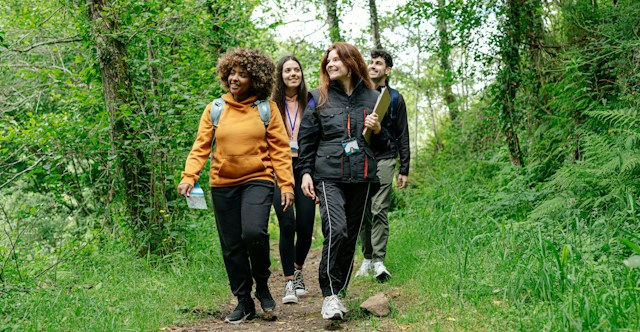
You don’t need a vast wilderness. A patch of trees on school grounds, a nearby park, or a quiet green corner can be enough. Here is a sequence I suggest for educators, counselors, and parents.
Six steps for educators and facilitators:
Cross a threshold. Pause at the edge of the space, set devices aside, and mark the shift from everyday mode to forest time.
Offer invitations, not instructions. “You might notice” leaves room for every answer to be right.
Slow the pace. Move at the speed of the slowest curiosity. Patience is practiced, not preached.
Invite a sensory pause. Sit, look, listen, and let the setting do its quiet work.
Share and name. Gather in a circle and let participants describe what they noticed and felt, building emotional vocabulary in their own words.
Close with reciprocity. Thank the place in whatever way feels genuine, and return regularly across seasons.
One honest note: much of the physiological research on forest bathing comes from adults, and studies of nature-based SEL with children are still growing. Forest therapy is a powerful complement to SEL, not a replacement for mental health care. Anyone struggling with persistent anxiety or anger deserves support from a qualified professional, and any outing with young people needs proper supervision and safety planning.
Finding peace again
We can’t slow the world down. But we can help one another learn to slow down inside it, to recognize what we feel, stay aware of it, and recover when life knocks us off balance. Social-emotional learning gives us the language. The forest gives us a practice ground.
Read more from Juna Ting-Wei Chang
Juna Ting-Wei Chang, Forest Therapy Guide
Juna Ting-Wei Chang is a forest therapy guide and founder of Shinrin-Yoku Taiwan, now part of Green Shower. She is the first Taiwanese guide certified by the Association of Nature and Forest Therapy (ANFT) and also holds the Taiwan Forest Therapist Certificate. With a background in languages, cross-cultural experience, and landscape and recreation management, Juna brings science, tradition, and lived experience together in a warm, grounded way. Her work supports individuals, organisations, and international groups in cultivating emotional resilience, presence, and sustainable wellbeing through nature-based practices.
References:
Bratman, G. N., Hamilton, J. P., Hahn, K. S., Daily, G. C., & Gross, J. J. (2015). Nature experience reduces rumination and subgenual prefrontal cortex activation. Proceedings of the National Academy of Sciences, 112(28), 8567 to 8572.
Collaborative for Academic, Social, and Emotional Learning. (n.d.). What is the CASEL framework?
Durlak, J. A., Weissberg, R. P., Dymnicki, A. B., Taylor, R. D., & Schellinger, K. B. (2011). The impact of enhancing students’ social and emotional learning: A meta-analysis of school-based universal interventions. Child Development, 82(1), 405 to 432.
Louv, R. (2005). Last child in the woods: Saving our children from nature deficit disorder. Algonquin Books of Chapel Hill.
Taylor, R. D., Oberle, E., Durlak, J. A., & Weissberg, R. P. (2017). Promoting positive youth development through school-based social and emotional learning interventions: A meta-analysis of follow-up effects. Child Development, 88(4), 1156 to 1171.