

Having Knee Pain and Neck Pain at the Same Time? Could It Possibly Be Related?
Kicki Hjortmarker is known for her broad knowledge and extensive experience working with the human body and mind to heal injuries and chronic pain conditions. She is the founder of Swedish Balance, dedicated to helping people live a balanced life pain-free.

Sure, they can be related! The body functions as a single unit, with all its systems and joints working together. If you have knee pain, don’t be surprised if it results in a stiff neck or a headache. In this article, Kicki shares Allison’s experience and explains how hip alignment, muscle tension, and fascia may be connected to pain in different parts of the body.
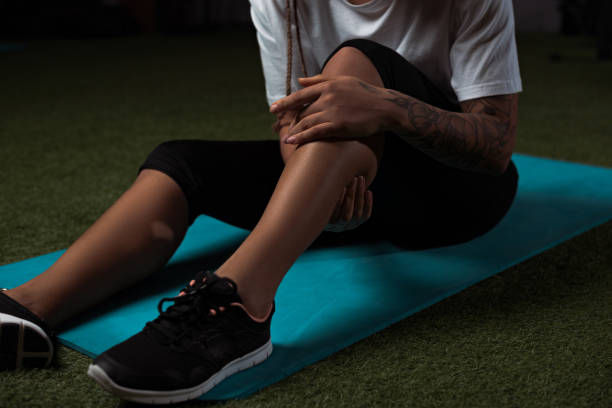
Why do I have a headache, knee pain, and weakness at 27?
Allison, one of my younger clients, is a good example. She decided to intensify her back workouts at the gym.
Since her spine is compromised in a few places, she makes sure to keep her back muscles strong and recently decided to make them even stronger. It couldn’t hurt, right?
This backfired big time! At first, her lower back felt sore. Not a big deal. She thought it was good because it meant it would get stronger.
However, 24 hours later, her left knee began to swell and cause problems. She experienced restricted movement and pain. She couldn’t extend her leg, and two days later, she had major difficulty walking. She also had a headache, and her neck had locked up.
Can a bad knee affect your back and hip?
So, Allison came to me for treatment. The first thing I did was check her alignment.
I found that her left hip was rotated to the left and posteriorly; her right leg was pulled medially, toward the center of the body; and her right hip was elevated and pulled anteriorly. There was also an inversion of her left foot.
Her main complaint was knee pain, but her back and hip were also hurting. She wondered whether her “bad knee” could affect her back and hip.
It absolutely could! But sometimes, it’s hard to tell which comes first: the chicken or the egg. In Allison’s case, it seemed that the back came first. If the hips are out of alignment, the knee joint is often affected.
The issue generally doesn’t stem from the knee alone unless the joint has sustained a direct blow.
Restricted sacroiliac joint and iliotibial band
While working with Allison, I found that her left sacroiliac joint, or SI joint, which links the pelvic bone to the sacrum, the lowest part of the back, was extremely tight and restricted.
The joint was being overused and aggravated by her existing imbalances as she worked to strengthen her lower back.
The iliotibial band, or IT band, a long, taut tendon running from the hip to the knee on the outer side of the leg, was also extremely tight.
Restrictions led to knee pain and more
Tension and restriction in the SI joint spread to the left hip, IT band, and the entire leg, intensifying around the knee.
Since fascia is a continuous web throughout the body, tension can spread widely. Muscle groups don’t have to be directly connected for this to happen.
That said, it may not be so strange that tension could easily spread throughout the body, from the sacrum to the head or from the knee to the hip.
Swelling in the knee and foot discomfort from a back workout
The tension spread beyond the initial area to involve the lower leg and foot. Noticeable swelling developed around the knee. Due to restrictions in the muscles and fascia, the knee became inflamed and sustained severe trauma.
All this happened after a back workout!
Correcting hip alignment to relieve knee pain
On the right side of Allison’s body, the psoas major, which originates in the back near the spine and inserts on the inside of the femur, was extremely tight.
Her body compensated diagonally across the body. A tight left SI joint and a tight right psoas were noted.
To alleviate the knee pain, I started by correcting the hip alignment because the misalignment was straining the knee. This provided Allison with immediate pain relief.
So, what about the neck pain and headaches?
The body has fascial tension patterns. Restrictions and trigger points tend to accumulate along these lines. Fascia is a continuous sheet throughout the body with no interruptions.
It surrounds everything, including organs, bones, the brain, muscle groups, individual muscles, and even each cell.
Therefore, when a restriction exists in one part of the body, such as the knee, this tension can spread through fascial tension patterns all the way into your neck and head.
This shows that neck pain and headaches can originate lower in your body than you might expect.
Align your joints and relieve myofascial pain now! Call or text me at 1 (323) 404-6613. Email me here.
Read more from Kicki Katarina Hjortmarker
Kicki Katarina Hjortmarker, Holistic Bodyworker
Kicki Hjortmarker has a solid background in the hands-on healing field, treating people with injuries and chronic pain conditions. With a holistic approach, she integrates Neuromuscular Massage Therapy, Craniosacral Therapy, Hypnotherapy, Reiki, Pilates, and more. To practice the artistry of mind/bodywork and massage therapy has been Kicki's lifelong passion. It started with the awareness of her own body as a child and ballet dancer, and, later, as a gymnast who developed chronic lower back pain whilst on the Swedish National Team in Rhythmic Sports Gymnastics. Decades later, she overcame nerve damage and temporary paralysis in one hand. This taught her to trust the healing power of body and mind, and that the body prefers holistic healing methods over conventional treatments. Her mission is to encourage and inspire others to do the same. To trust the healing power of body, mind, and spirit!







