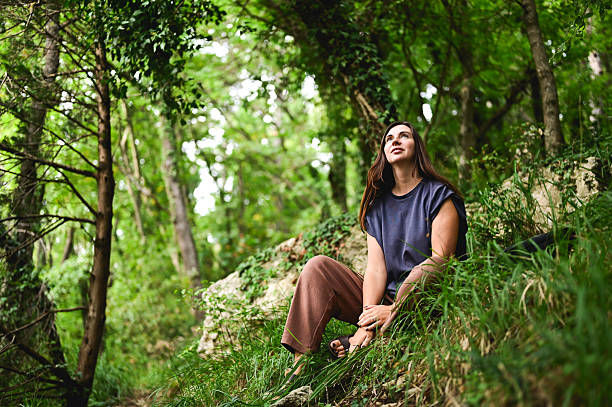
Forest Therapy is a Way of Life, Not a One-Time Escape
Written by Juna Ting-Wei Chang, Forest Therapy Guide
Juna Ting-Wei Chang is a forest therapy guide and founder of Shinrin-Yoku Taiwan, specialising in evidence-based forest therapy and Shinrin-yoku. She supports individuals and organisations in slowing down and gently returning their attention to themselves and the more-than-human world through nature.

I used to be a project manager who rushed, controlled, and worried. Here is how relational forest therapy became less an escape from stress and more a way of embracing change, imperfection, and life itself.
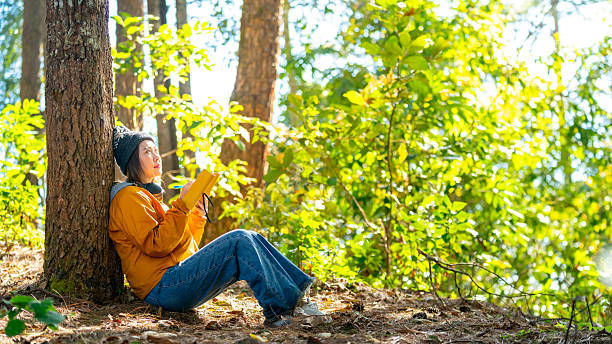
For years, my job was to make plans and keep them on track. I worked as a project manager in a tech start-up, a world of timelines, deadlines, and things that change overnight.
I was good at it, partly because I rushed. I wanted to control everything, and whenever things didn’t go as planned, I worried. I was also a perfectionist, so slowing down always felt like falling behind.
Today I work remotely, and that flexibility has given me room to guide forest therapy walks as a side project. I still spend most of my working time at a computer. Yet something has changed in how I meet the world, and I credit the forest for much of it. First, a quick word on what I mean by forest therapy.
What is relational forest therapy?
Relational forest therapy is the approach taught by the Association of Nature and Forest Therapy (ANFT). Its idea is simple: the forest is the therapist, and the guide opens the door.
Instead of leading activities or explaining the forest, a guide offers gentle invitations to slow down and notice, then steps back. We collaborate with the forest as a partner, not just use it as a setting, and the healing comes from that relationship.
What the forest taught me about control
A forest doesn’t follow anyone’s plan. The weather shifts, the path is muddy, the light isn’t what you hoped for. When I guide a walk, I can prepare the place and the invitations, but I can’t control the weather, the group, or what each person experiences. My role is to open the door and then let go of the outcome.
That was uncomfortable at first for someone like me. But walk after walk, I watched things unfold beautifully without my managing them, and slowly my body began to learn what my mind had resisted: not everything needs to be held tightly to turn out well.
It also changed how I handle worry. I used to get caught in a loop whenever plans changed. Researchers call this kind of repetitive, self-focused thinking rumination, and in one study a 90-minute walk in nature reduced it, while a walk beside a busy road did not (Bratman et al., 2015). I can’t say exactly what happens in my own head, but I know I am more relaxed with change than I used to be.
Seeing imperfection differently
Letting go of control opened the door to a second lesson, this one about perfectionism. I used to see imperfection as something to fix. A forest sees it differently. No two leaves are alike, no tree grows in a straight line, and a fallen log is not a failure: it becomes the soil for what comes next. Almost nothing in a forest is perfect, and nothing is wasted.
I am learning to look at imperfection in the same way, as texture, as information, as part of the process. In project work, we measured success by reaching objectives. Forest therapy has no destination, and that has taught me to give more attention to the process and the experience, not only the result. Goals still matter to me. I just no longer need to sacrifice the journey to reach them.
Living it, not just visiting it
This is why I call forest therapy a way of life, not a one-time escape. It doesn’t have to be fancy. It is simple, genuine, and, for me, quietly profound. I often describe it as a shift from “Doing” to “Being”, and that shift can happen at a desk as much as under a tree. Be patient with yourself, too. Changes in us move at a forest pace as well.
Forest therapy is not something I do once in a while to recover from my life. It is something I am learning to bring into it: a little more present, a little more patient, and a little more at ease with what I can’t control.
Read more from Juna Ting-Wei Chang
Juna Ting-Wei Chang, Forest Therapy Guide
Juna Ting-Wei Chang is a forest therapy guide and founder of Shinrin-Yoku Taiwan, now part of Green Shower. She is the first Taiwanese guide certified by the Association of Nature and Forest Therapy (ANFT) and also holds the Taiwan Forest Therapist Certificate. With a background in languages, cross-cultural experience, and landscape and recreation management, Juna brings science, tradition, and lived experience together in a warm, grounded way. Her work supports individuals, organisations, and international groups in cultivating emotional resilience, presence, and sustainable wellbeing through nature-based practices.
Reference:
Bratman, G. N., Hamilton, J. P., Hahn, K. S., Daily, G. C., & Gross, J. J. (2015). Nature experience reduces rumination and subgenual prefrontal cortex activation. Proceedings of the National Academy of Sciences, 112(28), 8567-8572.