Finding Calm in the Chaos Through Mindfulness – An Interview with Sithara Sajeev
Sithara Sajeev is a physiotherapist, meditation and mindfulness teacher, and founder of State of Harmony Wellness Centre in Melbourne. Drawing on nearly two decades of clinical experience, alongside her work in meditation and mindful movement, she explores the connection between mind and body, as well as stress, overwhelm, overthinking, self-compassion, attention, and the pressures that can leave us feeling disconnected from ourselves.
In this interview, Sithara shares how her work has evolved, what mindfulness has taught her about the way we think, move, and respond to life, and how learning to pause and relate to ourselves with greater awareness and kindness can create meaningful change.
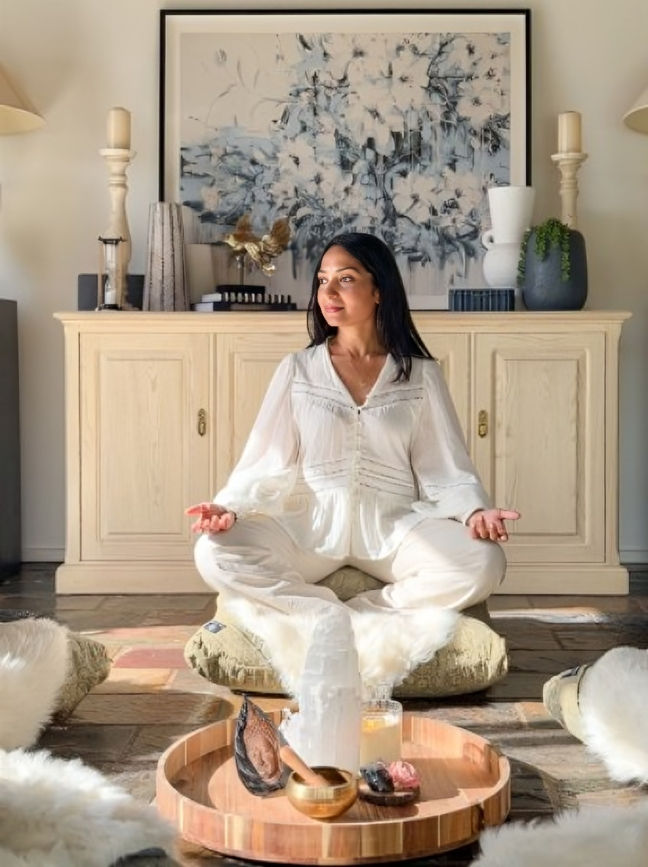
Sithara Sajeev, Physiotherapist, Meditation & Mindfulness Teacher
After nearly two decades in physiotherapy, what inspired you to bring meditation and mindfulness into your work at State of Harmony?
I first came to meditation during a challenging period in my own life. At the time, I wasn’t looking for anything profound. I was really looking for some mental peace.
As my practice grew, and later when I studied to become a meditation and mindfulness teacher, I started seeing well-being differently. I had spent nearly two decades helping people look after their bodies. Still, I began to understand more deeply how much our mental and emotional state can influence how we experience our bodies too.
When I saw someone for physiotherapy or Pilates, I might be helping with pain, strength, or movement. Still, they were bringing so much more into the room: stress, responsibilities, fears, expectations, and the way they spoke to themselves.
Movement can change how we feel mentally, and our state of mind can influence how we move and care for ourselves physically. Meditation added something that had been missing for me: the opportunity to slow down enough to notice what is happening, gain clarity, and make more conscious choices. That became an important part of why I created State of Harmony.
Was there a particular experience in your physiotherapy career that changed how you understood the connection between physical and emotional well-being?
Working with people experiencing persistent pain at Cabrini Health really changed the way I thought about pain and recovery. I was part of the team involved in establishing a persistent pain program, and it became very clear that pain could not always be understood simply by looking at a scan, an injury, or one part of the body.
Two people could have quite similar physical presentations and experience pain and recovery very differently. Stress, sleep, fear, previous experiences, beliefs about pain, and what else was happening in someone’s life could all play a part.
I also noticed how often people who were used to caring for everyone else had very little space left for themselves. They might know what would support their recovery, but actually finding the time and energy to prioritise themselves could be difficult.
That experience really broadened the way I looked at pain and recovery. It made me much more aware that you can’t always separate the physical from everything else that is going on in a person’s life.
How does your clinical background influence the way you combine Clinical Pilates, meditation, and mindful movement?
My physiotherapy background means I’m always observing more than whether somebody can perform an exercise correctly.
I notice whether they are holding their breath, bracing unnecessarily, pushing through discomfort, or worrying about getting something wrong. Sometimes someone can perform an exercise perfectly well, but they are gripping through their whole body while doing it.
That is where mindfulness can bring another dimension to movement. Instead of only asking, “Can I do this exercise?” we can also become curious about how we are doing it. Can I breathe? Where am I holding tension? Can I feel the difference between useful effort and unnecessary gripping?
Meditation gives us another opportunity to practise noticing what is happening internally without immediately needing to change or fix it.
I don’t see Clinical Pilates, mindful movement, and meditation as interchangeable. Each has its own purpose. But I think they can complement one another beautifully, helping someone build physical capacity while also becoming more connected to what their body and mind are communicating.
You've written openly about overthinking, even as a mindfulness teacher. What do you think people misunderstand most about practising mindfulness?
I think one of the biggest misconceptions is that being good at mindfulness means having a quiet mind. Mine certainly isn’t quiet all the time.
The mind thinks. It plans, remembers, worries, rehearses conversations, and sometimes takes us ten steps into a future that hasn’t even happened. Mindfulness isn’t about forcing that to stop. For me, it is much more about recognising what the mind is doing without immediately getting swept away by it and without giving ourselves a hard time for being human.
I might suddenly realise I’ve been replaying that conversation for the last ten minutes, or I’m imagining the worst-case scenario again. That moment of noticing gives me an opportunity to come back to what is actually happening now.
I still overthink. I still get distracted, and sometimes I react before I remember to pause. The difference is that I often notice sooner.
To me, mindfulness is not about perfect presence. It is learning to notice, return, and meet ourselves with a little more compassion when we inevitably wander.
With constant digital distractions and growing reliance on AI, what concerns you most about how we're learning to manage our attention?
Sometimes I think we are living with twenty tabs open at once, both on our computers and in our minds. We can be replying to a message while thinking about an email, half-listening to someone, remembering something we forgot to do, and then getting pulled toward another notification. Artificial intelligence (AI) can help us produce and process more than ever before, which can be incredibly useful, but I think we also need to ask what we might lose if we become very good at doing more while becoming less able to stay with one thing.
People often say time is our greatest asset. But what is the value of having time if our attention is somewhere else for most of it?
That is one reason mindfulness feels particularly relevant now. During meditation, attention wanders, and we bring it back. Then it wanders again, and we bring it back again. That simple repetition is attentional training.
In a world where so much is competing for our attention, practising the ability to choose where we place it has never been more important.
For someone who struggles with perfectionism and constant self-criticism, what is a practical way to begin developing self-compassion?
I think a practical place to begin is simply noticing the voice you use with yourself when something goes wrong. Kristin Neff describes self-compassion through three elements: mindfulness, common humanity, and self-kindness. I find that framework very helpful. Mindfulness allows us to recognise, “I’m being really hard on myself right now.” Common humanity reminds us that mistakes, struggle, and not having everything together are part of being human. Self-kindness asks us to respond with some of the understanding we would naturally give someone we care about.
A question I often come back to is, “If someone I loved were in exactly this situation, what would I say to them?” Most of us would never speak to someone we love in the way we sometimes speak to ourselves.
Self-compassion isn’t about saying everything we do is fine or avoiding responsibility. We can still think, “I wish I had handled that differently.” But we can learn from an experience without using it as another reason to tear ourselves apart.
Why do you think so many women struggle to rest without feeling guilty, and what can help them change that relationship?
I think many women have learned, often without consciously realising it, to connect being productive, capable, and useful with being worthy.
We finish one thing and immediately see the next thing that needs doing. There can be an unspoken rule that we are allowed to rest once everything else is finished: the work, the children, the house, the messages, and the washing. But everything is rarely finished.
I think it can be helpful to become curious about where those expectations came from. What did we see growing up? Did we see the women around us sit down and rest without apologising for it, or were they usually looking after everyone else first? I’ve had to notice some of those patterns in myself too.
Changing our relationship with rest starts with recognising the old rules we may still be living by and questioning whether they are actually serving us. Rest doesn’t have to be a reward we receive once we have finally done enough. It is part of being human and something our bodies and minds genuinely need.
You often encourage people to approach themselves with greater kindness rather than constantly striving to improve. How has that philosophy changed your own life?
It has taken a lot of unnecessary pressure out of ordinary life. In the past, I could create surprisingly rigid expectations around very small things. The washing needed to be folded and put away. Dinner needed to be organised a certain way. If I hadn’t completed something I thought I should have, there could be a very harsh internal response.
Now I’m much more able to see a basket of washing sitting there and think, “It can wait. I’ll get to it when I can.”
It sounds insignificant, but for me, it represents a much bigger change. An unfinished task no longer has to become evidence that I haven’t done enough.
I try to bring that same kindness to more meaningful situations too. If I replay a conversation and wish I had handled something differently, I remind myself that I responded with the awareness, energy, and resources I had at the time. I can reflect and think, “Next time, I might do that differently,” without punishing myself for what has already happened.
I’m certainly not perfect at it, but there is much less harshness now and much more room to be human.
If readers could make one small change in how they respond to stress, difficult thoughts, or personal expectations, where would you encourage them to start?
I would start with a few minutes each day when you are not trying to achieve anything. Put the phone down. Notice how your body feels. Notice where your mind has been. Ask yourself, “What is actually going on for me today?” Then pay attention to what comes next.
If the answer is, “I’m exhausted,” does another voice immediately tell you that you shouldn’t be tired because you haven’t done enough? If you made a mistake, does your mind instantly start listing everything you should have done differently?
We spend our entire lives in relationship with ourselves, yet we often give very little attention to what that relationship actually sounds like.
You don’t need to fix everything you notice. Begin by listening. Notice the patterns and practise responding to yourself a little more kindly.
A few minutes each day may seem small, but small moments of awareness add up. When we start seeing our patterns clearly, we create the possibility of living with a little more choice rather than simply repeating them.
For those who would like support putting this into practice, I offer in-person and online meditation sessions through State of Harmony.
Read more from Sithara Sajeev