Fear of Authority and the Power of Choice
Written by Sabio Janiak, Founder of Mastering Harmony
Sabio Janiak is a psycho-sensory specialist and human behaviourist, and founder of Mastering Harmony. He guides individuals to rewire stress-driven neural patterns, resolve trauma, and restore emotional balance using cutting-edge neuroscience and holistic methods, empowering lasting clarity, resilience, and high-performance living.

We tense up in front of bosses, police officers, and even ticket inspectors. The reason has little to do with them and everything to do with what we believe they can take from us. Picture a company director on a train. In the boardroom this morning, everyone waited for her decisions. Now a ticket inspector is walking down the carriage, and she feels a small, familiar tightening as she reaches for her ticket. She has a valid ticket. She has done nothing wrong. Still, her body reacts.
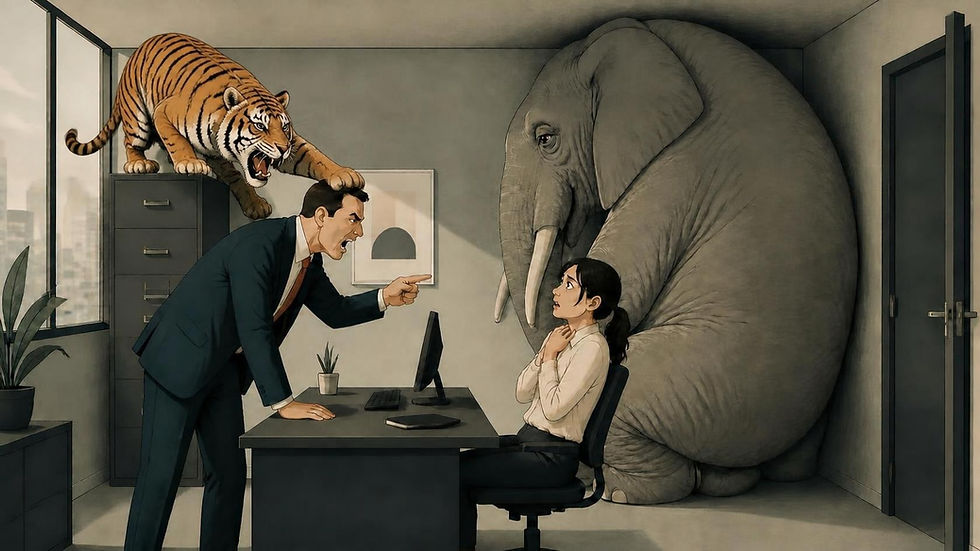
Most of us know this feeling. The police car in the rear-view mirror while we drive within the limit. The manager who says, "Can I see you for a minute?" The security guard at the supermarket exit.
Authority is everywhere, and so is the quiet tension it creates. In my work, I often say the issue is never the issue. The boss, the officer, and the inspector aren't the real cause. To understand why we fear authority, we first need to understand fear itself.
The one fear beneath all fears
As an end-of-life doula, I sit with people at the edge of life, and over time, I've come to see that beneath every fear lies one fear: the fear of losing the body.
This is not quite the fear of death as an idea. It is something more physical and immediate. Without the body, everything goes: our experiences, the people we love, this world. Our whole biology is built around one task: to keep the body alive and keep the player in the game.
To do this, the body has a watchman. The brain's threat system, with the amygdala at its centre, constantly scans our surroundings and asks one question below our awareness: Am I safe? It also knows how conflict escalates. Words become tension, tension becomes aggression, and aggression can become violence. So when we meet someone who holds power over us, the watchman takes note long before our thinking mind joins in.
This is not weakness. It is the mechanics of a body designed to survive.
What authority can take?
Once our basic survival is secure, when we are fed, housed, and relatively safe, two other needs come forward: freedom and belonging. Both are deeply tied to survival. Freedom lets us move, choose, and protect ourselves. Belonging kept our ancestors alive because, for a social animal, being cast out of the group could mean death.
Authority is whoever or whatever has the power to take one of these away. The police officer can stop us, the boss can restrict or dismiss us, and the inspector can fine us or put us off the train. That is why we tense up. We don't fear authority. We fear what authority can take from us.
Authority isn't only a person. It can also be an idea: a belief nobody questions, a family rule, a cultural expectation, "that's just how things are done," or "that's what my mother did." Going against these can feel as dangerous as defying a boss because what's at risk is belonging. If I think differently, will I still be accepted?
Cybernetics, the science of how systems steer themselves, describes a living being as an autonomous system, one that controls its own actions and works to avoid losing that ability. Seen this way, our fear of authority makes perfect sense. It is the fear of losing the steering wheel.
Life is a series of frames. Here is something so simple I have never found an exception to it: we always live inside a frame. Life itself is the largest frame. Within it sit others: a country, a city, a home, a family, a workplace, a relationship. Each frame has rules. A workplace has contracts, a hierarchy, and expectations. A family has its agreements, spoken and unspoken. A country has laws.
Some things are simply the way they are. A wall is solid, and the body cannot walk through it. Unless we live alone in a forest, other people will influence us. A frame will always have rules. Let's be honest about one thing. Nobody drags us to work by the hair. We walk there on our own feet because the frame gives us something: money, security, prestige, purpose, a place to belong. Even when we complain about it, we keep choosing it because it still serves us in some way.
Why the frame starts to hurt
If we choose our frames, why do so many of us feel trapped and resentful inside them? I believe it's because we often enter frames with the mind of a child.
A child doesn't read contracts. A child hopes to be looked after, to be fed, to be safe, and to have someone else carry the responsibility. Part of us never lets go of that longing. So we take the job, say yes to the arrangement, or step into the relationship without looking clearly at its rules. We tell ourselves we'll see what happens. Then reality arrives, and the frame feels like a cage.
Psychologist Stanley Milgram, in his famous studies of obedience, described what he called the agentic state, a mode in which people stop seeing themselves as responsible for their actions and hand that responsibility to the authority above them. It's the child's position in an adult body. It feels safer at first because someone else carries the weight. The price is that we give away our power, and the person who gives away power soon starts to fear the one who holds it.
The anger is often at ourselves. When we look honestly at the frustration we feel towards a boss, a partner, or a system, we often find something uncomfortable underneath. Much of the anger isn't at them. It's at ourselves: for saying yes without looking, for staying in something that no longer serves us, for keeping silent when we wanted to speak.
I want to be careful here. This is not about blaming anyone who is being harmed, bullied, or exploited. Harm is real, and it is never the fault of the person on the receiving end. This is about reclaiming the choices we still have because recognising our part is where our power returns.
Two ways to meet a frame
Cybernetics offers a simple insight. Towards any system, we can take one of two stances. We can leave it as it is and observe it, and then our task is understanding. Or we can change it, and then our task is making decisions.
Applied to the frames of our lives, this gives us a clear map. We can observe from outside. Before entering a job, a relationship, or a community, we can watch, ask questions, and learn how it really works. What are the rules, written and unwritten? Who holds authority, and how do they use it? What does this frame ask of the people inside it? Observing is not passive. It is the most important preparation we can do, and the child mind usually skips it.
Or we can enter. Here's what many people miss: entering a frame is never neutral. The moment we join a team, our presence changes it, and the frame begins to change us. From that moment on, we are making decisions, whether we notice them or not. Staying silent in a meeting is a decision.
Accepting extra hours is a decision. Not leaving is a decision too. So the first and most important decision is the entry itself. We can enter a frame unconsciously, drifting in and hoping it will look after us, or we can enter it consciously, knowing what we are agreeing to. Every later decision becomes easier when the first was made with open eyes.
Commit, test, choose again
Once we've chosen to enter, the adult mind does something the child mind fears: it commits fully. This may sound like the opposite of freedom, but it is what makes freedom possible. You cannot judge a frame you never fully entered. If you join a job with one foot out the door, you'll never know whether the job didn't work or your half presence didn't. Half commitment feels safer, but it gives you false information.
Think of it as running a real test. You enter the frame, commit to its rules for a set period, and then step back and assess honestly. How does this work for me? What does it give me, and what does it cost? Then you have three clear options: recommit, renegotiate, or leave.
This is why agreements and contracts matter so much. They make the frame visible and tell everyone what they are committing to. An agreement kept only when it's convenient is a quiet form of lying to others and to ourselves. Consistency, doing what we said again and again, is what turns intention into results. The ability to commit is a sign of a mature mind.
The right to change your mind
Does commitment mean we're stuck forever? No. Adults have every right to change their minds. The difference is how we do it.
Changing your mind is honest when you say so openly and renegotiate. It becomes a lie when you stay silent and quietly stop keeping your word.
This also applies to the authority of ideas. Recipes are useful because they give reliable results. But no one is obliged to cook exactly as the recipe says or as their mother did. What she did made sense in her time. We can keep what serves us and change what doesn't.
A simple practical rule: what's on my plate is mine. Start changing the things that affect only you: your room, your habits, the agreements you make with yourself. Each one you keep builds trust in yourself. Where the frame is shared with others, at home or at work, change it together through honest conversation rather than silent withdrawal.
This is where fear of authority starts to lose its grip. When we know we chose the frame, understand its rules, and can change our agreement, the person holding authority no longer holds all the power. We hold some of it too.
Practices for meeting authority as an adult
Name what you're afraid of losing: When you tense up near authority, ask: Is it my freedom or my belonging that feels at risk? Naming it brings the thinking mind back online.
Settle the watchman: Feet on the floor, a long, slow breath out. A calm body makes clearer decisions than a frightened one.
Give every frame a fair test: Commit fully for a set time, such as three months in a new job, then assess honestly and choose again: stay, renegotiate, or leave.
Keep one small promise to yourself each day: Consistency in small things builds the adult who can stand calmly in front of big ones.
Who you are behind the camera
There is one final test of the adult mind. Who are you when no one is watching?
The integrated person is the same in front of the camera and behind it. No mask and no performance, only someone who has chosen their frames, keeps their agreements, and says openly when they change their mind.
That person still respects authority. They show their ticket, follow the rules of the frames they've chosen, and listen to the people who lead them. But they no longer shrink. They know that the boss, the officer, and the inspector cannot take away what matters most: their ability to choose.
The issue was never the inspector, the boss, or the rule. It was whether we had chosen. Fear of authority loosens when we stop waiting to be allowed and start choosing.
Read more from Sabio Janiak
Sabio Janiak, Founder of Mastering Harmony
Sabio Janiak is a psycho-sensory specialist and human behaviourist, and the founder of Mastering Harmony. Over the past two decades, he has worked in 88 countries as a therapist, musician, and workshop facilitator, exploring the connections between sound, art, the nervous system, and human behaviour. He specialises in trauma resolution and nervous system regulation, helping individuals rewire stress-driven neural patterns and restore emotional balance. Using holistic modalities and applied neuroscience, Sabio empowers people to cultivate resilience, emotional clarity, and self-regulation. He continues to evolve the Mastering Harmony Method through individual sessions, group workshops, and practical training programs.