

Engineering Appreciation at Scale – Lessons From the CEO Behind Half a Billion Digital Rewards
Updated: 8 hours ago
Bill Grassmyer trained as an engineer. He holds a bachelor's degree from Virginia Tech and a master's in mechanical engineering from MIT, and he has spent more than two decades on a problem most companies treat as an afterthought: how to get a reward, a thank-you, or a small moment of recognition to another person, reliably and at scale.
Long before co-founding Giftogram, he led MediaTree, a digital rewards company that delivered more than half a billion digital rewards, from music downloads and movie tickets to e-books, and was named the promotional products industry's fastest-growing supplier in 2008. That experience taught him something with less to do with technology than people: delivery is only half the job. What determines whether a reward truly lands is whether it feels thoughtful.
It left him with a conviction that still shapes Giftogram, the employee rewards platform he co-founded that also supports customer incentives and other business rewards: technology shouldn’t replace human connection and appreciation. It should remove the operational work so organizations can make every reward feel more personal, regardless of why it’s being sent.
The workplace appreciation gap
The modern workplace has an appreciation problem. Gallup's 2026 research found global employee engagement had fallen to just 20%, its lowest level since 2020 and the second consecutive year of decline. Manager engagement, the group with the greatest influence over team performance, dropped sharply from 27% to 22% in a single year. People may still show up to work, but many are no longer fully invested.
The engagement figures show the scale of the problem, employee conversations offer a clearer view of what that disengagement can feel like day to day. In its own research, Giftogram analyzed 43,513 public workplace conversations across 12 Reddit communities, finding a similar pattern from a different angle. Employees described feeling invisible more than four times as often as they described feeling valued. “Nothing,” receiving no recognition at all, was one of the most common workplace experiences mentioned, ahead of a verbal thank-you or extra time off.
The business case for employee appreciation
It's tempting to dismiss appreciation as a soft culture issue, but the evidence suggests otherwise. Gallup estimates that low employee engagement costs the global economy the equivalent of around 9% of GDP in lost productivity, and for an individual business, replacing an employee who leaves can cost between half and twice their annual salary. Disengagement isn't a culture metric, it's a financial one. That helps explain why employee rewards platforms have moved beyond occasional gifting and into the infrastructure of larger recognition programs. The technology can make rewards easier to manage and distribute, but the business case starts earlier: making sure good work is noticed in the first place.
Low resignation rates can look like loyalty, but in a weaker job market many employees stay while quietly disengaging. That's why employee recognition deserves a place on the leadership agenda: it's one of the simplest and least expensive ways to influence engagement before those resignations show up as receipts in a board pack.
"You can't buy someone's engagement back once they've stopped caring," says Grassmyer. "But you can keep it, and that costs far less than most executives think, and means far more to employees than most leaders realize."
The challenge of scaling employee recognition
Employee recognition doesn't become difficult because leaders stop valuing it, but because administration grows faster than appreciation. What works for a team of 30 quickly breaks down across 3,000 employees, multiple countries and dozens of reward types. Every reward raises operational questions: who approves it, which budget pays for it, how tax is handled, how it's delivered and how it's tracked.
This administrative burden is often what stalls recognition programs. The desire to appreciate is still there, but the process simply becomes too difficult to sustain.
Payroll, payments and customer relationship management all reached the same point. As businesses grew, spreadsheets, email approvals and manual administration could no longer keep up. Employee recognition is now following the same path.
Technology can automate the administrative layer behind recognition without automating the recognition itself. HR systems and workflow tools can trigger reward delivery when predefined events occur, while managers still decide who should be recognized, why and what should be said. The result is less manual administration around budgets, recipient data and distribution, while the human act of appreciation stays human.
Grassmyer is an advocate of automation and AI, and Giftogram is a reflection of that philosophy. The platform is used by more than 25,000 businesses and is rated the #1 highest-satisfaction rewards software by G2 users, with a place in G2's Top 100 Highest Satisfaction list. Yet despite building technology to automate rewards at scale, he argues the industry is focused on the wrong thing.
"Automating delivery is the easy part," he says. "The difficult part is making sure the person on the other end still feels like somebody stopped to think about them. If automation removes the thoughtfulness, all you've done is make indifference more efficient."
Moving money versus making someone feel seen
That distinction is where Grassmyer thinks many reward programs go astray, though he's quick to point out that not every reward serves the same purpose. Some rewards exist primarily to compensate rather than recognize. A customer earning a rebate, a channel partner hitting a sales target or a research participant, for example, expects to be paid quickly, reliably and in a form they can actually use. But every reward is still an interaction with the recipient, and every interaction shapes how they remember the organization behind it.
Speed and reliability may be the primary objective, but they're rarely the only one. Enterprise gifting at scale is also an opportunity to create a thoughtful, personal experience. Modern reward platforms make that possible by combining automation with recipient choice, allowing global organizations to deliver rewards efficiently without making them feel transactional.
Employee recognition is a different challenge wrapped in the same transaction. The payment is easy, the point is making someone feel seen. Apply the same silent efficiency you'd use for a survey payout and you risk creating exactly the "nothing" that emerged so often in the data. What separates a reward that resonates from one that doesn't, Grassmyer argues, is the power to choose.
"Automation can scale delivery. Thoughtfulness is what gives a reward meaning. Our job is to build technology that makes it effortless for businesses to show appreciation through personal messages, their own branding and the freedom to choose what matters most to them."
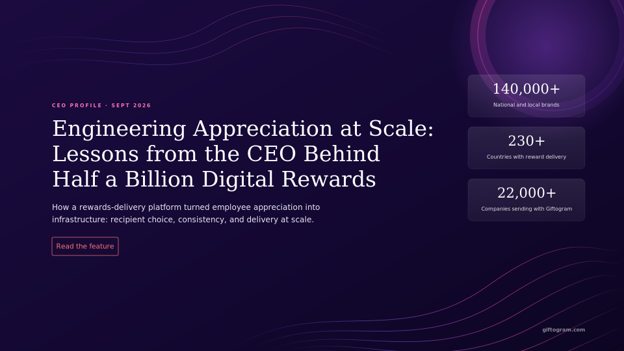
That philosophy runs throughout Giftogram's platform. Businesses can automate reward delivery while still adding their own branding, message and recipient choice, turning what could have been a routine transaction into a more personal experience. Since launching in 2012, Giftogram has helped more than 25,000 businesses send hundreds of millions of rewards worldwide. Behind the scenes, it supports digital gift cards, prepaid Visa and Mastercard cards, charitable donations and cash disbursements through manual campaigns, no-code automation and APIs. Businesses can personalize every reward with their own branding and message, while recipients choose from more than 140,000 national and local retailers worldwide, ensuring the reward feels relevant wherever they are.
Grassmyer, though, talks less about the technology than what it makes possible: giving organizations the ability to deliver thoughtful, personal rewards consistently, no matter how large they become.
Appreciation as a discipline, not a date
That's why Grassmyer believes employee recognition should be treated as an operational discipline rather than a seasonal gesture. Holiday gifting and Employee Appreciation Day should reinforce recognition, not define it.
"One day a year is a reminder, not a strategy," he says. "The companies that keep people engaged are the ones where appreciation happens all year and rewards contribution, not just presence."
For years, scale was the enemy of that. The larger an organization became, the harder it was to make recognition feel personal. Today, that trade-off has largely disappeared. Businesses can recognize people consistently, globally and at scale without sacrificing authenticity, provided technology amplifies the thought rather than replaces it.
That is the paradox at the heart of Grassmyer's career. After helping businesses deliver more than half a billion digital rewards, he believes the technology has never been more capable, not because it replaces human appreciation, but because it makes thoughtful recognition possible at a scale that once seemed impossible. The real measure of success is the same as it has always been: whether someone leaves feeling seen.







