Could Your Pelvic Floor Be the Root Cause of Your Low Back Pain?
Updated: Sep 2
Stella Dimitrakakis is a Doctor of Physical Therapy, Board-Certified Orthopedic Specialist, and Certified Functional Manual Therapist specializing in orthopedic and women’s health. She helps people move better and avoid unnecessary injections or surgery through personalized care and evidence-based approaches.

You've done the magnetic resonance imaging (MRI). You've tried the chiropractor, the massage therapist, maybe even a round or two of physical therapy focused on your spine. Your low back pain, or that nagging hip or knee pain, gets a little better, then creeps right back. If this sounds familiar, there may be a piece of the puzzle no one has looked at yet: your pelvic floor.
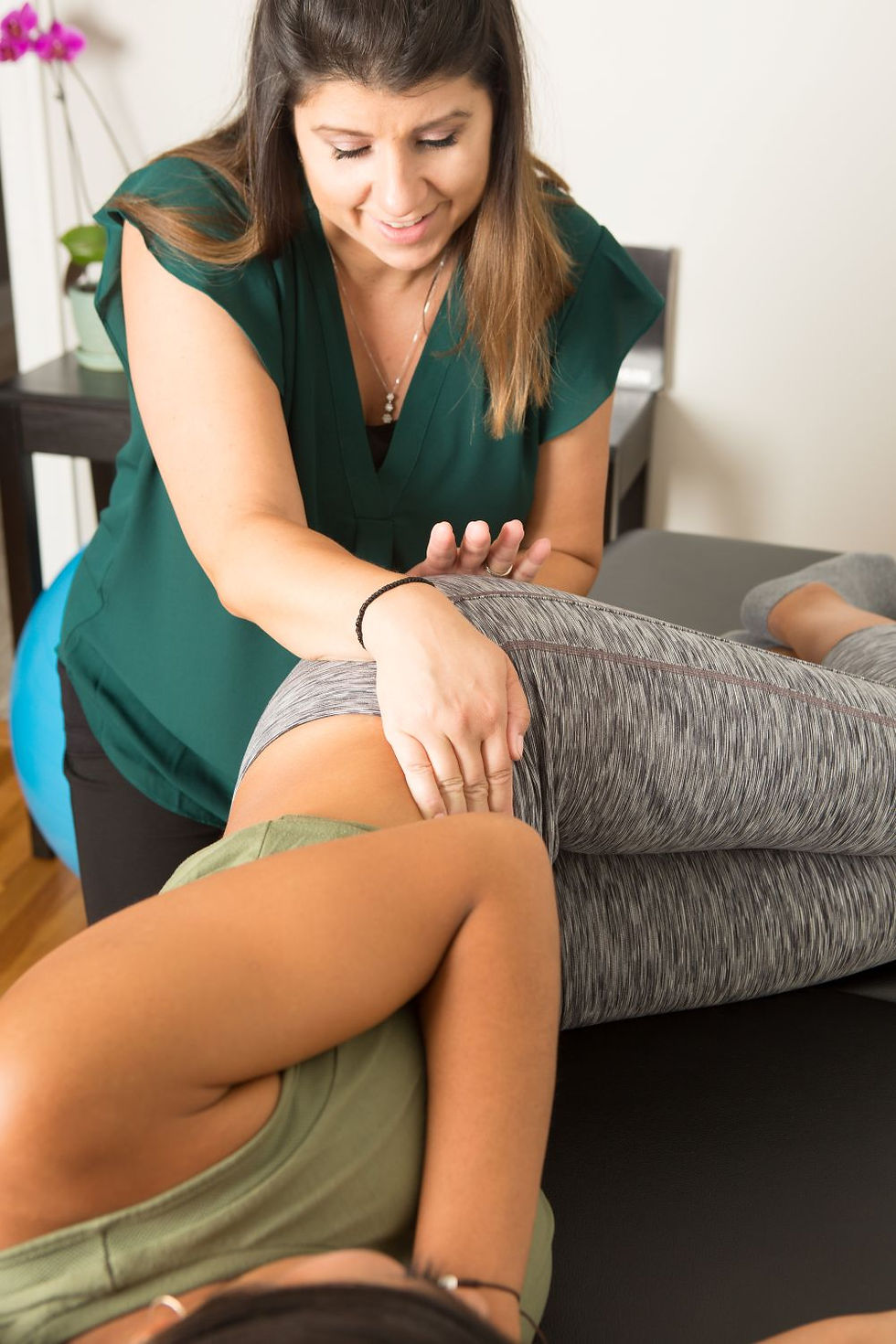
As a pelvic floor physical therapist, I see this pattern constantly. Clients arrive convinced their pain is purely structural, a disc, a joint, a "bad hip," when the real driver is a group of small, deep muscles most people have never heard of, let alone had assessed.
This isn't just a postpartum issue
When people hear "pelvic floor," they usually picture postpartum recovery and assume it has nothing to do with them. That assumption keeps a lot of people in pain longer than they need to be. The executive sitting through nine consecutive hours of meetings a day is loading their hip flexors and pelvic floor in a shortened position for most of their waking life. The runner, cyclist, or CrossFit athlete pushing through unexplained hip tightness may be dealing with the same guarding pattern, just from overuse instead of underuse.
Men have a pelvic floor too. It's just as capable of becoming tight and poorly coordinated as a woman's, even though it rarely gets mentioned in that context. If you've never given birth and you're still dealing with unexplained hip, groin, or low back pain that hasn't responded to the usual treatment, the pelvic floor is still worth ruling out.
Trigger points that masquerade as sciatica
Muscles all over the body can develop trigger points, tight, irritable bands of muscle fibers that refer pain to other areas, sometimes far from where the trigger point actually lives. This is well documented in muscles like the piriformis. What's less well known is that the pelvic floor plays by the same rules.
Take the obturator internus, a deep hip rotator that also forms part of the pelvic floor and pelvic sidewall. When it develops trigger points, it can refer pain into the buttock, the sacroiliac (SI) joint, the posterior thigh, and even down the leg in a pattern that feels a lot like sciatica. Clinically, this muscle gets mistaken for piriformis syndrome or a disc problem all the time, simply because no one thought to check the pelvic floor.
Other pelvic floor muscles, including the levator ani, coccygeus, and the obturator internus fibers closer to the pelvic floor itself, have their own referral patterns, often sending pain into the front of the lower abdomen, the groin, and around the hips. If your "hip pain" or "lower abdominal pain" has never responded to treatment focused on the hip, this may be why.
The pelvic floor, the hip, and the low back are one system
The pelvic floor isn't an isolated structure. It works together with your deep abdominals, your diaphragm, and your spinal stabilizers as part of what most people call "the core." When the pelvic floor is chronically tight or simply uncoordinated, meaning it doesn't know how to fully contract and, just as importantly, fully relax, it can quietly limit hip mobility. A hip that doesn't move well doesn't stay quiet. It hands the job off to whatever joint is willing to compensate.
This is where things get interesting for anyone chasing knee pain or low back pain that "comes out of nowhere." Limited hip range of motion, whether from restriction in the joint itself or in the muscles surrounding it, forces the body to borrow movement from somewhere else. Often, that somewhere is the lumbar spine, which starts absorbing rotation and extension it was never meant to handle. Sometimes it's the knee, which compensates for a hip that won't rotate or extend properly. Either way, the symptom shows up far from the actual source of the restriction.
Why external treatment isn't always the full answer
Manual therapy, dry needling, and targeted stretching for the deep hip rotators, including the obturator internus, genuinely help a lot of people, and treating these muscles externally should absolutely be part of the plan. But here's the honest clinical truth: it isn't always 100% effective on its own because some of the muscle simply can't be fully reached or assessed from the outside.
I like to compare it to washing a window from only one side. You can get it quite clean, and it will look a lot better. But if there's residue on the other side, you'll never get full clarity until someone addresses both sides of the glass. The pelvic floor works the same way. External work addresses one side, while a skilled internal assessment addresses the other. Combining both is often what finally resolves a case that's been "80% better" for months but never fully clears.
To be clear, not every patient needs an internal assessment. Many people improve significantly with external treatment alone, and a good clinician should be able to tell the difference between the two groups.
The clues that point to the pelvic floor
So how do you know which category you're in? A few screening questions usually point us in the right direction:
Do you deal with constipation, straining, or a sense that you never fully empty your bowels?
Do you experience urinary leakage or unusual urinary frequency or urgency?
Do you have to push or bear down to get your urine stream started, or does it not come out easily on its own?
For women, is there pain with intercourse?
These aren't random questions. Bowel, bladder, and sexual function are directly governed by the same muscles we're discussing, so difficulty in these areas is a strong signal that the pelvic floor deserves a closer look.
One more clue we use in the clinic: even without an internal exam, we can often palpate the obturator internus externally, near the hip or next to the ischial tuberosity, the sit bone you feel when you sit on a hard chair. If that spot is tender, or if pressing on it reproduces or refers pain to the SI joint or glute, that's rarely the whole story. It's usually just the tip of the iceberg, with more of the pattern living deeper in the pelvic floor itself.
The takeaway
If your low back, hip, or even knee pain has been stubborn, has bounced between providers, or keeps almost resolving but never quite does, it may be worth asking a different question: not "what's wrong with my back?" but "what's happening at my pelvic floor and hip that's forcing my back to compensate?"
A thorough evaluation, one that considers trigger points, hip mobility, coordination, and yes, sometimes an internal assessment, can uncover what months of treatment focused on the back alone may have missed.
If this sounds like your story, it's worth having a conversation with a pelvic floor specialist who treats the whole system rather than just the site of the pain. You can learn more about this approach, or reach out with questions here.
Read more from Stella Dimitrakakis
Stella Dimitrakakis, Founder & Physical Therapist
Stella Dimitrakakis, Physical Therapist (PT), Doctor of Physical Therapy (DPT), Board Certified Clinical Specialist in Orthopaedic Physical Therapy (OCS), Certified Functional Manual Therapist™ (CFMT), Pregnancy and Postpartum Corrective Exercise Specialist (PCES), and Selective Functional Movement Assessment Level 1 (SFMA L1), is the Founder of Soma Vita Physio & Wellness. She specializes in orthopedic rehabilitation, pelvic health, and temporomandibular joint (TMJ) dysfunction, helping active adults recover from pain, rebuild strength after pregnancy, and optimize long-term resilience. Her holistic approach blends advanced manual therapy, movement optimization strategies, and nervous system integration to support sustainable performance at every stage of life. Stella’s work centers on empowering individuals to move confidently and future-proof their bodies for lifelong health.