Catherine Cifuentes-Rojas – From Andean Classrooms to RNA Therapeutics
Catherine Cifuentes-Rojas grew up in the foothills of the Andes, the daughter of two elementary school teachers. Her father was also the local Volunteer Chief. That combination of steady instruction and hands-on emergency response shaped how she approaches problems today: understand the fundamentals, then act.
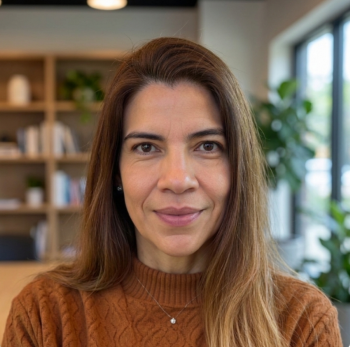
She read encyclopedias cover to cover as a child. She taught herself English and French so she could watch films and read novels in their original language. When her mother fell ill, nine-year-old Catherine learned to cook for the household rather than wait for someone else to fix the gap. None of this was assigned to her. She sought it out.
That pattern, of taking on the unfamiliar before anyone asks, is the throughline of her career.
Graduating too early to start college
Cifuentes-Rojas finished high school at 15. She was Class Valedictorian, a Math Olympiad winner, and the top scorer on Colombia's national ICFES exam in her hometown. But she was too young to enroll in university.
Instead of treating the gap year as a delay, she spent it teaching English in public schools. It was practice for skills she would need later: breaking down complex material for people who are encountering it for the first time, and doing it with patience.
She went on to earn a B.S. in Clinical Microbiology at Universidad del Valle, where she worked on malaria vaccine research at the Malaria Vaccine and Drug Development Center. Seeing immunology applied to a live public health problem, rather than studied in the abstract, is what pointed her toward research as a career rather than a subject she was simply good at.
From cancer immunology to RNA biochemistry
Her M.S. in Cancer Immunology at Pontificia Universidad Javeriana led to a faculty post there, teaching immunology while still in her twenties. She then moved to Texas A&M University for a Ph.D. in Genetics, shifting her focus toward RNA biochemistry and molecular biology.
That was a real pivot, not a small adjustment. Vaccine immunology, cancer biomarkers, and RNA biochemistry are different disciplines with different tools and different questions. Cifuentes-Rojas has said that adaptability, the willingness to reinvent yourself scientifically, is one of the traits that has carried her from one field to the next.
Long non-coding RNA and a national prize
At Massachusetts General Hospital and Harvard Medical School, she spent seven years studying long non-coding RNAs in stem cell biology, first as a postdoctoral fellow and then as an Assistant in Molecular Biology. The work was funded by NIH awards, including an F32 NRSA fellowship and a K99/R00 Pathway to Independence Award.
In 2020, the National Academy of Sciences awarded her research the Cozzarelli Prize in Biological Sciences. It is one of the more selective recognitions in the field, and it came after nearly a decade of work most people outside molecular biology never hear about until a discovery is fully formed.
Building platforms instead of running experiments
After Harvard, Cifuentes-Rojas moved into biopharma. At Sail Biomedicines, she worked as Senior Scientist on circular RNA platform technology, then became Associate Director of Discovery Biology and Interim Head of In Vivo Pharmacology, overseeing target validation.
In 2022, she joined Ginkgo Bioworks as Director, leading Genetic Medicines and Biologics. There, she led the effort to build the company's internal RNA therapeutics platform from scratch, while directing a team of more than 30 scientists in a matrixed environment, across federal programs with BARDA and HHS.
The shift from bench scientist to platform builder is a different kind of work. It means fewer hours at the bench and more time deciding what forty other scientists should be working on, and why. Cifuentes-Rojas has described bridging traditional immunology with computational and AI-driven teams at Ginkgo as one of the harder adjustments in her career, requiring her to learn the technical vocabulary of machine learning engineers well enough to set direction for them.
What the early years still explain
Cifuentes-Rojas often traces her working habits back to that year she spent teaching English before starting college. She calls it a lesson in using unplanned time productively rather than waiting for the "right" moment to begin.
She keeps two cats, Sunspot and Mars, and a Belgian Malinois named Dalton, and takes long walks with him when she needs to think through a decision. Outside the lab, she volunteers at her children's school and at a local animal shelter, and donates to conservation and children's charities including the World Wildlife Fund and ChildFund International.
The distance between a classroom in the Andes and a genetic medicines platform in Boston is considerable. What connects them is a habit she picked up before she was ten: when something needs doing and no one else is doing it, do it yourself.