Can Brainwave Entrainment Become Meditation? Low-Carrier Frequencies, Duration, and Yinnergy
Morgan O. Smith is an author, meditation facilitator, and spiritual teacher with over two decades of experience. His teachings emphasize nonduality, spiritual awakening, and sound technology integration through his Yinnergy Meditation system, which promotes emotional, mental, and spiritual growth.

Brainwave entrainment is often described as something that supports meditation. My own experience led me toward a more radical possibility: properly structured entrainment can become part of the meditation itself. Low carrier frequencies, progressive sound architecture, exposure time, and the relationship between rhythm and awareness eventually shaped the system I developed as Yinnergy.
Why I became interested in low carrier frequencies
My work with brainwave entrainment gradually led me toward progressively lower carrier frequency environments. This did not begin as a theory I wanted to prove. It emerged from experience.
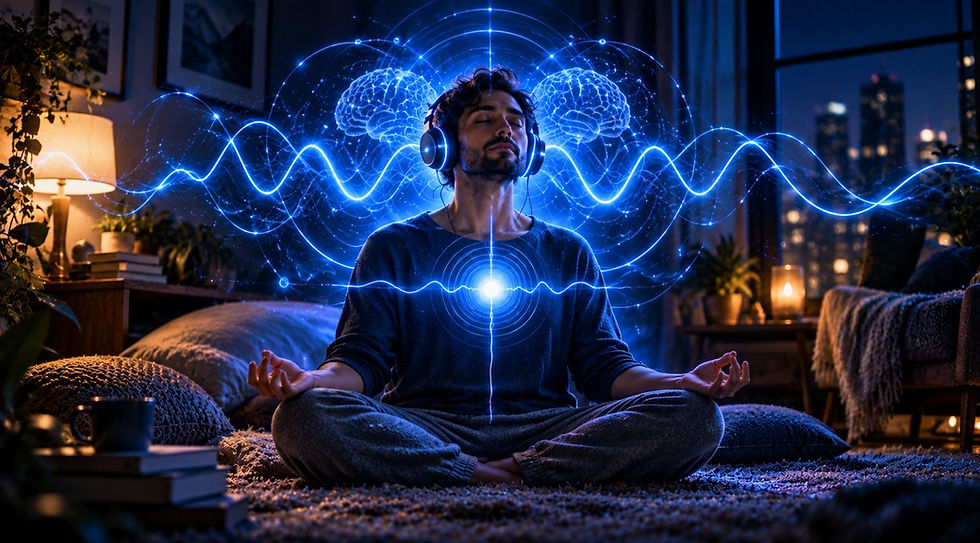
Over years of daily practice, I found that low carrier frequency entrainment produced a qualitatively different meditation experience for me than simply placing a conventional binaural beat beneath music. The experience could become deeply immersive. Instead of feeling as though I were listening to something while trying to meditate, the distinction between sound and meditation could begin to soften.
This became one of the foundational principles behind Yinnergy. My view that low carrier frequency entrainment can become part of the meditation itself comes primarily from sustained personal practice, experimentation, and development. I am not presenting my specific low carrier architecture as a settled scientific conclusion. Experientially, however, the distinction has been profound.
What does “the technology meditates you” mean?
Traditional meditation is often taught through deliberate action: follow the breath, repeat the mantra, observe thoughts, maintain attention, and return when the mind wanders. These are powerful approaches, but they place much of the responsibility for generating and sustaining the practice on the meditator.
Entrainment introduces another possibility. You put on the headphones. The auditory stimulation begins. The nervous system encounters an organized rhythmic pattern. The session develops over time.
Depending on how the audio is designed, rhythmic stimulation can encourage movement toward slower or faster patterns associated with different states, while binaural methods present different signals to the two ears within one coordinated auditory experience.
The practitioner is therefore not merely listening to music or nature sounds while attempting to meditate. The entrainment is part of the mechanism shaping the state. That is what I mean when I say the technology can “meditate you.”
The goal is not unconsciousness. It is a shift from having to consciously manufacture every aspect of meditation toward entering a process already structured to unfold.
Why duration matters in brainwave entrainment
A meditation session is not a light switch. What happens during the first five minutes can be very different from what happens after twenty, thirty, forty-five, or sixty minutes. Attention settles. The body adjusts. Thought patterns change. Sensory experience can become subtler.
Positive research on binaural beats has also found that longer exposure periods can be associated with stronger outcomes. That aligns with something I have emphasized in my own practice for years: duration is part of the architecture. A frequency tells you only part of the story. How long you remain within a rhythmic environment may matter as well.
Why rhythm has always belonged to meditation
Using rhythm for meditation is not as modern as it may sound. Chanting uses rhythm. Mantra uses repetition. Drumming uses rhythm. Breathwork creates rhythm. Walking meditation uses repeated movement. Prayer beads structure attention through repetition.
What contemporary sound technology adds is precision. Carrier frequencies can be selected. Beat relationships can be calculated. Multiple layers can operate simultaneously. Stereo placement can be controlled. Transitions can be timed.
Rhythms can change across an entire session. This creates another contemplative possibility: the meditation environment itself can be engineered to evolve.
How Yinnergy grew from this exploration
I began meditating in 2003 and created Yinnergy in 2010 after years of working with meditation and brainwave entrainment. As the practice and experimentation developed, I became increasingly interested in the relationship between sound, attention, brain rhythms, nervous system states, altered states of consciousness, and spiritual development.
Eventually, experimentation became architecture. Architecture became a system. That system became Yinnergy Meditation. Rather than building a session around a single binaural beat, I began working with progressively structured auditory environments involving different carrier relationships, beat frequencies, layers, phases, and depths. The frequency architecture became part of the practice.
What happens when entrainment becomes a discipline?
My interest is not limited to whether one binaural beat can produce a short-term effect. I am interested in what happens when entrainment becomes a meditation discipline.
What happens when it is practiced consistently?
What happens when frequencies progress over months and years? What happens when the practitioner develops alongside the system?
What happens when sound becomes a vehicle not only for relaxation but also for increasingly deep contemplative states?
Those questions move brainwave entrainment beyond novelty. They turn it into practice.
From brainwaves to consciousness
Technology can take us surprisingly far into the mechanics of meditation. We can calculate frequencies. We can engineer rhythmic environments. Electroencephalography (EEG) can measure aspects of neural activity. Neurofeedback can make some of that activity visible.
But eventually, another question appears. A frequency is heard. A thought is known. A state changes. An experience begins and ends. What knows that any of this is happening?
For me, this is where brainwave entrainment becomes more than sound technology. It becomes part of an investigation into consciousness.
Why I created Yinnergy Flow
The deeper Yinnergy system developed as a progressive meditation path, but not everyone wants to begin with an intensive system. Over time, another question became important to me: How can I translate what I have learned from more than two decades of meditation and entrainment into something people can actually use as part of ordinary life?
That question helped lead to Yinnergy Flow. The intention was not to make the technology simplistic. It was to make the experience of using it simple.
The practitioner does not need to understand EEG, carrier frequencies, binaural mathematics, or auditory processing before beginning. Put on the headphones. Choose a session. Enter the practice. The complexity can remain underneath the experience.
Experience meditation differently with Yinnergy Flow
Brainwave entrainment begins with rhythm, but it does not have to end there. Rhythm can become structure. Structure can become immersion. Immersion can reduce unnecessary effort and open the possibility of deeper meditation.
I did not simply want technology that played while I meditated. I wanted to explore whether technology itself could participate in producing the meditative process. That exploration became Yinnergy.
If you’re interested in exploring the relationship between neuroscience, meditation, and nondual realization, my book Bodhi in the Brain (available on Amazon and Barnes & Noble) delves deeper into these topics.
For ongoing insights and discussions, connect with me on Instagram, YouTube, and my blog, where I share reflections on consciousness, self-inquiry, and the lived experience of awakening.
Read more from Morgan O. Smith
Morgan O. Smith, Meditation Facilitator, Spiritual Teacher & Creator of Yinnergy
Morgan O. Smith is a spiritual teacher, author, and meditation facilitator with over two decades of experience in mindfulness and nonduality teachings. Known for his pioneering Yinnergy Meditation system, he blends sound technology with traditional spiritual practices to promote deep personal and spiritual growth. His work emphasizes direct spiritual experiences, self-realization, and the clearing of emotional and mental blocks. Morgan's teachings are rooted in nonduality, and he encourages seekers to explore deeper states of consciousness through meditation and self-inquiry.
Reference: