

Building a Multi-Award-Winning Pain Relief Clinic – Exclusive Interview with Jamie Lloyd
From launching his clinic during lockdown while working multiple jobs to earning 10 industry awards, Jamie Lloyd’s journey reflects resilience, determination, and a commitment to helping people overcome chronic pain. In this interview, he shares how his personal experiences, clinical expertise, and Clinical Reset™ approach shape his work in pain rehabilitation, personalised care, and helping clients regain confidence in everyday life.
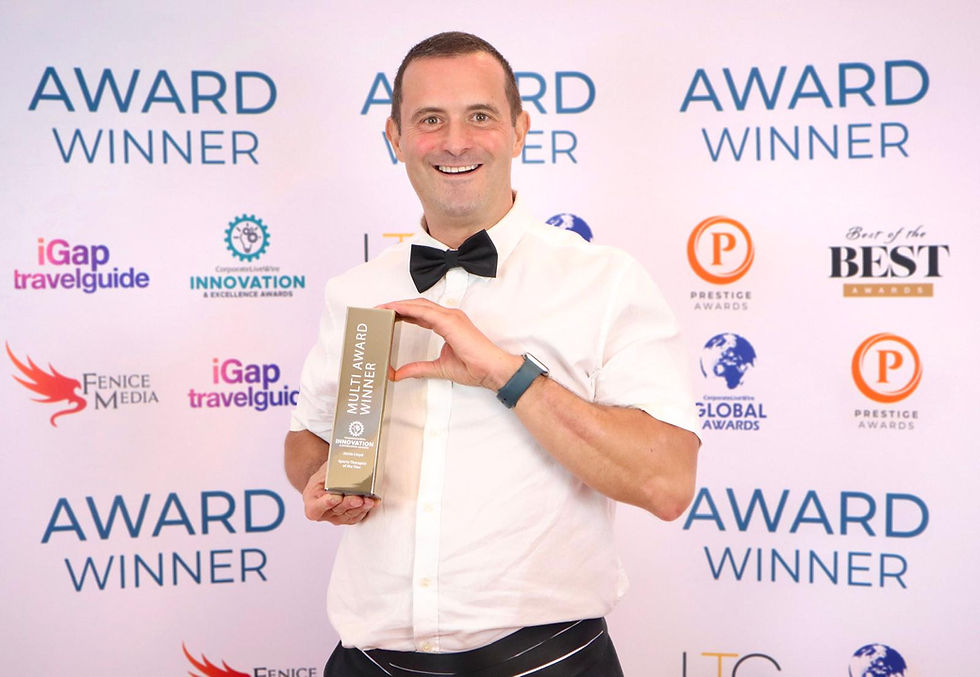
Jamie Lloyd, Chronic Pain & TMJ Specialist
You opened your clinic during lockdown while gardening by day and delivering pizzas at night. How did you build it without government funding, a business loan, or a mentor and become fully booked within six months?
During lockdown, I opened my clinic with no government funding, no business loan, and no mentor. I was gardening during the day and delivering pizzas for Domino’s at night to pay the bills while building the business.
I believed in what I wanted to offer, but I still had to make it work practically. That meant taking the jobs available, developing my clinical skills, and learning how to run a business at the same time.
Within six months, I was fully booked. Word-of-mouth recommendations played an important part in that growth. People shared their experiences with friends, relatives, and colleagues, helping me build a reputation.
From the beginning, I wanted clients to feel listened to and understand the reasoning behind their care. That remains central to the clinic today.
Looking back, I am proud that I was prepared to do the work needed to get started. Those gardening jobs and pizza deliveries helped make the clinic possible.
What did 12 years as a London firefighter and 20 years in personal training teach you that you now bring to your work in chronic pain rehabilitation?
Firefighting taught me to stay calm, assess situations carefully, and communicate clearly when someone was frightened or vulnerable. You learn to pay attention, work within your capabilities, and recognise when additional support is needed.
Personal training taught me how differently people respond to exercise and advice. Two people can have similar goals but need very different starting points. Their confidence, previous experiences, responsibilities, and available time all matter.
I bring those lessons into my clinical work. Someone might book because their back hurts, but their main concern could be losing their livelihood, giving up a sport, or struggling to look after their children.
Understanding that context helps us agree on meaningful goals. My fitness background also helps me think beyond the treatment appointment. Where appropriate, I want to help people rebuild strength, movement, and confidence over time. The plan needs to fit their life well enough for them to use it consistently.
You have experienced years of back pain, sciatica, injuries, and jaw surgery yourself. How has that influenced the clinic you wanted to create?
My experience includes 12 years of back pain and sciatica, back surgery, 18 years of jaw problems, and major jaw surgery. I have also experienced six shoulder dislocations, two shoulder operations, Achilles tendinosis spanning 30 years, a ruptured hamstring, a knee ligament tear, a fractured ankle, a broken collarbone, a broken hand, and chipped finger bones.
Around 18 months ago, I underwent major dental surgery involving a bone graft and two dental implants. Going through these injuries, operations, and recoveries taught me resilience, patience, and the importance of adapting when progress is difficult. They also showed me how pain can affect confidence, sleep, work, and family life.
I remember wanting someone to listen, explain things clearly, and help me understand my next steps. That shaped the clinic I wanted to create, somewhere people have time to tell their story, ask questions, and participate in decisions. It is one reason I offer 90-minute appointments.
My history reminds me to ask rather than assume, personalise care, and recognise when another professional’s expertise is needed.
When someone arrives after years of pain and several unsuccessful treatments, how do you approach their assessment and agree on a way forward?
I begin by listening to their story. I want to understand how the problem developed, what has been investigated, which treatments they have tried, and what helped, even temporarily.
I also ask what the pain is preventing them from doing. That gives us a starting point for goals that matter to them.
Each treatment is informed by the biopsychosocial model of pain. I consider physical findings alongside psychological and social influences, including sleep, stress, beliefs about pain, work, and daily responsibilities.
I take a holistic, full-body approach, assessing relevant areas beyond the site of pain without assuming that every finding is causing their symptoms.
My 90-minute appointments give us time to explore that picture and discuss a manageable plan. This may involve hands-on treatment, rehabilitation, self-management, or referral.
When someone has experienced repeated disappointment, I think it is particularly important to explain the reasoning clearly, review progress, and avoid making promises that no practitioner can guarantee.
What is your Clinical Reset™ approach, and how do assessment, treatment, and retesting help you personalise care?
Clinical Reset™ is my structured approach: Assess, Measure, Treat, Retest, and Adapt. First, I assess the person’s symptoms, history, and goals. I also carry out relevant orthopaedic and range-of-movement testing, based on the Jing Method, before and after every session. This provides measurable outcomes, helps evaluate their response to treatment, and guides a results-based approach.
Treatment is informed by the biopsychosocial model of pain and a holistic, full-body assessment. Depending on the individual’s needs, it may include hands-on techniques, movement, rehabilitation, and practical advice.
Retesting helps us check what has changed and decide what to continue or adapt. Alongside clinical testing, we track practical outcomes, such as how comfortably someone can move or perform an everyday task.
An immediate improvement is useful information, but it does not establish the cause of pain or guarantee lasting progress. Follow-up helps us assess whether changes carry over into daily life.
“Reset” describes my working framework, with an emphasis on thoughtful assessment, measurable progress, and ongoing adaptation.
Beyond pain scores, what changes matter most to your clients, and how do you assess progress in movement, confidence, and everyday life?
Pain scores can be useful, but they cannot capture everything that matters to a person. One client’s priority might be sitting through a working day more comfortably. Another may want to return to the gym, walk further, or enjoy a family outing without constantly planning around symptoms.
I ask people what they would like to be able to do and what improvement would look like in practical terms. We then revisit those goals alongside movement, function, and their own account of how things are going.
Confidence matters too. Someone may become more comfortable trying an activity they previously avoided, even while some symptoms remain.
I also ask about sleep, work, and participation in everyday life where relevant, while recognising that these can be influenced by many factors.
For me, meaningful progress means helping someone move towards their own priorities. It needs to be assessed over time, with room to adjust expectations and the plan.
How do you combine hands-on treatment with rehabilitation and self-management to help clients take a more active role in their care?
I see the appointment as one part of a wider plan. Hands-on treatment may help some people feel more comfortable, but we also need to consider what happens between sessions.
Depending on the assessment, rehabilitation might involve gradually building movement, strength, or tolerance for a particular activity. My personal training background helps me adapt exercises to different starting points.
I try to keep self-management practical. A small number of relevant actions that someone understands and can maintain is more useful than a long programme they cannot fit into their day.
We discuss how to pace activities, recognise patterns, and respond when symptoms fluctuate. Where sleep, stress, or other health concerns need further support, working with the appropriate professional can be valuable.
The aim is to help clients understand their options and become more confident in making decisions about their care. Their feedback helps determine what we continue, change, or stop.
What has receiving awards, including Best Small Family Business, meant to you as the founder of the clinic?
Winning 10 awards in 2026 has been an incredibly proud milestone. When I think back to opening during lockdown, gardening by day and delivering pizzas at night, receiving recognition at this level means a great deal.
My 2026 awards include:
Best Small Family Business, Business Awards UK.
Sports Therapist of the Year, Corporate LiveWire, following my win in 2025.
Therapist of the Year, Complementary Health Professionals.
Excellence in Male Health Advocacy, Great British Workplace Wellbeing Awards.
CREA Global Award, Brainz Magazine.
Best Sports Massage & Pain Relief Clinic, Surrey, SME News Business Elite Awards.
Most Innovative Pain Relief & TMJ Clinic, SME News Greater London Enterprise Awards.
Chronic Pain Rehabilitation Excellence Award, SME News Greater London Enterprise Awards.
Best Specialist TMJ Clinic, Surrey, SME News Southern Enterprise Awards.
Personalised Pain Rehabilitation Excellence Award, Surrey, SME News Southern Enterprise Awards.
These recognise different aspects of my work, from chronic pain rehabilitation and temporomandibular joint (TMJ) care to business development and health advocacy.
I am grateful to everyone who has supported and recommended the clinic. These achievements motivate me to keep learning, improving, and earning the trust people place in me.
With multiple award wins behind you, what are you most proud of, and what do you want to develop next for Jamie Lloyd Pain Relief Clinic?
I am most proud of having built a clinic that people actively recommend to others. Jamie Lloyd Pain Relief Clinic now has more than 300 five-star Google reviews, and clients travel from across the UK and overseas to seek our help.
That trust matters to me, and I want to continue earning it. Professional development remains a priority. During 2026, my training has included advanced electrotherapy covering pulsed electromagnetic field (PEMF) therapy, laser, shockwave, and transfer of energy capacitive and resistive (TECAR) therapy, alongside further TMJ education and Level 1 and Level 2 Cranial and TMJ courses. I continually consider how that learning can be applied appropriately.
I am also developing my book, The Jaw Connection, following an offer from Handspring Publishing. Looking ahead, I want to strengthen the clinic’s work across chronic pain and rehabilitation while continuing to develop my TMJ expertise. My focus is on thoughtful growth, clear communication, and helping people work towards meaningful goals.
Jamie Lloyd is the Founder and Clinical Lead of Jamie Lloyd Pain Relief Clinic at Thames Ditton & Esher Golf Club, Surrey. A former London firefighter and experienced personal trainer, his work focuses on chronic pain, musculoskeletal rehabilitation, and TMJ dysfunction.
Read more from Jamie Lloyd







