Bringing Lived Experience Into Medical Conversation
Claire Silverstone-Bright is an author, speaker, and criminology researcher whose work connects lived experience with public education. She is the author of A Life Lived Chronically: Memoir of a DES Daughter and writes on DES, justice, and rehabilitation.

There is a particular feeling that comes with entering a conference where the subject under discussion is also part of your own medical history. You listen with interest, but sometimes with recognition. You encounter the language of research and clinical practice while carrying memories that do not fit neatly into either. You have come to contribute, yet there can still be a quiet question about how to introduce yourself. Patient? Author? Researcher? Advocate?
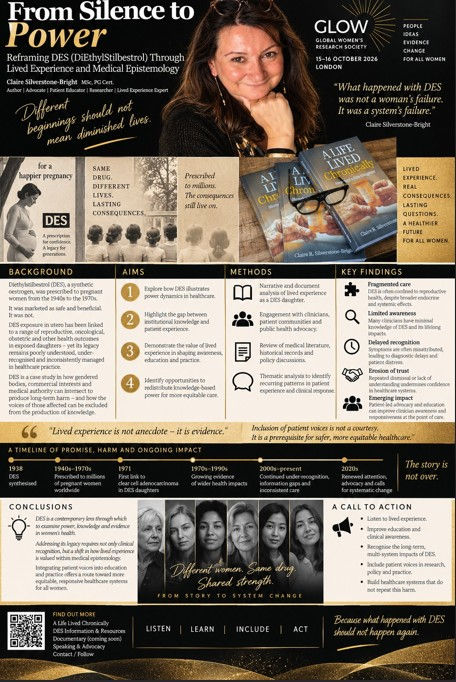
At GLOW this October, where I presented my poster, “From Silence to Power: Reframing DES Through Lived Experience and Medical Epistemology,” I brought all of those identities with me. I also brought the body that would need to recover afterward.
Medical Conversation: From case study to witness
I am a DES daughter. My mother was prescribed diethylstilbestrol during pregnancy, and the consequences of that exposure have become part of the story of my life.
Writing my memoir, A Life Lived Chronically, gave me a way to tell that story in its continuity. Medical care had recorded different parts of it at different times, through different specialisms. Writing allowed me to put those parts back into the life in which they happened.
Earlier this year, I spoke at a gynaecology conference under the title “From Case Study to Witness, The Lived Reality of a DES Daughter.”
That distinction matters to me. As a case study, a person is interpreted. As a witness, she can offer her own account, identify connections, and ask questions about the interpretation.
Speaking in that setting meant bringing a lifetime of experience into a room accustomed to discussing bodies through clinical knowledge. It also meant accepting the vulnerability of making that experience public.
By the time I arrived at GLOW, I had already begun exploring what it means to make that move. It still took courage.
What a person can bring
At GLOW, I was conscious of bringing an explicitly lived experience perspective into a predominantly medical environment. I wondered how many others were there in a similar capacity.
My poster asked questions about how knowledge is recognised, whose account carries authority, what happens when a person’s experience falls between specialisms, and what can be missed when an unfamiliar history is treated as peripheral.
“Medical epistemology” can sound remote from everyday life. For me, it reaches into the consulting room. It concerns what is accepted as knowledge, who is believed, and how a person’s account enters the process of understanding what is happening to her.
A personal account cannot answer every clinical question. It can reveal questions that deserve to be asked. It can describe the cumulative burden of repeatedly explaining a medical history. It can show how separate appointments and diagnoses interact within one life. It can explain why uncertainty, communication, and recognition matter long after a consultation ends. I wanted to bring that continuity into the conversation.
Gratitude, questions and a place in the discussion
My relationship with medicine holds both gratitude and wariness. I have depended on clinical expertise. I have also had reasons to question how my experience has been understood. Both belong in an honest account.
Entering these rooms gives me an opportunity to engage with people whose knowledge differs from mine and to learn. It also gives me an opportunity to contribute the understanding I have developed through living, researching, and writing about DES.
My academic training helps me frame an argument. My experience helps me understand why the argument matters. Neither requires me to leave the other at the door.
That is something I hope my presence communicated: a person can be affected by a subject and capable of thinking critically about it.
The body comes too
GLOW was fabulous. It was also physically exhausting. That combination belongs in this story. The effort of travelling, presenting, concentrating, and meeting people does not disappear because an opportunity is valuable.
There is a particular tension in advocating for greater recognition of lived experience while managing the effects of that experience throughout the day. The contribution people see may occupy a short conversation beside a poster. The preparation and recovery extend beyond it.
I wanted to be there, and I was glad I went. Afterward, I needed rest. Those facts sit comfortably together.
What I hope remained
I cannot know exactly what impression I made on everyone I encountered. I hope I made DES more visible. I hope the poster encouraged someone to consider what a patient’s account might add to a clinical understanding, or to recognise a question that deserves further attention.
I also hope I conveyed that lived experience can contribute analysis as well as testimony. We can describe what happened to us, reflect on how it was understood, and participate in thinking about what should happen next.
For me, entering the room was an act of authorship. I was there with my own questions, my own interpretation, and something I wanted to contribute.
That is what I hope to keep doing, and what I hope becomes possible for more people whose lives are being discussed in rooms they have rarely been invited to enter.
Read more from Claire R. Silverstone-Bright
Claire R. Silverstone-Bright, Author, Expert by Experience & Criminologist
Claire Silverstone-Bright is an author, speaker, and criminology researcher working at the intersection of hidden medical harm, justice, and rehabilitation. Her memoir, A Life Lived Chronically: Memoir of a DES Daughter, explores the lifelong impact of DES exposure and the wider consequences of being medically harmed, misunderstood and unheard. Through her writing, public speaking, and research, Claire examines how identity can be rebuilt after adversity. Her mission is to transform lived experience into public education, compassion, and meaningful change.