AI Can Write Your Speech, but Should It?
Sonia Maslovskaya is an award-winning public speaking and communication coach, marketing executive, and Fractional CMO. With a background in linguistics and intercultural communication, she combines storytelling, strategic messaging, and business leadership to help people communicate with confidence and impact.

When you have a speech or presentation coming up, it's tempting to open ChatGPT, Gemini, Claude, or another AI chatbot and ask it to write everything for you. Why spend hours working on a speech when AI can produce one in seconds?
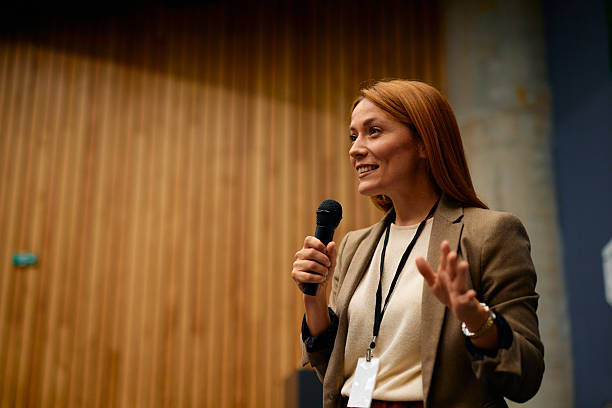
I understand the temptation. We're constantly told to work smarter, not harder, and AI can save us time. But as a public speaking coach, I want people to think twice before handing over their speeches to a chatbot.
The danger isn't that AI will produce a bad speech. It might produce a perfectly competent one. The problem is that its language and ideas can sound familiar, even when the subject is deeply personal. AI may produce a perfectly coherent and polished speech, but will anyone remember it? And, more importantly, will they remember you?
Where do your ideas come from?
In an essay published by the University of Oxford's Institute for Ethics in AI, Xiaolan Deng explores two forms of creativity: original and associative creativity.
Associative creativity involves connecting existing ideas in new ways. AI can do this remarkably well. It can suggest unexpected metaphors, connect seemingly unrelated concepts, and find fresh ways to structure an argument.
Original creativity, as Deng defines it, involves something different. It comes from subjective experience and intentionality: the personal experiences, qualia, emotions, and deliberate choices that are uniquely yours.
Consider what this means for public speaking.
AI can write a speech about overcoming adversity. It can construct a compelling narrative and suggest a memorable closing line. But it doesn't know what you went through, what the experience taught you, or how it changed your understanding of the world. Unless you bring those details into the process, the speech will rely on general ideas about adversity rather than the lessons you personally learned.
Your audience can find general advice almost anywhere. What they cannot get from anyone else is your particular perspective and the conclusions you've reached through your own experience.
If you want your speech to stand out, don't ask AI to supply the substance. Give it your substance, and let it help you structure it.
Before you ask AI to write your speech, get clear on your intention
When I coach someone on public speaking, the first thing I want them to do is get exceptionally clear on the intention behind their speech.
Do you want to educate, motivate, inspire, persuade, entertain, or transform your audience in some way? What is the purpose of your presentation? What do you want it to accomplish?
Many speakers start writing or designing slides before they have answered these questions. AI makes it even easier to skip this step. Enter a topic, and within seconds you can have an outline, a script, and a polished presentation. But a topic is very different from a message.
Here's an exercise I use with my clients.
Imagine you've been promised 30 minutes on stage. Just before your presentation, the organizers approach you with an apology. They're running behind schedule, and they can give you only five minutes.
What would you say? More importantly, what is the one thing you want your audience to remember after you've left the stage?
Your answer is the core message of your speech. Once we identify it, we can build the speech around it rather than trying to make every interesting thought fit.
My approach is to write the conclusion first. What do you want your audience to understand, believe, or do by the time you finish speaking? Once that is clear, we develop an opening that complements the conclusion and draws people into the message. Only then do we build the supporting points.
There's another principle I teach my clients: in every presentation, the audience is the main character. You, as the speaker, are the co-star. Your slides? They're the supporting cast.
Your job isn't to prove how much you know. It's to take your audience somewhere. You might want them to reconsider a belief, understand something in a new way, or feel compelled to act.
Once you understand that, your preparation changes. Instead of asking, "What do I want to say?" you start asking, "What does my audience need to hear?"
AI can help you organize your ideas, but it cannot decide your intention for you. That responsibility belongs to the speaker.
When your speech is a story, start with your experience
Personal storytelling requires a different kind of preparation.
When I work with a client who wants to tell a personal story, I ask them to write freely about their memories, thoughts, feelings, and experiences. I don't want them worrying about chronology, the perfect opening, or whether every sentence sounds polished. At this stage, editing can get in the way. I want the raw material first. Only then do we decide how to shape it.
A story might unfold chronologically, following events in the order they happened. It might build toward a pivotal moment, like a mountain rising toward its peak. Or it might follow a rise, fall, rise structure, showing how a setback led to a different kind of strength or understanding. The structure should serve the story, not the other way around.
Once you've captured your thoughts and experiences, AI can help you explore different narrative structures, identify a turning point, or determine which details best support your message. But it shouldn't invent the emotional substance of your story. What happened, what you felt, what you learned, and how the experience changed you are yours to provide.
One rule I always follow with my clients: we don't touch the slides until we're crystal clear on the content and flow of the speech. Visuals should support the speech, not become a crutch or a teleprompter.
Where AI can be useful
None of this means you need to do everything yourself. AI can be an incredibly useful tool, particularly when it comes to research.
If you're preparing a presentation that requires statistics, industry insights, or academic research, AI can help you find relevant sources, summarize research papers, compare findings, and analyze data. It can also help you explore an unfamiliar subject and identify questions worth investigating.
This can save hours of work. But don't confuse a useful research assistant with an infallible source of information. AI tools can misrepresent findings, produce inaccurate citations, or confidently present incorrect facts. Check the original sources, verify statistics and quotations, and make sure the evidence actually supports your argument.
Use AI to accelerate your research, not to eliminate your responsibility for getting the facts right.
AI can also help you structure a speech, strengthen transitions, explore metaphors and alliteration, and develop different ways to open a presentation. You can ask it to challenge your reasoning, identify gaps in your argument, or suggest alternatives when a section isn't working.
The key is to treat its suggestions as options, not instructions. You remain responsible for deciding what belongs in your speech and what doesn't.
In the age of AI, your humanity is your advantage
The appeal of AI is efficiency. It can organize thoughts, strengthen arguments, and take hours of research off your hands. Used thoughtfully, it can make you a more effective communicator.
But the pursuit of the perfect speech can become a distraction from the reason people listen in the first place.
Audiences want a perspective that makes them think, a story that makes them feel, or an insight that changes how they see the world. They want to hear from someone who has lived, learned, struggled, made mistakes, and found something worth sharing in the process.
That doesn't require a flawless performance. Often, the moments that connect a speaker with an audience are the ones that feel least rehearsed: an admission the speaker hesitated to make, a lesson learned the hard way, an unexpected laugh, or a personal detail that seemed too raw to share.
So by all means, use AI. Let it challenge your thinking, help you find the structure, and take some of the busywork off your hands. Just don't hand over the part that matters most.
In a world where everyone can generate the perfect words, the courage to share something vulnerable and the willingness to speak from real human experience, even when it's messy or imperfect, are what make people listen.
Read more from Sonia Maslovskaya
Sonia Maslovskaya, Public Speaking & Communication Coach
Sonia Maslovskaya is a public speaking and communication coach, marketing executive, and Fractional CMO who helps professionals and business leaders communicate with clarity, confidence, and impact. With a master's degree in Linguistics and Intercultural Communications, she combines expertise in language, storytelling, and audience engagement with hands-on business leadership experience. She previously served as Member Leader of the Forbes Coaches Council Public Speaking Group and received the Forbes Coaches Council Member Leader Award for Best Group Event in 2021. Her recognitions also include the Los Angeles Tribune Citation of Excellence Award in 2025 and Marquis Who's Who Honored Listee status in 2024.