

Your Ancestors Are Not Just Dead People, They Are a Living Framework
Updated: Jul 24
Written by Dr. Asanee Brogan, Ori Alignment Coach
Dr. Asanee Brogan is an Ori Alignment Coach, Ifá educator, and author. She is the founder of Asanee 44, a spiritual brand rooted in the Ifá tradition that offers lineage-based guidance and support through Ifá divination, Odu Ifá wisdom, and Ori-centered ancestral work. She is also the host of the African Spirit Reintegrated + Reimagined podcast.

Western culture teaches us to grieve our deceased loved ones, bury them, and move forward. When someone dies, you attend the funeral, keep their photo on the mantel, and eventually learn to live without them. That is the script. Grief has a beginning and an end, and once you reach the end, the person you lost becomes a memory instead of a presence.
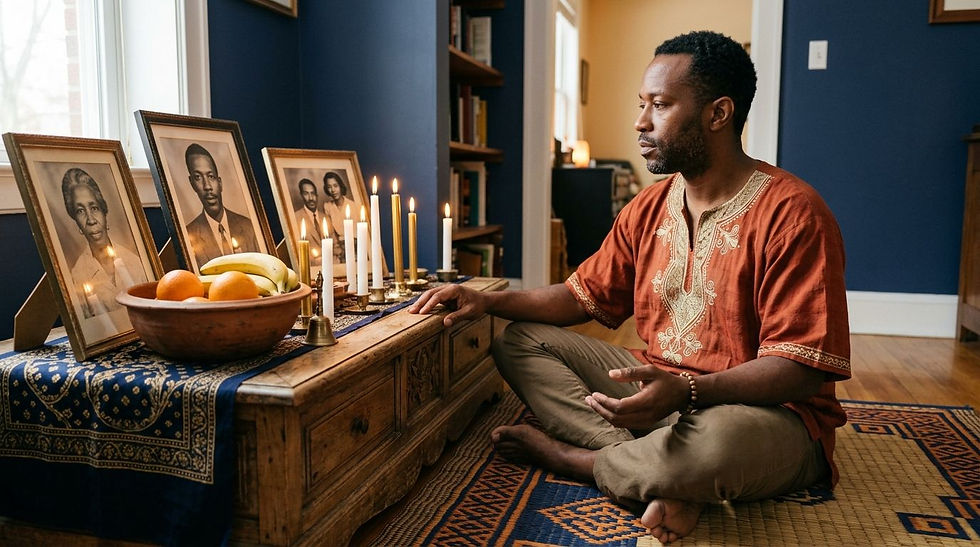
However, that script is incomplete. It treats ancestors as relics of the past. In the Ifá tradition and across many African cultures, ancestors are not just ancient beings. They are inside us. They shape how we love, how we live, how we survive, and how we make decisions, even if we do not know all of their names or narratives.
Our ancestors are not just dead people. They are the blueprint of a living framework stored deep within our essence.
The DNA of memory
This is not just tradition or belief. It is biology. Epigenetics has shown that trauma and resilience can be passed down through generations at the cellular level. Descendants of enslaved Africans may carry inherited patterns in their bodies’ responses to scarcity and threats. This is not a metaphor. It is documented in our blood and genetic expression.
That means the instinct to hide what you have, even from people you trust, did not start with you. It started with ancestors who learned that showing off their skills, abilities, or resources could mean death or severe punishment.
The way you read a room before you speak, sizing up who is safe and who is not, did not start with you. It started with people who had to know within seconds whether a look or tone of voice meant danger.
The way you watch your children with a level of vigilance that sometimes exhausts you did not start with you. It started with mothers and fathers who could be separated from their children without warning. They maintained a hypervigilant level of protective awareness within their bloodline as a survival response.
These are inherited survival mechanisms. Someone before you needed them to live, and your mind and body kept the instructions.
However, your inheritance did not stop at survival. Your ancestors also passed down their ingenuity, their joy, and their capacity to love fiercely. The way you care for your family, the way you create, the way you laugh, and the way you enjoy life’s simple pleasures, these aspects of your being came from them too. The same bloodline that holds vigilance also holds resilience, creativity, and celebration.
This is ancestral memory. It is not something you have to imagine or believe in. It is something you can measure.
The wisdom they left behind
Beyond biology lies lived experience. Our ancestors figured out how to survive under conditions most of us will never face, and the lessons they learned did not disappear when they died. Those lessons were passed down through storytelling, discipline, and the way a grandmother stretches a single chicken into three meals. They were also passed down through the way communities established their own banking systems when colonial banking infrastructure was not available to them.
In Ifá and other ancestral traditions, we understand this as ancestral intelligence, the wisdom our ancestors continue to offer through various mechanisms. This is not a closed chapter. It is our living, breathing book of life.
Think about what specific ancestors in your own bloodline survived and how they learned to evolve, such as:
How to build community and sustain stable societies.
How to raise children while living under constant threats.
How to maintain joy and celebration in good and bad times.
How to make a way when there was no map for the road ahead.
None of that knowledge came from a book. It came from a lived journey, and it is still available to you, whether you are aware of it or not.
Ancestral intelligence as social capital
Here is where this stops being sentimental and becomes practical. Ancestral intelligence functions as real capital, just as land, money, or education does.
Communities that remain connected to their ancestral knowledge tend to establish stronger networks. They know how to lean on and into each other. They know how to trust. They know how to organize resources.
This is a tool you can draw from, build on, and hand down, just like anything else of value. When you tap into ancestral intelligence, you are not reaching into the past for comfort. You are reaching into an asset your family has been developing for generations and adding to it before you pass it forward.
What changes when you claim this
Understanding that this framework already exists inside you is one thing. Using it on purpose is another. Here are a few ways to start:
Identify an inherited pattern within your bloodline. Ask where that pattern actually started and who needed it first.
Ask how a specific ancestor survived or thrived. Do not focus only on your general family history. Instead, inquire about specific individuals from your lineage. What did they learn or do to make it through?
Pay attention to areas where you innately draw on wisdom, such as your daily decisions, how you cook, how you discipline, how you save, and how you forgive.
Speak to them. Whether through prayer, ritual, or simply talking out loud, treat your relationship as an ongoing connection.
None of this requires you to believe in anything in particular. The evidence is in your habits, your instincts, and your body.
The living framework
Western culture says your lost loved ones are gone. Ifá and similar ancestral traditions say they are present, active, and still living within us. Your ancestors are the foundation you are standing on right now, whether you have acknowledged it or not.
You are not just remembering them. You are still being shaped and cultivated by them. The only question is whether you claim your inheritance on purpose.
Learning to recognize your ancestors’ presence, receive their gifts and blessings, and build a real relationship with them takes practice and effort.
For guidance on how to go deeper, "Connecting with Your Ancestors: A Practical Guide for Living a Destiny Driven Life" by Dr. Asanee walks you through the process of establishing such a connection.
Read more from Dr. Asanee Brogan
Dr. Asanee Brogan, Ori Alignment Coach
Grounded in years of study and practice within the Yoruba-based Ifá tradition, Dr. Asanee Brogan creates accessible learning resources. These tools guide individuals toward ancestral reconnection and Ori alignment. Through Asanee 44, she provides Ifá divination, rituals, products, courses, and more that honor African spirituality with authenticity and cultural integrity.







