

Why Talented People Stall, and What Confidence Has to Do With It
Updated: 3 hours ago
Written by: Demetra Moore, Leadership & Communication Coach
In my coaching practice, I meet the same kind of person again and again. They are capable. They have done the work, earned the results, and can point to a track record that speaks for itself. Yet in the moments that matter most, when it is time to speak up, make the call, or put themselves forward, they hold back. What stops them is almost never a missing skill. It is confidence.

That word gets used loosely, so let me be precise. By confidence, I mean the belief that you can act well even when you are unsure of the outcome. It is the most encouraging part of my work because, unlike raw talent, it can be built. Recent data from the field, long-standing research in psychology, and my own work with clients all point the same way.
What capable people struggle with
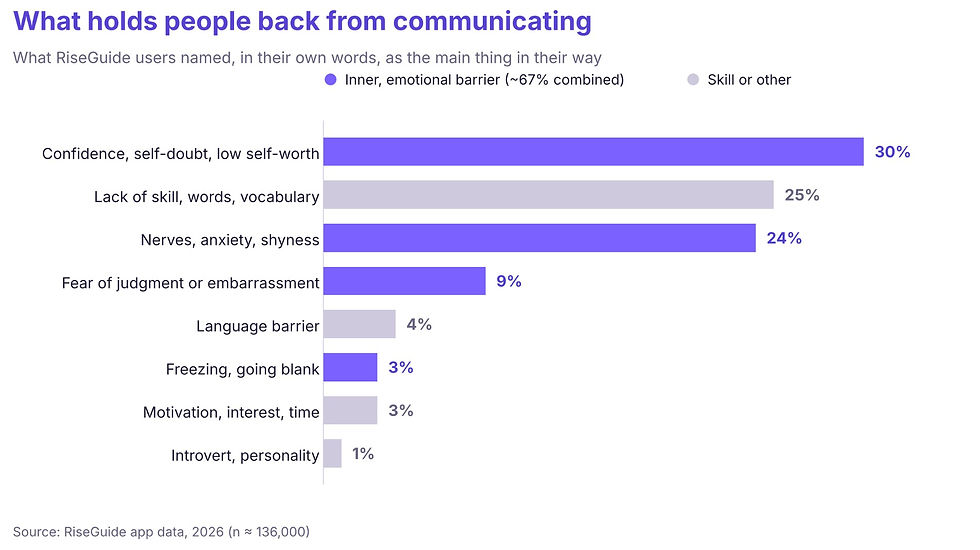
RiseGuide, the expert-led self-improvement app I consult for, recently surveyed over 136,000 of its users, asking them what keeps them from communicating the way they want to. The pattern was hard to miss.
About 67% named something internal rather than a gap in ability:
low confidence, self-doubt, or a shaky sense of their own worth
nerves, anxiety, or shyness
the fear of being judged or getting it wrong
Only about a quarter pointed to what you might expect: a lack of the right words or vocabulary. For every person who blamed a lack of skill, more than two named something happening inside them, and confidence or self-doubt alone accounted for roughly a third of all answers.
The same priority shows up in what people choose to work on. About one in four who set a goal in the app pick a path built around confidence.
And this is not unique to one app. The same phenomenon appears across decades of research on how people perform at work, which has also answered another important question.
Why does this happen?
Over the years, a few explanations for this have held up well, and they line up with what I see in the room.
The first is that belief and ability are not the same thing. The psychologist Albert Bandura called the belief that you can carry out a specific action self-efficacy, and he distinguished it clearly from actual competence. You can be fully able to do something and still not believe you can, and it is that belief, more than the underlying skill, that decides whether you attempt it, how long you stay with it, and how you recover when it goes badly.
The effect is measurable. A large review of workplace studies by Stajkovic and Luthans linked higher self-efficacy to roughly a 28 percent difference in performance.
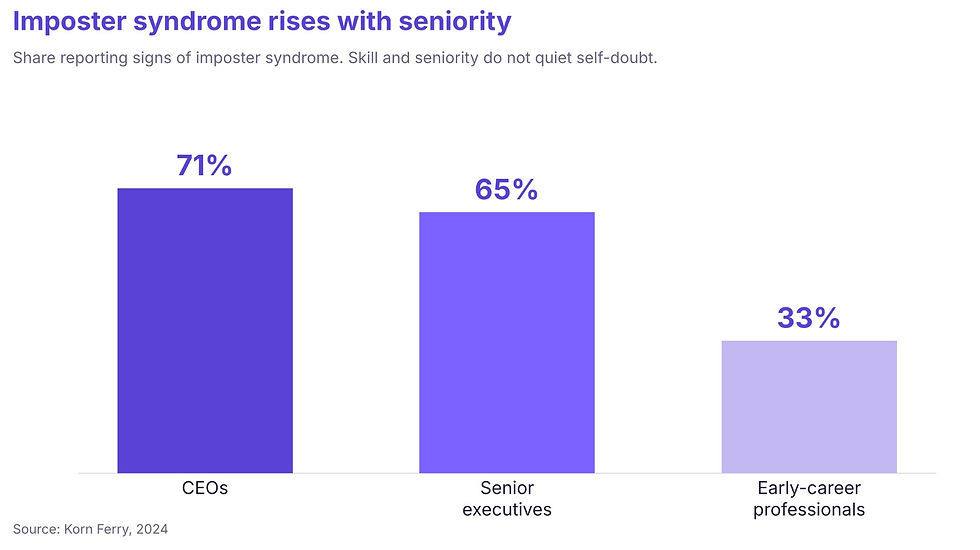
The second is that competence does not cure self-doubt. If it did, confidence would climb steadily with experience and seniority. It does not. Korn Ferry’s 2024 research found that about 71 percent of CEOs and around 65 percent of senior executives show signs of imposter syndrome, compared with roughly a third of early-career professionals. The people with the most proof of their ability are often the ones most convinced they do not belong.
In my own practice, I have come to see a third reason underneath both. Most people lean on motivation, and motivation is a mood. It shows up on the good days and disappears on the hard ones, usually when the stakes are highest. In its place, the inner critic takes over, running a commentary of doubt. Skill does nothing to quiet that voice, and neither does a title. Left unmanaged, it only grows louder as the pressure rises.
How do you train confidence?
This is a fair question because confidence is not a technical skill. With hard skills, progress is easy to see because either you can do the task or you cannot, whereas confidence is harder to measure and looks different from one person to the next. That does not make it impossible to train. The practices I rely on are specific, most of them take only seconds or minutes, and they are the ones I work through with clients and use in my own life.
Name the critic before you argue with it. When self-doubt speaks, most people either believe it or try to win a debate with it, and neither response gets them very far. What helps more is to catch the thought and label where it is coming from, silently or on paper, as in, “That is my inner critic telling me I will embarrass myself.” In Positive Intelligence, the framework I practice, this voice is called the Saboteur, and noticing it this way makes it easier to treat the thought as just a thought rather than the truth. Done consistently, in the moment it shows up, it gets easier over time.
Reset your attention with a ten-second rep. Confidence tends to slip when the mind starts spinning in the minutes before something difficult, and the quickest way back is a physical one. Take three slow breaths and put your full attention on one thing you can actually feel, whether that is your feet on the floor, your hands on the desk, or the air leaving your nose. About ten seconds of it is enough to settle you. Positive Intelligence calls these PQ reps, and they build the same way reps do in a gym. It helps to do a few throughout an ordinary day rather than only in a difficult one, so that the calm is available to you by the time you need it.
Move through a simple rhythm in a difficult moment. Under pressure, I come back to the same three steps with every client, and they take less than a minute to work through. The first is awareness, which means naming what you are actually afraid of, out loud or on paper, such as, “I am afraid this pitch will be rejected.” Putting it into words tends to take some of its power away. The second is acceptance, which means allowing the feeling to be there instead of arguing with it. The fear can be present and you can still act, and letting go of that resistance frees the energy you were spending on it. The third is action, which means choosing the smallest useful next step and taking it, whether that is sending the email, asking the question, or making the call, rather than trying to handle the whole situation at once.
Act before you feel ready, and keep a record of how it goes. Confidence often grows after the fact: you act while still unsure, things turn out better than the Saboteur predicted, and your belief adjusts to match what actually happened. So it helps to pick one thing each week that sits slightly outside your comfort zone, do it on purpose, and then write down how it really went, since memory has a way of erasing the wins. Over a month, that record becomes evidence your doubt has a hard time arguing with.
I leaned on all of this when I left corporate America during the pandemic to build my own practice. Within a few weeks, deals I had counted on fell through, and my Saboteur was relentless, telling me I had gambled everything for nothing. What carried me through was not a surge of motivation but a handful of small habits I could repeat on any day, good or bad: naming that voice for what it was each morning, doing my reps before every uncertain call, letting the fear sit there instead of fighting it, and taking one concrete action a day, whether a single outreach or a single proposal. The situation did not resolve overnight, but my ability to keep acting inside it grew, and that is what eventually helped turn it around. I see clients go through the same shift, usually within a couple of weeks, and it comes from how they learn to meet the pressure rather than from the pressure itself easing.
What this means for leaders
None of this takes anything away from skill. Keep getting better at your craft, because it matters. But skill sits unused until confidence puts it to work, and most of the people I meet already have more ability than they credit themselves with. What they are missing is rarely another qualification. It is the belief that they can use what they already have, and that belief is the trainable part.
So if you see yourself, or someone on your team, being held back by a lack of confidence, treat it as something you can practice rather than a fixed trait. Start small. The next time the pressure rises, name what is happening, accept where you are, and take one clear step. Do that often enough, and the belief catches up with the ability it was always meant to serve. You can begin, as my clients do, exactly where you are.
About the Author
Demetra Moore is a leadership and communication coach, founder of Moore Out of Life, host of The Essence of Leadership podcast and a RiseGuide consultant. She holds a Professional Certified Coach (PCC) credential with the International Coaching Federation, has coached leaders at companies including Google, SpaceX, and Genentech. Her work helps people communicate with confidence and lead with empathy.







