

Turn PCOS Into Your Power – Markéta Čepová on Why You Should Never Settle for Just Managing It
Markéta spent almost a decade feeling like a hypochondriac before she got a name for her pain: PCOS (Polycystic Ovary Syndrome). Like so many women, she was told it was incurable and could only be managed. She decided otherwise and made herself a promise to heal fully. Following her inner voice, she spent years studying and testing everything she learned on herself until she did.
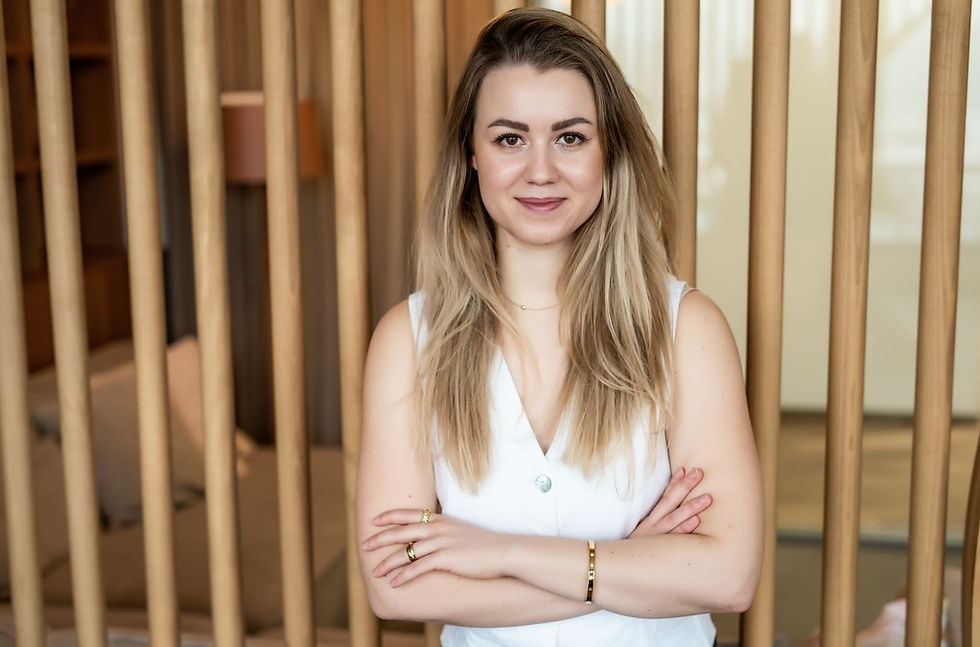
Markéta Čepová, PCOS Advocate & Author
Today, she is the founder of Return to Feminine, the program she wishes she'd had when her symptoms first appeared. She teaches through her own story and creates a container where women come together and, with her guidance, change their lives. Feeling good in her body and mind took Markéta years. What drives her now is knowing that with a proven path, support, and the right tools, it can take another woman weeks or months.
In this interview, she shares the obstacles she faced along the way, what returning to femininity means, and why PCOS can be more than a struggle. It can carry an important lesson, and a woman who chooses to learn it can open a new chapter of her life and step into it as a new version of herself.
What inspired you to create Return to Feminine, and how did your personal experience with PCOS shape the work you do today?
Return to Feminine was inspired by my own journey with PCOS and by how long and lonely it was. My symptoms started when I was 13, but I wasn't diagnosed until I was 21. For eight years, I felt like a hypochondriac. When I finally got a name for it, I was told it was incurable. What followed was figuring out how I could turn my health around on my own, which was often emotionally heavy and lonely.
About two or three years after my diagnosis came my biggest breakthrough. I discovered how disconnected I had become from my own femininity. The urge to create something and share what I had learned had come to me a few times before, but after that breakthrough, it became even louder. Still, I was scared to speak about it and didn't know how to deliver my message. With the help of my coach, I finally started acting on that urge.
Today, I know that what took me over a decade can take another woman weeks or months. That is what drives my work. Nothing I teach comes from a textbook. I lived it, and I had to make it work in my own busy life, through the doubts and obstacles in my own mind. That's why I don't just hand women information. I share what I've lived through the way a friend would, as someone who has walked the same path and is simply a few steps ahead. That makes change so much easier.
Before receiving your PCOS diagnosis, what were the biggest challenges you faced in trying to understand what was happening with your body?
The biggest challenge was that no one was looking at me as a whole. I was living with a missing period, daily acne, thinning hair, digestive issues, redness and hot flushes, and constant anxiety. Yet every specialist treated each symptom separately. That experience showed me two things. First, the system rarely sees us as a whole. Second, even in the hands of a specialist focused on a single symptom, it rarely sees us as individuals. To give you a few examples, my hormone results were compared with general reference ranges and declared fine, even though my cycle was missing. My skin, the body's largest organ and one deeply connected to the nervous system, was treated only with topical antibiotics and creams, while the metabolic, hormonal, and nervous system imbalances underneath were left untouched. Gynecologists offered contraception or injections to bring on a period instead of looking for the root causes.
Searching on my own wasn't much easier. I only spoke Czech, and it was long before AI. The advice I found was scattered and often contradictory, and it was mostly about what not to do and what to be afraid of. That fear only made my anxiety worse.
The fact that it took me so long to get a diagnosis isn't surprising. Up to 70% of women with PCOS remain undiagnosed, and those who do get a diagnosis often wait years for it. According to some studies, diagnosis comes, on average, more than four years after a woman first notices her symptoms, and 47% see three or more health professionals first. At the end of the day, a diagnosis doesn't give you all the answers, but it gives you something to hold on to. Finally, you stop feeling like a hypochondriac.
You've shared that your menstrual cycle returned within three months of making lifestyle changes. What were the most important changes during that time?
The most important change wasn't the lifestyle change itself. It was the change in my mind. After my diagnosis, I was told PCOS was incurable and could only be managed. I decided not to accept that. For the first time, I cultivated a deep trust in my body and its ability to fully heal. I made myself an absolutely clear promise that I would never give up on fully healing and that I would do everything I could to give my body that chance.
That belief is what made the practical changes possible. I changed the way I ate, adjusted my daily routine and sleep, and practiced Dinah Rodrigues hormonal yoga about five times a week. Without the shift in my mindset, I don't think I would have stuck with any of it.
Within three months, my period came back. It was a beautiful milestone, but not the finish line. The deeper ease and freedom I feel today came years later, through the inner work. Lifestyle changes can bring your cycle back. Your inner work decides whether you finally feel at ease.
Through your own research and experience, what have you come to believe is often missing from conventional approaches to managing PCOS?
What's most often missing is the inner world, your mind and your emotional state. Many approaches focus on what you eat and how you move. Those things truly matter, and they can help a lot. But on their own, they address only part of what's really going on inside you. What's left out are your beliefs, your emotions, and your nervous system. When the inner world is left out, a lifestyle change alone may not work fully, and some symptoms, such as anxiety, can persist.
I always invite women to remember how they felt in their bodies as little girls, before the symptoms appeared. Even when their period never fully disappeared or has come back, most of them know that feeling of ease isn't fully back yet.
When I speak about conventional approaches, I mostly mean the guidance women find outside of doctors' offices. Unfortunately, some women still encounter contraception offered as the only solution. Not everywhere and not from every doctor, but it still happens. I don't even consider that an approach to healing.
So my message is simple. Never settle for just managing it. PCOS can be fully healed, including the anxiety and the tension in your body. I'm living proof.
What misconceptions about PCOS and natural symptom management would you most like to help women understand?
The first misconception hides in the words “symptom management.” So many women believe that keeping their symptoms under control is the best they can hope for. I want them to aim higher because every one of them can heal fully. They should never settle for just managing it.
The second is that healing means following a strict diet and giving up gluten and dairy forever. In my work, there's no such rule.
The third is that there's one right way. There's no universal recipe, and I like to say that you are the alchemist. I give you a set of tools and explain how and why each one works. You experiment and find the combination that fits your body because not everything works for everyone. Even in my own experience, something that didn't work for me at one point worked beautifully later.
The last is that healing has to be hard and take ages. When you fully commit and take the right steps in the right order, big shifts can happen surprisingly fast.
Your path isn't about following someone else's rules. It's about cultivating confidence in yourself and finding your own way back to yourself.
What inspired you to develop a healing program for women with PCOS, and what did you want it to offer that you struggled to find yourself?
I created the program to offer what I didn't have: guidance and someone to talk to about what I was going through. I received information piece by piece and spent years figuring out how to actually live it. Looking back, with the knowledge and experience I have now, I would take the steps in a different order. It would have been faster, with far fewer moments of feeling helpless.
Today, the situation is different. Women have access to more information than ever. What they often lack is a way to bring it into their everyday lives, and knowing alone doesn't bring the ease they long for.
I also didn't know back then that the whole experience was trying to teach me something. The process of overcoming PCOS required me to transform from within, and that inner shift changed how I show up in the world, my relationships, my work, and my life in general, for the better.
So I wanted to create a container where real change can happen, together with women who are going through the same thing. So many women tell me they don't want to fight alone anymore. Neither did I.
What can women expect to experience through your program, and what practical tools or insights do you hope they gain?
The most important tool is the path itself. Women get a roadmap with the right steps and, above all, the right order, so they can move past mental blocks and the obstacles of everyday life.
What I really aim for, though, are skills. They learn to build new habits that actually stick and to read their body's signals. These are skills that stay with them forever. The tools are what help them develop those skills, including guided recordings, somatic practices, and step-by-step guides for creating inner change. I explain everything through storytelling, my own experience, and real examples, so it's easy to understand and apply. They get a clear structure, with room to discover what works for them, and they never have to do it alone.
I also see insights as a tool. Sometimes a simple shift in perspective is enough for the same action to bring a completely different result. A woman may keep doing exactly what she did before, yet with a new perspective, the outcome changes.
Every woman starts from a different place and moves at her own pace. I guide her and help her discover the healing power that is already within her because she is the one who heals herself.
The idea of returning to femininity is central to your philosophy. What does that mean to you, and how has it shaped your own relationship with your body?
To me, returning to femininity means coming back to who we naturally are, to our authentic selves. I believe one of the root causes of PCOS is the disconnection from our femininity. By femininity, I don't mean appearance or gender roles. I mean the qualities every woman carries within. Men carry them too, but my work is with women. These qualities include feeling deeply, reflecting, creating, softness, vulnerability, empathy, and devotion. Somewhere along the way, often through experiences in childhood or difficult moments later in life, many of us learned to see these qualities as weakness. Some of us may have suppressed them to protect ourselves. Others kept them but never learned how to live them in a way that doesn't work against us.
Returning to femininity also means living in a way that respects the rhythms, cycles, and natural fluctuations of our bodies, and creating our lives from a place of peace and ease instead of constant pressure and pushing.
For me, reconnecting with my body became the way back to my femininity. When I was disconnected, I simply didn't listen to my body, and so I didn't cooperate with it because, in a way, I hated it. Restoring a loving relationship with my body was part of my return. As I slowed down and started listening to it with love and curiosity, I learned to interpret the messages it was sending me. Now I know it has its own intelligence. Whenever symptoms appear, it's simply my body's way of showing me that something in me or in my life is out of balance.
As you continue developing Return to Feminine and sharing your work on Instagram, what message would you like to leave with women who are still searching for answers about their PCOS?
If most of your days revolve around your symptoms and often feel like suffering, trust that despite the hardship, you're exactly where you need to be, even if that idea seems ridiculous to you right now. Never give up on feeling good because healing fully and glowing is meant for you too.
If you're currently looking for answers, know that they're already out there. So many women who have overcome PCOS are generously sharing what they've learned. But always keep in mind that answers are only one part. The real change happens when you act on them and experience the results for yourself.
Most of all, know this. PCOS can be a gateway to a whole new chapter of your life. When you approach the healing process as a transformation that comes from within, the inner change you create and the skills you build along the way will reach far beyond your physical health. They will change how you feel every day, how much love you feel within you and around you, your relationships, and maybe even your career. One day, you may look back and feel grateful for what PCOS taught you.
That's what my whole program is built around. You can turn PCOS into your power. I'd be more than happy to connect with you on Instagram.
Visit my website for more info!
Read more from Markéta Čepová







