The Neuroscience of Change
Trishiana is a global Feminine Wellness & Sensuous Living Coach, an inspiring author, speaker, and coach. Her work explores how women can access deeper healing, vitality, and creativity by aligning with the body's natural intelligence and higher states of awareness.

Every January, millions of people make sincere promises to themselves. This will be the year they exercise consistently, eat more nourishing food, reduce stress, strengthen their relationships, or finally pursue the project they have been quietly imagining. Yet only weeks later, many quietly return to familiar patterns. For decades, we have been told that lasting change requires greater willpower or stronger discipline. Modern neuroscience tells a more compassionate and ultimately more empowering story. Change does not begin with determination. It begins with biology. Understanding that distinction may be one of the most important shifts available to anyone who has ever tried to change and wondered why it was so difficult. The greatest discoveries of the twenty-first century may not be about what humans can build, but about what humans can become.
The brain was built to adapt, not to keep you comfortable
Our brains are remarkable organs, designed not primarily to make us successful or happy, but to help us survive, adapt, and learn from experience. To operate efficiently in an endlessly complex world, the brain continually transforms repeated thoughts, emotions, and behaviors into familiar patterns that require progressively less conscious effort.
In other words, what we repeatedly experience gradually helps shape who we become. This is not a character flaw. It is intelligent biology.
Understanding this changes the question we ask ourselves. Instead of asking why we cannot change, we begin asking how we can work with our biology rather than against it.
What neuroscience actually is
Neuroscience is the scientific study of the brain, the nervous system, and how they influence our thoughts, emotions, behaviors, learning, memory, and overall health. Drawing from biology, psychology, medicine, and cognitive science, neuroscience seeks to understand one of the most complex structures in the known universe: the human brain.
Over recent decades, advances in brain imaging and research have transformed our understanding of human potential. Scientists now know that the brain is not the static organ it was once believed to be. It is dynamic, adaptable, and continually shaped by experience throughout life.
That discovery changes everything about how we think about change itself. If the brain can change, then perhaps we can too.
Your brain is designed to predict, not to observe
Although the human brain accounts for only about two percent of our body weight, it consumes roughly twenty percent of the body's energy at rest. One of the ways the brain manages this extraordinary demand is by using previous experience to predict what is likely to happen next.
Every routine, every belief, every emotional reaction, and every habit becomes part of a familiar predictive pattern. These patterns allow us to navigate daily life efficiently, but they also explain why meaningful change can feel genuinely uncomfortable. The unfamiliar demands attention, learning, and adaptation.
When we understand this, we stop asking what is wrong with us and start asking what conditions would make the new behavior easier to repeat. That is a fundamentally different and more productive relationship with change.
Every experience leaves a physical trace in the brain
For much of the twentieth century, scientists believed the adult brain was relatively fixed after early development. That view changed dramatically with research into neuroplasticity, the brain's lifelong ability to reorganize itself in response to learning, experience, and practice.
Research by neuroscientists Bryan Kolb, Robbin Gibb, and Terry Robinson demonstrated how experience can measurably alter brain structure and function. A striking human example came from a study published in "Nature" by Bogdan Draganski and colleagues, who observed measurable changes in gray matter after adults learned to juggle. The message was significant: the adult brain remains capable of meaningful change.
A useful way to understand this is to imagine walking across an untouched field. The first journey leaves only the faintest impression. Walk the same path repeatedly, and a trail begins to form. Continue, and eventually there is a well-worn road. Our brains adapt in much the same way. Repeated experiences strengthen neural pathways. Repeated behaviors become increasingly familiar. Repeated responses become increasingly automatic.
The brain does not simply remember what is important. It becomes more efficient at what it repeatedly practices.
Why information alone does not create transformation
Have you ever read an inspiring book, attended an extraordinary event, or listened to a powerful conversation, only to discover that very little actually changed afterward? Most of us have had that experience.
Information expands awareness, while transformation requires integration. We can intellectually understand that we should exercise more, sleep better, manage stress, or change a pattern of behavior. Knowing and doing, however, are very different neurological processes. Lasting behavioral change requires repeated experience until healthier responses become increasingly natural.
Learning begins cognitively, while transformation becomes biological.
The nervous system: The hidden gatekeeper of change
One of the most important insights emerging from neuroscience is that chronic stress does not simply affect how we feel. It influences how the brain functions and adapts.
Research by neuroscientists Richard Davidson and Bruce McEwen, including work published in Nature Neuroscience, has shown that prolonged stress can affect neural systems involved in attention, emotional regulation, memory, and decision-making. Encouragingly, these same systems also retain the capacity to adapt through supportive experiences and intentional practices.
When the nervous system perceives persistent threat or overwhelming stress, the brain naturally prioritizes protection. Creativity narrows. Curiosity diminishes. Patience becomes more difficult, and decision-making becomes increasingly reactive. This is not weakness. It is biology attempting to protect us.
Our ancestors relied on rapid survival responses when confronting physical danger. Today, many people activate those same stress systems through relentless deadlines, financial uncertainty, digital overload, inadequate sleep, relationship strain, and constant stimulation.
This leads to an important realization: before we can create sustainable external change, we often need to create the internal conditions that support it.
The biology is always listening
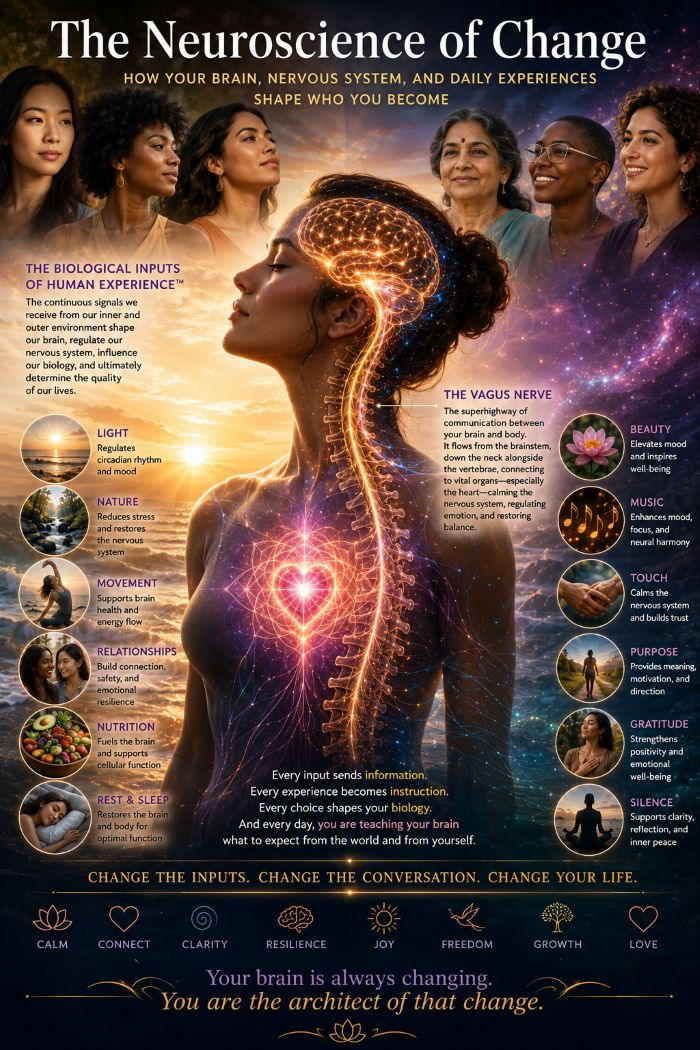
If the brain is continually adapting, what is teaching it? The answer extends far beyond our conscious thoughts. Every moment of every day, the brain and nervous system receive information from both inside and outside the body.
Breath and movement
Light and nature
Sleep and nutrition
Touch and sound
Relationships and conversation
Stress and perceived safety
Beauty, meaning, and purpose
These experiences become biological information that the brain continually interprets. Am I safe? Am I supported? Can I recover? Can I grow? The answers to those questions, shaped by our daily experiences, quietly determine the quality of our attention, emotional regulation, creativity, and resilience.
The biological inputs of human experience
Over recent years, this line of thinking has led to a framework that deserves broader attention: what might be called the biological inputs of human experience. These are the continuous internal and external signals that shape the brain, regulate the nervous system, influence our biology, and ultimately determine the quality of our lives.
Some of these inputs are widely recognized, including breath, nutrition, movement, and sleep. Others are easily overlooked, including natural light, nature, touch, beauty, music, meaningful relationships, purpose, curiosity, gratitude, silence, and even the stories we repeatedly tell ourselves.
None of these inputs exists in isolation. Together, they create the biological environment in which our minds and bodies function.
Breathing patterns influence autonomic nervous system regulation.
Light helps synchronize circadian rhythms that govern hormones, mood, and cognition.
Movement supports brain health and neuroplasticity.
Sleep strengthens learning, memory consolidation, and restoration.
Relationships influence stress physiology and emotional regulation.
Nature, beauty, music, gratitude, and contemplative practices are increasingly studied for their effects on attention and well-being.
This perspective fundamentally changes how we think about personal growth. We are not simply thinking beings trying to change our minds. We are biological beings continually responding to our environment, including the one we consciously create.
Change the inputs, change the conversation
Instead of continually asking how we can force ourselves to change, perhaps the more useful question is: what signals am I repeatedly giving my biology?
What does my morning teach my nervous system? What does my environment communicate to my brain? What do my breathing patterns tell my body? What do my relationships reinforce? What does my sleep, or the lack of it, make easier or harder tomorrow? What am I repeatedly practicing with my attention?
When we improve the quality of the biological inputs we experience each day, we begin changing the conditions under which our brain and nervous system operate. As those internal conditions evolve, new behaviors become easier to sustain. Transformation becomes less about force and more about alignment, less about intensity and more about consistency.
Why we return to old habits under stress
This also helps explain something almost everyone experiences: why old habits return during difficult seasons. Research by Lars Schwabe and Oliver Wolf, published in the Journal of Neuroscience, suggests that under stress, the brain often relies more heavily on established habits than on flexible, goal-directed thinking. The brain seeks efficiency, and familiar pathways require less effort.
Returning to an old behavior during a stressful period does not necessarily mean failure. It often means that the conditions supporting the new behavior need strengthening.
Understanding this replaces self-judgment with self-awareness. Instead of asking what is wrong with us, we begin asking what conditions would make the healthier response easier to repeat. That is a profoundly different relationship with change.
Small inputs, over time, create extraordinary lives
We often underestimate small actions because we evaluate them individually rather than collectively. One conscious breath, one nourishing meal, one walk in morning sunlight, one meaningful conversation, one restorative night of sleep, one moment of genuine gratitude, and one decision to pause rather than react can all contribute to meaningful change.
None of these appears life-changing in isolation. Yet transformation rarely arrives through one dramatic breakthrough. It accumulates quietly. One healthy choice makes the next healthy choice slightly easier. One new behavior becomes increasingly familiar. Weeks become months. Months become years. Gradually, what once required tremendous effort begins to feel natural.
Sustainable change may never have been about perfection. It has always been about practice.
Becoming architects of our own biology
Perhaps the most hopeful insight emerging from modern neuroscience is not simply that the brain can change. It is that we can consciously participate in that change.
We cannot control every circumstance or eliminate every source of stress. But we can become more intentional about many of the experiences we repeatedly provide our brains and bodies.
Every choice becomes information. Every experience becomes instruction. Every repeated action becomes practice. Every day, in ways both large and small, we are teaching our biology what to expect from the world.
The question is no longer whether your brain is changing. It is. The deeper question is: what are you teaching it?
Because your greatest asset is not simply your intelligence, your income, your title, or your accomplishments. It is your capacity to consciously influence the biological inputs that shape your attention, emotions, relationships, decisions, resilience, and creativity.
The future we seek is not created in one extraordinary moment. It is created through thousands of ordinary moments that quietly shape the extraordinary human being experiencing them, one breath, one experience, one conversation, and one choice at a time. Perhaps that is the true neuroscience of change.
Experience the shift
If this article opened something in you, the most effective next step is not more information. It is experience.
The Sensuousity Reset is a guided nervous system restoration experience that puts the principles in this article directly into practice. Through a guided audio activation, reflective embodiment journaling, and science-informed education around stress physiology and regulation, it offers a practical entry point into the kind of biological shift this article describes.
Access the Sensuousity Reset. To subscribe to the complimentary Feminine Wisdom Newsletter and explore ongoing articles, guided resources, and wellness education, visit here.
To explore the full Sensuousity Method, including immersive retreats, private coaching, and educational resources, visit my website.
Read more from Trishiana Shelton
Trishiana Shelton, Feminine Wellness Coach & Global Advocate
Trishiana, a feminine wellness coach, author, & editor of Feminine Wisdom Newsletter, a free feminine wellness publication for high-achieving women that reports on research on how to reduce stress, restore nervous system coherence, and elevate their lives through feminine wellness & sensuous living practices. She integrates modern science, ancient wisdom & lifestyle practices that cultivate vitality & lasting transformation. She is an inspiring speaker, coach, and global advocate for feminine wellness. Her work explores how women can access deeper healing, vitality, and creativity by aligning with the body's natural intelligence and higher states of awareness.
References:
Davidson, R. J., & McEwen, B. S. (2012). Social influences on neuroplasticity: Stress and interventions to promote well-being. Nature Neuroscience, 15, 689 to 695.
Draganski, B., Gaser, C., Busch, V., Schuierer, G., Bogdahn, U., & May, A. (2004). Neuroplasticity: Changes in grey matter induced by training. Nature, 427, 311 to 312.
Kolb, B., Gibb, R., & Robinson, T. E. (2003). Brain plasticity and behavior. Current Directions in Psychological Science, 12(1), 1 to 5.
McEwen, B. S., & Morrison, J. H. (2013). The brain on stress: Vulnerability and plasticity of the prefrontal cortex over the life course. Neuron, 79(1), 16 to 29.
Schwabe, L., & Wolf, O. T. (2009). Stress prompts habit behavior in humans. Journal of Neuroscience, 29(22), 7191 to 7198.