

The Difference Between Honoring Your Ancestors and Romanticizing Them
Written by Dr. Asanee Brogan, Ori Alignment Coach
Dr. Asanee Brogan is an Ori Alignment Coach, Ifá educator, and author. She is the founder of Asanee 44, a spiritual brand rooted in the Ifá tradition that offers lineage-based guidance and support through Ifá divination, Odu Ifá wisdom, and Ori-centered ancestral work. She is also the host of the African Spirit Reintegrated + Reimagined podcast.

"My ancestors got my back." "My ancestors are going to come for you." "My ancestors are all good." You've seen and heard this conversation all over social media, in online circles, and even in real life. It sounds like reverence, but it isn't. It's actually a distortion of how ancestral connections are conceptualized in lineage-based traditional African practices like Ifá.
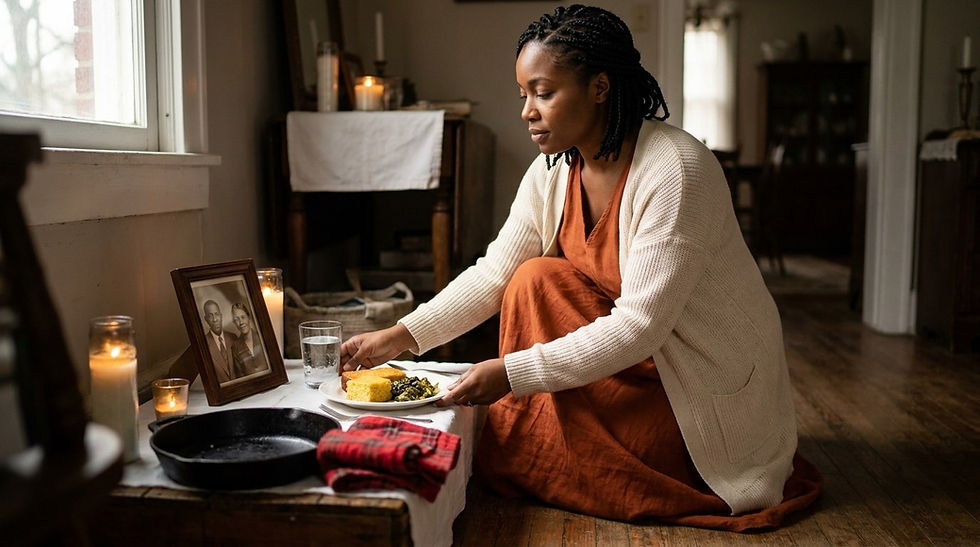
Honoring vs. Romanticizing
Honoring your ancestors means engaging with their memory, their wisdom, their legacy, and the real, defined role they continue to play in your life now. Romanticizing them means treating them as all-powerful, completely benevolent beings with no boundaries on what they can do and no accountability for what they did in the past.
One is a relationship grounded in ancient wisdom. The other is a fantasy that serves the living person more than it reflects the true nature of ancestor veneration.
What romanticizing often looks like
This shows up in ways you've probably already seen many times online or even in person. You may encounter people who:
Use ancestral language as an aesthetic. They line beautifully decorated altars with crystals, sage, bones, and other curios. They speak vague "energy" talk with no real engagement with lineage, history, or tradition. However, ancestors are tied to legacy and lineage. When we engage with them, we operate within the confines of traditional practices passed down for generations.
Believe that once an ancestor dies, everything they did wrong is suddenly wiped away. Thereafter, this person is often spoken about as if they were a perfect being. While many of our ancestors were good people who did amazing things for their communities, none of them were perfect. They had character flaws that we must acknowledge and reconcile if we wish to help them, and ourselves, move forward to the next level.
Saying "my ancestors got my back" as an excuse for bad behavior, as if ancestral protection means immunity. They may use this language to convey the notion that they maintain infinite, boundless protection even when they engage in egregious acts. This is simply not true. Our ancestors punish as well as reward. We can’t cover our ill deeds in the protective arms of our lineage without enduring consequences.
Treat every skill or gift passed down as good simply because it's ancestral. They never identify what their ancestors did wrong with their talents and power. You can honor the intellect or resourcefulness of your ancestors while still calling them out when they operated outside the bounds of balanced character. This is necessary for us to learn how to honor and integrate their skills into our own lives while also correcting the flaws in their behavior.
Talk about ancestors as limitless and all-powerful beings, able to do anything for you with no boundaries. They usually attribute every miraculous or good thing in their lives to their ancestors. While our ancestors play a tremendous role in leaving behind a generous legacy and bestowing blessings upon us, they are not the Supreme Being. They have distinct, finite roles within the cosmos that must be recognized and properly honored within that context.
The same instinct behind the "Back to Africa" movement
This pattern isn't new, and it isn't only about the ancestors. It's the same instinct that drives the romanticization of Africa by diasporians who repatriate or desire to do so. Often, these individuals view the continent as a singular, grandiose homeland, praising only its beauty and ignoring the difficult, adverse realities that exist there as well.
Real honoring of a place or a person maintains both the good and the hard truth. In honoring the good, we also find ways to reconcile the difficult aspects. That's balance. Romanticizing removes the recognition that reconciliation is necessary. This ultimately keeps us in our feelings while we neglect the real work.
What ancestral honor actually requires
Honoring your ancestors isn't a feeling, trope, or trend. It's a practice established in truth, correction, and connection. Among many other things, it includes:
Understanding that ancestors have a defined role in your life, not unlimited power. They help, guide, and intervene within their assigned role. Treating them like an unlimited treasure trove of blessings and protection puts them in the wrong position.
Recognizing that ancestors correct you as much as they protect you. When you do wrong, the response isn't "I'm covered no matter what." Honoring your ancestors means correcting your behavior so the same behavior doesn't repeat in future generations.
Establishing a real, consistent relationship with your ancestors instead of using empty, trendy language to describe them or only invoking them when you need something. That means regular offerings, regular acknowledgment, and regular gratitude.
This is where some people get it mixed up. They believe reverence means never questioning their ancestors' past deeds, never sitting with the consequences of their mistakes, and never expecting to give them anything beyond blind praise. Real reverence questions, corrects, and still shows up with gratitude.
What beginners get wrong about ancestral connection
This mistake doesn't only happen online. It happens in real life too, in conversations with family, in circles of individuals newer to ancestral practices, and everywhere in between.
Someone hears the language before they understand their lineage. They hear "ancestors," "protection," and "guidance," and they run with it. They begin speaking with certainty about a role they don’t know much about and a relationship they haven't invested real time in.
This ultimately boils down to aesthetic banter, and it spreads because it's easier to sound and look spiritual than it is to actually do the work.
Real ancestral work requires your heart and soul. It asks you to understand the roles, limitations, and wider cosmology within which this relationship exists. If you're new to this, the fastest way to get it wrong is to skip the real work of study and application and go straight to using trendy words and phrases.
Connecting with your ancestors the right way
If you're just beginning this relationship, you don't need to start with direct communication or grandiose gestures. Instead, you can begin with the basics and allow your connection to grow from there.
Study how your ancestors function within the cosmological framework of traditional practice. From there, establish a consistent practice of gratitude and honor that helps you create a real connection. Continue the process and allow your relationship to deepen as you grow in wisdom and knowledge.
This is exactly why I wrote Connecting with Your Ancestors: A Practical Guide for Living a Destiny Driven Life. It was published to provide people interested in honoring their ancestors with grounded knowledge and practices for doing so. If you're new to this space and want to go deeper, grab your copy so that you can begin establishing a meaningful relationship with your ancestors today.
Read more from Dr. Asanee Brogan
Dr. Asanee Brogan, Ori Alignment Coach
Grounded in years of study and practice within the Yoruba-based Ifá tradition, Dr. Asanee Brogan creates accessible learning resources. These tools guide individuals toward ancestral reconnection and Ori alignment. Through Asanee 44, she provides Ifá divination, rituals, products, courses, and more that honor African spirituality with authenticity and cultural integrity.







