Reclaiming Intuition in a World of External Authority
Written by Richard Harrison, Founder of Compassionate Breath, Breath, Sound & Meditation Facilitator
Richard Harrison is a breath, sound & meditation facilitator and founder of Compassionate Breath. With a rich background in yoga, meditation, and breathwork, he empowers individuals to transform trauma into resilience through his unique blend of breath, sound, and symbolic geometry.

We live in a world saturated with voices claiming to hold the truth. Everywhere we turn, there are people offering answers, promising transformation, and pointing towards a better way of living. We are encouraged to seek wisdom from those who appear further along the path, the gurus, the teachers, the guides, and the experts.
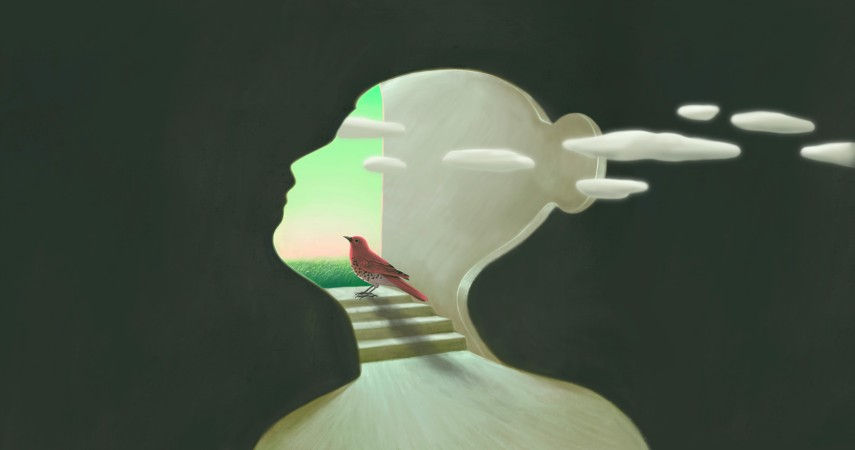
There is undoubtedly value in learning from others. Their experiences can illuminate possibilities we might never have considered, and their guidance can help us navigate unfamiliar territory. Yet somewhere along the way, we can begin to mistake guidance for authority, inspiration for instruction, and the wisdom of another for something greater than our own.
We begin to look outside ourselves for answers to questions that can only truly be explored within. But what if the wisdom we seek has never been absent? What if the voice we have been searching for has been quietly waiting beneath the noise of expectation, conditioning, and external influence?
Perhaps the journey of awakening is not about finding someone who can show us the way, but about remembering that we have always possessed an inner compass of our own.
This is the journey of reclaiming the Inner Oracle, rediscovering our intuition, restoring our inner authority, and learning to trust the quiet intelligence that resides within us.
The myth of the guru: From pedestal to mirror
The archetype of the guru is ancient, born from humanity's longing for guidance in the darkness. In the Vedic tradition, the word ‘guru’ is associated with the dispelling of darkness, representing one who helps another move from ignorance towards insight. When embodied with humility and integrity, this role can be profoundly meaningful.
A good teacher can open doors, challenge assumptions, and introduce us to ways of seeing the world that might otherwise remain beyond our awareness. They can become important companions on our journey of personal and spiritual development.
Yet over time, something can become distorted. What begins as a relationship of learning and reflection can gradually develop into a hierarchy. The teacher is elevated, the student looks upwards, and the distinction between guidance and unquestionable authority begins to blur.
We place teachers on pedestals, seeing their light while overlooking their humanity. We can begin to believe that they possess something we lack, that their understanding is somehow more complete, or that their interpretation of truth should take precedence over our own experience. But a teacher is a mirror, not a master of our inner world.
They may reflect qualities we admire, possibilities we wish to explore, and aspects of ourselves that have yet to be fully recognised. Yet the wisdom we perceive in another does not necessarily originate with them. Often, what we recognise and admire is something that is already present within us, waiting to be awakened.
The pedestal, therefore, can become a place of projection. We place our own capacity for wisdom, understanding, and insight onto another because it feels safer to admire those qualities than to take responsibility for cultivating them ourselves.
The challenge is not to reject teachers or dismiss the value of their knowledge. It is to recognise the difference between learning from someone and surrendering our own capacity to discern. True guidance should encourage us to become more fully ourselves, not less.
The cost of externalising authority
When we continually defer to external authority, something subtle begins to happen. We gradually lose confidence in our own ability to recognise what feels right, what holds meaning, and what is true for us.
At first, this may appear harmless. We seek reassurance, look for confirmation, or follow the advice of someone whose experience we respect. But when this becomes a pattern, our relationship with ourselves can begin to change.
We stop listening as closely to our own instincts. We question our feelings when they differ from the expectations of others. We may even suppress an inner knowing because it conflicts with something we have been taught to believe.
Over time, this can create fragmentation within us. Emotionally, we become increasingly dependent on external validation. We look for approval to reassure ourselves that we are making the right choices. Indecision can become a familiar companion, and when our own truth differs from that of someone we admire, we may experience guilt, shame, or a sense of having somehow betrayed them. Yet perhaps the deeper betrayal is the one we unknowingly inflict upon ourselves.
Cognitively, our ability to question and discern can become diminished. Instead of exploring ideas for ourselves, we begin to adopt the beliefs and perspectives of others. We may confuse familiarity with truth or mistake confidence and certainty in another person for genuine wisdom.
The tension between what we are told and what we intuitively feel can create an uncomfortable inner conflict. Rather than exploring that conflict, we may simply silence the part of ourselves that is asking questions.
Spiritually, the consequences can be even more profound. We can become so focused on the messenger that we lose sight of the message, so devoted to the form that we forget the essence.
We may spend years pursuing enlightenment through external teachings, practices, and authorities, all the while overlooking the possibility that our connection to something greater has never been dependent upon another person.
There is also a quieter grief that can accompany this realisation, the recognition of how long we may have lived outside ourselves, seeking externally what was always whispering within. But this grief need not become regret. It can be a threshold, a moment of recognition that invites us to return to ourselves. Reclaiming our authority is not an act of rebellion. It is an act of remembering.
The moment the mirror cracked
I once revered a teacher whose insight and teachings had played a significant role in shaping my spiritual journey. Their perspective had helped me explore new ways of understanding myself and the world, and I held their wisdom in considerable regard. But there came a point when their position on a deeply personal subject diverged sharply from my own felt truth.
It created a quiet but profound internal conflict. How could someone whose teachings I respected so deeply hold a perspective that felt so misaligned with something I instinctively knew within myself?
For a time, I found myself caught between the authority I had placed in that person and the quiet voice of my own understanding.
It was an uncomfortable place to be. There is a particular vulnerability in questioning someone we have come to admire, especially when their teachings have become part of the framework through which we understand our own development. But something important began to emerge from that discomfort.
Perhaps the question was not whether they were right or I was right. Perhaps the more important question was why I had allowed another person's interpretation to carry greater authority than my own experience.
The moment the mirror cracked, I began to see the projection. This was not about dismissing everything I had learned or denying the value of the teacher's contribution. It was about recognising that their perspective belonged to them, just as my own understanding belonged to me.
I could honour what I had received without feeling obliged to adopt everything that came with it. In that moment, I began to understand that resonance, rather than reverence, must be my compass. Perhaps this is one of the most important transitions we can make on a spiritual journey, moving from the need to believe in someone else's truth towards the willingness to explore and trust our own.
Rediscovering the Inner Oracle
The Inner Oracle is not something we need to acquire. It is something we remember. It is that quiet, intuitive knowing that exists beneath the constant activity of the thinking mind. It is the feeling that sometimes arrives before words, the subtle recognition that something is right or wrong for us, even when we cannot immediately explain why. It is the whisper beneath thought, the awareness that emerges in moments of stillness, and the sense of connection that can arise when we are fully present.
We might describe it as the convergence of intuition, resonance, and a deeper, more instinctive form of knowing. It is not necessarily a voice that speaks in clear instructions, nor does it always offer certainty. Sometimes it appears as a feeling, an image, a dream, or an unexpected insight.
The difficulty is that we have become accustomed to listening to everything except this. Modern life encourages us to prioritise information, analysis, and external opinion. We are surrounded by competing voices, endless distractions, and an almost constant demand for our attention. We are conditioned to look for answers that can be explained, measured, or validated by someone else.
There is nothing inherently wrong with reason or knowledge. Both are valuable, and discernment requires us to engage with them. But when we allow the thinking mind to become our only source of guidance, we risk overlooking another dimension of our intelligence.
The Inner Oracle is not lost. It has simply become quiet beneath the accumulated noise. To rediscover it, we must shift from seeking to listening, from asking others to tell us what is true to developing the awareness to recognise what resonates within us. This begins with stillness.
The 3 gates of the Oracle
There are three qualities that can help us reconnect with our inner knowing: silence, resonance, and trust.
The gate of silence
Stillness is the natural language of the Inner Oracle. When the mind is constantly occupied, it becomes difficult to distinguish our own deeper feelings from the many influences competing for our attention.
Silence creates space for something different to emerge. It does not require elaborate rituals or hours of meditation. Even a few quiet minutes each day can begin to change our relationship with ourselves.
Sit comfortably, close your eyes if that feels natural, and bring your attention to your breathing. As you inhale, gently acknowledge, ‘I am here.’ As you exhale, allow the words, ‘I am listening.’ There is no need to search for an answer. Simply become present with yourself.
The gate of resonance
The Inner Oracle does not always communicate through logical explanations. Sometimes it speaks through the subtle language of resonance, the feeling of expansion or contraction that arises when we encounter an idea, a decision, or a particular direction in life.
When something resonates deeply, we may experience a sense of openness, alignment, or quiet recognition. When something feels misaligned, there may be tension, resistance, or an inner discomfort that is difficult to ignore.
Before accepting an external opinion or making an important decision, pause and ask yourself:
Does this feel true within me?
Does this expand or contract my sense of being?
The intention is not to treat every passing emotion as an absolute truth, but to become more attentive to the information our experience provides.
The gate of trust
Listening to our intuition is one thing. Trusting ourselves enough to act upon it is another. We may hear that quiet inner voice but immediately question it. We may dismiss an intuitive feeling because it cannot be rationally explained, or seek reassurance from others before allowing ourselves to move forward.
Trust develops through experience. It grows as we learn to recognise our own patterns, understand our responses, and become more comfortable with the uncertainty that accompanies personal choice.
One way to cultivate this is through an Oracle Journal. Record intuitive impressions, dreams, symbols, moments of unexpected insight, and situations in which something felt particularly aligned or misaligned.
Over time, patterns may begin to emerge. We become more familiar with the ways our intuition communicates and better able to distinguish deeper knowing from fear, expectation, or impulse.
The aim is not to become infallible. It is to develop a relationship with ourselves that allows us to listen, reflect, and respond with greater awareness.
From seeker to sovereign: Living our own truth
To move beyond the myth of the guru is not to become dismissive of teachers, traditions, or the wisdom of others. It is to redefine our relationship with them.
We move from hierarchy towards reciprocity, recognising teachers as companions rather than gatekeepers of truth. We move from projection towards integration, understanding that the qualities we admire in others may also be qualities waiting to emerge within ourselves.
Most importantly, we move from dependency towards sovereignty. This does not mean that we must walk alone or believe that we already possess every answer. It means that we take responsibility for our own development. We remain open to learning while retaining the freedom to question, explore, and make our own choices.
We can receive guidance without surrendering our judgement. We can appreciate another person's wisdom without making it the foundation of our identity. We can follow a practice, explore a teaching, or embrace a philosophy while remaining aware that our own experience must always be part of the conversation.
There are simple ways to nurture this relationship with ourselves. Daily stillness allows us to hear what has been drowned out by the noise of everyday life. Taking time to reflect before making decisions gives us an opportunity to consult the different aspects of ourselves, the vulnerable child, the thoughtful sage, the courageous warrior, and the curious seeker.
We can learn to recognise when we are acting from fear, when we are seeking approval, and when we are genuinely responding to something that feels aligned.
We can also practise bounded learning, engaging with teachers and teachings while remembering that we do not have to accept everything we encounter. We can take what resonates, question what does not, and leave room for our understanding to evolve.
Perhaps this is the true meaning of spiritual maturity. Not the accumulation of teachings, titles, or experiences, but the gradual development of an inner relationship that allows us to navigate life with greater clarity and authenticity.
The next evolution of spirituality is not necessarily guru-less, but guru-full, an understanding that the teacher we seek externally can also be recognised within.
The inner guru is not infallible. Neither are we. But it is intimately ours, speaking through intuition, experience, reflection, and the quiet language of resonance.
The purpose of a teacher, ultimately, is not to make us dependent upon them, but to help us discover the capacity to walk our own path.
Conclusion: An invitation to remember
Perhaps the greatest teacher we will ever encounter is the one who has been with us all along. The world will continue to offer opinions, philosophies, explanations, and promises of enlightenment. There will always be someone who appears to know more, understand more, or have travelled further along the path, and there is nothing wrong with learning from them. But we must remember that their journey is theirs, just as ours belongs to us.
The wisdom we seek is not necessarily something waiting at the end of another person's teachings. It may be found in the quiet moments when we stop looking outwards and begin listening inwards.
The Inner Oracle does not demand our devotion. It asks only for our attention. It invites us to become still enough to hear, open enough to recognise, and courageous enough to trust.
The myth of the guru may have served its purpose, bringing us to the threshold of discovery. But the next step is ours to take.
We are not here simply to follow another's path, but to become more fully ourselves. Sit in silence. Listen deeply. Honour what you have learned, but never abandon the wisdom of your own experience.
The greatest text you will ever study is your own becoming. The greatest journey is the one that brings you home to yourself. The Inner Oracle? It has been waiting for you all along.
Your journey inwards: An invitation
If something in these words has resonated with you, perhaps it is an invitation to explore your own relationship with intuition, stillness, and inner knowing.
This is not about finding another teacher to follow, another philosophy to adopt, or another voice to tell you how to live. It is about creating the space to listen to yourself more deeply, reconnect with your own sense of balance, and discover what feels authentic and meaningful in your life.
This is the intention behind my work through ‘Compassionate Breath’. Through my work, I offer opportunities to step away from the noise of everyday life and reconnect with the quieter aspects of ourselves. These are not paths towards someone else's version of enlightenment, but invitations to explore your own experience, at your own pace.
I don't claim to have your answers. Nor would I wish to take the place of the inner wisdom that is uniquely yours. My intention is simply to offer a supportive space, gentle guidance, and practices that may help you rediscover it.
If you feel drawn to explore this further, I invite you to visit here. You may find something there that supports your own journey.
After all, the purpose is not to follow another's light indefinitely, but to recognise and learn to trust the light within yourself.
Read more from Richard Harrison
Richard Harrison, Founder of Compassionate Breath, Breath, Sound & Meditation Facilitator
Richard Harrison is a breath, sound & meditation facilitator and the founder of Compassionate Breath, where he integrates compassion, stillness, and remembering to help individuals transform trauma into resilience. Through a unique blend of breath, sound, and symbolic geometry, he empowers others to reclaim their sovereignty and live authentically. Richard’s mission is to harmonise the human experience through coherence and compassion, offering transformative practices that resonate deeply with those seeking healing and alignment.