Piano for a Mental Reset – Why Adults Are Returning to the Keyboard, with Olena Zhunda
Updated: Sep 8
Written by: Editorial Team
Modern life moves at a relentless pace, leaving little space for mental stillness and turning stress into an everyday routine. People worry about work, family, finances, and the constant stream of information that follows them throughout the day. Even moments intended for rest are often interrupted by notifications, news updates, advertising, social media feeds, and endless digital distractions. As a result, many adults struggle to switch their attention, recover mentally, and create space for genuine relaxation.
For some, an unexpected solution may be found not in another wellness app or productivity strategy, but at a piano keyboard. Beyond its musical appeal, the instrument offers an opportunity to focus attention, engage the mind in a meaningful activity, and temporarily step away from everyday concerns.
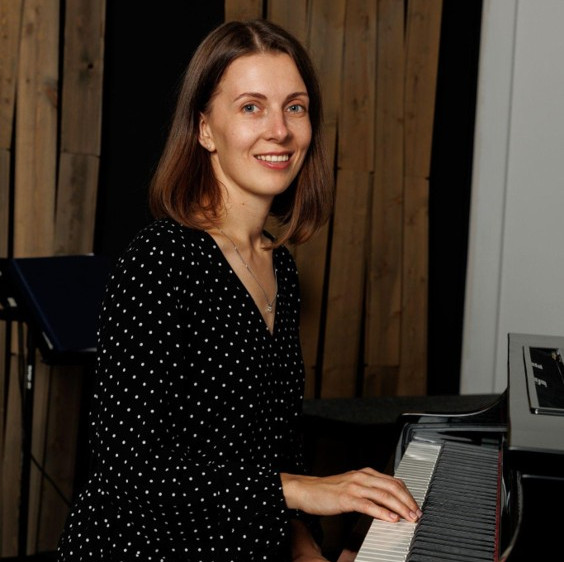
We spoke with Olena Zhunda, a Master of Musical Arts, educator, and author of a methodological model for developing artistic skills in pianists, about why more adults are choosing to learn the piano and how musical practice can become a valuable part of modern life.
Why it's worth playing
According to Zhunda, interest in piano study among adults has grown significantly in recent years. Students arrive with a wide range of goals. Some want to learn a favorite song, others hope to improvise, revive a skill acquired in childhood, fulfill a long-standing dream, accompany their own singing or that of family members, develop a meaningful hobby, reduce screen time, create a personal creative space after work, prepare a musical gift, or simply experience something beyond the routine of everyday responsibilities. For an adult, it is especially important that the repertoire has a personal meaning. Therefore, they often choose classical pieces, film music, jazz, Ukrainian songs, or modern compositions for study.
She believes that piano playing represents an active form of recreation because it requires a person to engage with a complex task involving multiple processes at once. While playing, the pianist reads notes or follows the keyboard, listens to the sound being produced, coordinates both hands, maintains rhythm, anticipates upcoming musical phrases, adjusts touch and dynamics, and continuously evaluates and corrects mistakes. Such activity temporarily displaces the flow of thoughts, messages and digital stimuli. A person stops consuming information and shifts into a creative mode. That is why the piano can work as an active digital detox: for a certain time, attention has a clear object, sequence and audible result.
“At the same time, I do not call it a treatment for stress. The piano does not replace sleep, physical activity, psychotherapy, medical care or solving real-life problems.”
Zhunda also points out how regular piano playing can help support cognitive and emotional well-being. She says that systematic training gives the brain a complex task in which auditory, visual, motor and executive processes are simultaneously involved. During piano practice, individuals engage their auditory attention, coordination, and memory while developing planning, anticipation, concentration, patience, self-control, and the ability to identify and correct mistakes.
According to Olena, the feeling of an immediate result is emotionally important. A person presses a key and immediately hears the result of their action. Even a small improvement, for example, a more even pulse or a more natural connection of two phrases, creates a feeling of personal competence.
“I do not recommend exhausting hours of classes for beginners. Short regular sessions of about 15 to 20 minutes can be a start. Fifteen minutes is a practical minimum that is easier to repeat systematically. It is better to practice short sessions several times a week than one two-hour class.”
Over time, piano study can strengthen discipline, patience, and concentration while teaching students to work toward long-term goals, respond calmly to mistakes, recognize progress, and enjoy the creative process itself. Zhunda says that a regular, screen-free creative ritual can become part of one's daily life.
As skills develop, adults may perform for friends and family, accompany singers, participate in amateur music groups, attend group classes, record their performances, or pursue personal creative projects.
The most valuable result of classes is the formation of a stable creative connection with music and the habit of moving from the mode of information consumption to the mode of personal action and creation.
Playing the piano vs. Meditation
Zhunda sees clear differences between piano practice and traditional meditation or mindfulness techniques. She says that in traditional meditation, a person often focuses on breathing, bodily sensations, or observing thoughts. While playing the piano, concentration is maintained through action: movement, listening, rhythm, coordination, musical form. That is, meditation often involves observing, while musical practice suggests organizing and creating.
She notes that different people respond to different methods of managing attention. For some, silence creates the ideal conditions for relaxation and reflection. For others, silence simply leaves room for another cycle of thoughts and worries. In those cases, a structured activity may provide a more effective path to concentration because it is demanding enough to interrupt the internal dialogue. She says that the piano is not ‘better’ than meditation. It is a different way of working with attention. Both practices can complement each other.
At the same time, Zhunda emphasizes that the benefits of piano playing depend on how the activity is approached. The instrument has a better chance of maintaining a positive emotional state when a person chooses it voluntarily, studies music that has personal meaning, works at an appropriate level of difficulty, practices consistently without excessive pressure, and views mistakes as a natural part of learning and the teacher takes the person's individual goals into account.
By contrast, the expected benefits may disappear if adults bring an excessively demanding professional mindset into their musical studies. Constant self-comparison, unrealistic expectations, overly difficult repertoire, physical overexertion, or treating every mistake as a personal failure can undermine the experience. The teacher explains that if a person has a long-term depressed state, panic symptoms, insomnia, severe exhaustion or cannot perform everyday duties, they need professional help. A music lesson is not therapy and should not be presented as a treatment.
Mistakes at the start
Adult beginners often encounter challenges that slow their progress and reduce motivation. Many repeatedly play an entire piece without isolating difficult passages, set unrealistic goals, compare themselves with professional musicians, focus exclusively on correct notes rather than musical quality, practice despite pain, or continuously search for new learning materials instead of developing a consistent routine. Another common mistake is waiting for inspiration before practicing, even though motivation often appears after the work has already begun. According to Zhunda, all these mistakes reduce motivation, because a person sees only the gap between themselves and the desired result. It is much more useful to compare today’s performance with their own recording from a month ago.
Zhunda believes that the piano remains one of the most accessible and practical instruments for adult beginners while also offering opportunities for musicians with prior experience.
“One of my adult students used to play the cello, and now she has decided to learn the piano. Her previous musical experience proved an advantage. She was well-versed in the bass clef, because it was the one she used when playing the cello, but reading the treble clef required additional practice. In addition, she is left-handed, so we carefully worked on the coordination of both hands, without altering her natural motor patterns. Unlike the cello, where performers typically focus on a single musical line, piano playing requires reading two staves simultaneously, coordinating both hands, and maintaining a balanced sound. Therefore, one of the main tasks at the initial stage was gradually building the skill of reading two-line notation. We worked in small steps, in no hurry to move on to complex repertoire. More important were regularity of classes, careful reading of notes and understanding of musical text. Today this student plays much more freely with two hands, confidently reads music in both clefs and navigates the musical notation much faster.”
Adults successfully form new skills when learning is built sequentially, taking into account their previous experience and individual characteristics.
Today, Zhunda lives in the United States, where she works as an accompanist at Wingate University, a piano teacher at Moonlight Music School in Monroe, North Carolina, and a pianist at Messiah Lutheran Church. She is also the founder of La Mi Sol Musical Art LLC, a piano studio dedicated to developing the creative abilities of both children and adults.
Her work in the United States is focused on implementing and refining an original piano teaching methodology adapted to the realities of contemporary American music education. The approach aims to strengthen artistic expression and stage confidence while supporting long-term musical development. Its effectiveness is reflected in students’ public performances, competition results, and awards at international events, including the Charleston International Music Competition.