Oksana Sheremeta Interview on Turning Self-Awareness Into Authentic Living
Oksana Sheremeta is an Authenticity Coach and creator of The Embodied Self Method™. She works with self-aware people who have read the books, done the inner work, and gained plenty of insight, but still catch themselves living according to what everyone else expects.
Oksana’s path has never been a straight line. Born in Ukraine, she came to New York at 20 with $500 and no English. She became a Registered Nurse, opened a wellness center, published a gut-health cookbook, and built a combined following of more than 500,000 across social platforms. Her first viral video was imperfect, had a typo, and reached 10 million views. It took off when she stopped trying to follow someone else’s formula and did it her way.
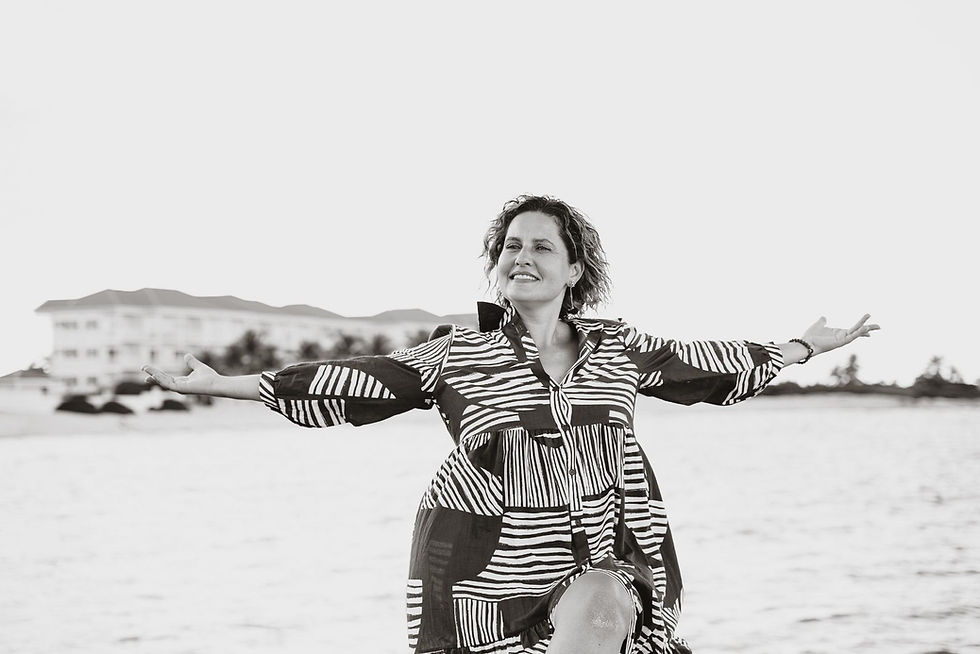
Oksana Sheremeta, Authenticity Coach
What does it mean to you to move from knowing yourself to actually living as yourself?
I like to say that awareness can show you the door, but only action can take you through it. In this case, knowing yourself is awareness. It helps you see your patterns, values, desires, and even parts of yourself you have hidden. But living as yourself happens on the other side of that door.
You can spend your entire life standing in front of it, studying it, touching it, knocking, even trying to eavesdrop in an attempt to make sense of what’s behind it. You may even come up with legitimate reasons not to open it. But until you turn the handle and step through, that knowledge remains something you understand and feel, but not something you embody.
Imagine you planted an apple seed. You nurture it, water it, study it, and one day it grows into a tree full of apples. You continue to nurture it and study all you can about these apples: what they taste like and what the tree needs to bear good fruit. But you never actually get to enjoy the fruit.
Moving from knowing to living is allowing yourself to actually taste your apples and share them with everyone else.
Why can someone understand their patterns deeply and still struggle to make choices that feel true to them?
FEAR. At the most fundamental level, that’s what comes to mind. But it has a different shape, face, and flavor for each of us. When you peel back its layers, you often discover two fears.
What will happen if I leave this familiar pattern behind? This is a fear of letting go: we are afraid to lose what feels comfortable and familiar.
What might happen if I make the choice that feels true to me? This is a fear of what comes next: we are afraid of where that choice may lead us.
Let’s peel back one more layer. Underneath both fears is meaning, the story we are telling ourselves about what each choice means. We may attach the meaning of safety, belonging, love, or being a good person to the familiar pattern. At the same time, we may believe that making the authentic choice means being selfish, disappointing someone, losing a relationship, or being judged by others.
For example, you may know that a pattern is destructive, but if it also means, “This is how I stay loved,” knowledge alone will rarely be enough to change it. Until that meaning shifts, this pattern will continue to feel safer than what is authentic.
How does The Embodied Self Method™ help someone recognize what their body may be telling them before their mind explains it away?
The Embodied Self Method™ begins with Body as First Language. I call this somatic awareness: noticing what is happening in your body before asking the mind to interpret it.
The body doesn’t speak in sentences. It speaks through sensations, tightness, heaviness, expansion, warmth, changes in breath, or the urge to pull away or move forward. The mind is fast. Within seconds, it can explain those signals away with, “I’m fine,” “I’m overreacting,” or “This is what I should do.”
In the method, we slow that sequence down with a present-moment somatic check-in: What is happening in your body? Where do you feel it? What changes when you imagine one choice and then another?
For example, the freedom to make my own decisions and choose how I live and work is very important to me. Whenever I consider a decision that may take away that freedom, I feel as though I’m suffocating, as if someone is holding me by the throat. I now recognize that sensation as a signal of misalignment, but I didn’t always understand it. I learned by noticing the pattern and deepening my relationship with my body over time.
The goal is not to treat every sensation as a command, verdict, or diagnosis, but to lean into it with curiosity. Over time, people learn their bodies’ unique language and begin recognizing misalignment before habit, fear, or other people’s expectations talk them out of what they already sense.
Where do you think the personal development industry places too much emphasis on insight and not enough on embodiment?
I think the personal development industry places too much emphasis on the breakthrough moment and not enough on what happens afterward. It is very good at helping people recognize patterns, name beliefs, and experience powerful realizations. But it often stops before integration, before helping someone carry that realization into an ordinary Tuesday. This is why we often confuse feeling moved with having moved.
Don’t get me wrong, a breakthrough matters tremendously. It can open the door, but opening the door is not the same as walking through it. Embodiment means practicing the new choice after the emotional high fades and the familiar pattern still feels safer. It is setting the boundary during an actual conversation, saying no while the guilt is rising, or choosing differently when there is no audience or applause.
The problem isn’t insight. The problem is treating insight as the finished product. A realization becomes transformational only when it begins to shape how someone responds, chooses, and lives.
What changes when resistance is treated as something protective rather than something to overcome?
When resistance is treated as an obstacle, we often try to muscle through it with more discipline or massive action. That puts us into a fight with ourselves and uses enormous energy.
But when we understand that resistance is protecting something, compassion becomes possible. We stop forcing ourselves and start listening to ourselves. Instead of asking, “How do I overcome this?” we can ask, “What is this protecting? What do I need to hear? What is one aligned next step that feels accessible right now?”
When that protective part feels heard, the internal guards begin to lower. The energy we were using both to defend ourselves and fight ourselves becomes available for perspective, choice, and action. We may discover that resistance isn’t saying, “No.” It may be saying, “Not like this. Not this fast. Not yet. Or not without support.”
The path may still require effort, but we no longer have to swim upstream because we assume that is the only way forward. Life begins to feel easier, not because the work disappears, but because the way we approach it becomes more aligned, sustainable, and rewarding. We are no longer doing the work and fighting ourselves at the same time.
How can someone tell the difference between genuine inner knowing and fear, conditioning, or temporary discomfort?
Discernment is not an intellectual formula. I wish I could offer a perfect checklist, but it is more like this: once you know, you know. Learning to trust that knowing takes practice.
At the most basic level, I believe discernment begins with somatic awareness, learning to notice and understand the signals of your body. Some people call it a gut feeling. As we deepen our relationship with the body, somatic awareness can open the door to intuition, a higher inner wisdom that arrives before the rational mind can fully explain what we know.
Here is where it gets tricky: the body doesn’t always offer a simple yes or no. An authentic choice may feel uncomfortable because it is unfamiliar, while a conditioned choice may feel safe simply because we know it well. Expansion and contraction are clues, not conclusions.
The journey toward discernment also involves meeting all parts of yourself, the good, the bad, and the ugly, without immediately rejecting or obeying any of them. Over time, you recognize how each one speaks. Fear may feel urgent and fill your mind with worst-case scenarios.
Conditioning often speaks through “shoulds” and other people’s expectations. Temporary discomfort may soften when you pause and give yourself time. Inner knowing is often quieter and steadier. Fear may surround it, but it keeps returning.
Sometimes the distinction is: “This scares me, but it still feels like me,” versus, “This feels like what I should choose, but it requires me to abandon myself.”
You develop discernment by practicing self-trust until you recognize what remains true underneath the fear.
What is one practical way to begin expressing yourself more authentically when you are used to meeting other people’s expectations?
One practical way is to learn to pause before answering. When you are used to meeting other people’s expectations, “yes” can leave your mouth before you have even checked in with yourself.
Before responding, take one conscious breath. That brief silence may feel like an eternity, but it gives your own voice time to enter the conversation. Then practice saying, “Let me think about it.”
Sometimes that pause may last a minute, an hour, or an entire day. What matters is that you don’t give an answer before giving yourself a chance to hear your own voice. Inside that space, you can notice what is happening in your body, what you actually want, and whether your answer is coming from truth or from fear, guilt, and the role you are accustomed to playing.
Authenticity doesn’t have to begin with a dramatic “no.” It can begin with not giving an automatic “yes.”
If you recognize the pattern only after the moment has passed, that moment isn’t wasted. Instead of criticizing yourself, replay it with curiosity: What did I actually want to say? How would I like to respond next time? Rehearsing the response in your mind helps make a new choice more accessible when the pattern appears again.
The goal isn’t to respond perfectly every time. It is to practice not abandoning yourself automatically. The pause is where self-awareness becomes choice, and choice becomes authentic expression.
What did your own transition from nursing and wellness entrepreneurship teach you about the cost of choosing a life that feels true?
My transition taught me that the real cost of choosing a life that feels true is not simply the money, time, relationships, or identities you sacrifice. Those are the forms of payment. The real cost for me was surrendering the guarantee that my choice would produce the result I wanted.
The cost of choosing a path that feels true is transformational rather than transactional. In a transaction, you give something away because you expect a specific return. In transformation, you invest without knowing what the return will be, what form it will take, when it will arrive, or even whether you will recognize it.
When I stepped away from the security of a nursing paycheck and invested five years and $150,000 in my wellness center, I hoped to make a specific amount of money, which would then prove to me that I was on the right path toward a life that felt true. When it closed, it felt like a complete failure. Only later could I appreciate that it has given me much more: public speaking, creativity, intuition, business experience, and the ability to lose something, get back up, and begin again.
As I finally stepped into this chapter of my life as an Authenticity Coach, I realized that the deeper lesson wasn’t that every investment eventually pays dividends. It was this: if you choose a path only because it guarantees a particular result, you’re not choosing the path. You’re choosing the result.
When you choose a life that is authentically yours, you are not buying a result, you are choosing alignment. Transformation begins when you stop asking, “Will this choice pay off?” and start asking, “Is this choice mine to make?”
What would you want someone who has done years of inner work but still feels stuck to understand about their next step?
What I would want them to understand is that their next step doesn’t need to be big, perfect, or life-changing. They may not need to keep digging for one more reason why they are stuck before they allow themselves to move.
If you have done years of inner work, you have already gathered knowledge, recognized patterns, and experienced powerful insights. At some point, more understanding simply becomes more understanding. Integration begins when you do something with what you already know.
Your next step is to give yourself permission to take one small action that gives expression to something you already know to be true. Set one boundary. Say the words you keep rehearsing silently. Decline one thing that doesn’t feel aligned. Begin something that continues calling you.
There is a humorous version of a familiar saying: if you can’t run, walk. If you can’t walk, crawl. If you can’t crawl, at least lie down facing the direction you want to go. It makes me laugh, but the meaning is profound: your speed matters far less than your direction.
You don’t need to understand everything before you act. Sometimes action reveals what more thinking cannot. Your next step doesn’t have to take you all the way there; it only has to move you from understanding into experience.
If you need support turning what you know into something you can actually live, that is exactly where I meet people in my work.
Read more from Oksana Sheremeta