Modern Men Need Initiation, and Not Just Once
Daryl Henderson is a master coach, facilitator, and artist known for blending spiritual traditions, shadow work, and leadership training. He is the co-founder of Odyssey of Man, the creator of True North Coaching, and the founder of One11, a health & wellness brand.

Every culture that lasted had a way of marking a man's crossings. We got rid of ours, and now most of us go through the biggest changes of our lives with nobody waiting on the other side. There's a fork in the road in front of me, and I've been pacing in front of it long enough to wear a groove in the dirt. It feels like years. Maybe it has been.
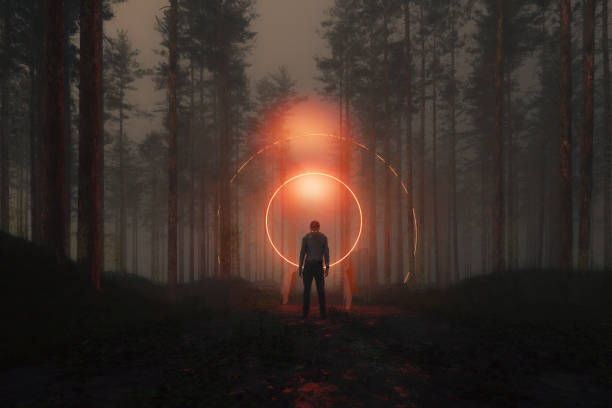
Down one road, I can actually see where it goes. It's not perfectly clear, but I can see well enough to know where it's headed. It's the known road, it's survivable, maybe even has some fun adventures along the way, and I could describe the next ten years of it to you in reasonable detail if you asked.
The other one leads off into a haze about forty feet ahead, and then I can't see a damn thing. No visibility at all. I can't shake the feeling that it's the one I'm supposed to take, even though it goes straight into a foggy mess of blank white with no idea where it's going to take me.
For me, it's the choiceless choice: go into the predictable future that I'm almost certain will leave me in lack and wanting, or choose the road that I have zero clue where it will take me but know deep down is the one I'm meant to follow.
I'm 46 years old, and I've stood at this crossroads more times than I can count. Each time it arrives, it's a bit of a surprise. Each time I end up with the same conclusion: I can't not choose the unknown road once I hear the call echoing from far away. Some part of my soul needs to know what will happen. So I choose the unknown road, time and again, to whatever end.
So I'm not writing this because I don't know how to cross. I've crossed plenty.
I'm writing it because of what happens after. I go into the fog, something in me gets rearranged out there, and then I come back and walk into a coffee meeting on Monday. Most of the time, nobody knows I went through something, much less that I somehow came back different. There's no one waiting, no one to tell me what I am now on the other side of it.
And at some point, it occurred to me that if I were a young teenager in an older culture standing at that same fork, somebody would have already come and gotten me. There'd be a fire waiting for us somewhere, and a person whose actual responsibility was to walk me into a process that would change me and help me choose the path ahead. I would not be sorting it out alone in my own head at two in the morning.
Now the ceremonies have mostly been replaced with self reliance, a few mildly encouraging words from our fathers if we're lucky, and a heaping dose of ways to numb our pain so that we forget there ever was a crossroads.
Initiation isn't a one-time event
I never even knew initiation was really a thing until I was in my early thirties. When I finally did learn about it, I filed it under something that happens to boys. A ceremony you get once, somewhere around thirteen or sixteen, that turns you from a kid into a man, and then you're done. That's the part I had completely backwards.
Because the thresholds don't stop when you stop being a teenager. A man will cross a dozen of them before he dies. It happens at his first real loss. When he gets married or becomes a father. It happens with the marriage ending, or the marriage deepening in a way that requires him to become somebody else and to grow into a new version of himself. It most definitely happens when burying a parent. Or when the business we committed years to building has to fold. Or when he turns fifty and understands in his body, not his head, that there is less road behind him than ahead.
Every one of those moments is a threshold. Every one asks him to leave a version of himself behind and come back as somebody who has been changed.
There is not one single structure in modern Western life that marks any of them. Nothing that helps us reflect on those moments and see what we've learned, who we've become, and lets us consciously enter into a new phase after going through a great transformation.
Yes, there are parties. We have milestones and awards. We have a card and a cake and somebody's brother-in-law making a speech. What we don't have is anybody standing on the far side of the threshold whose job it is to receive you and help you understand who you are now and where you are going. We don't have elders or guides that we respect who are there to honor the crossing and bless it.
I believe this is a great loss, and it's something that we can remedy.
What the old cultures actually did
Every culture that lasted long enough to be studied had a process for this, and the anthropologists who compared hundreds of them across every continent kept finding the same three part structure.
Separation. You get taken out. Away from the familiar, away from whoever has been comforting you. A real leaving, and it usually hurts in some way. It's meant to be uncomfortable and to rattle your cage a bit.
The ordeal. Something genuinely hard happens, and nobody rescues you from it. That's the entire design. You find out what you're made of by being put somewhere you can't talk your way out of.
The return. You come back, and the community receives you as something other than what left. Oftentimes, you're bestowed with a name, a role, or a responsibility. Everybody who watched you go now treats you differently.
Look at how completely the Lakota built all three into a single practice.
Haŋbléčeyapi, which translates roughly as "crying for a vision," is one of their seven sacred rites. A young man of around thirteen would go up on an isolated hill for one to four days with a blanket and a pipe, and no food and no water. Bear Butte in South Dakota is one of the traditional sites.
But he doesn't just wander off into nature by himself. A holy man, a wičháša wakáŋ, prepares him and takes him to the place. When it's over, helpers come back for him, walk him to the sweat lodge, and he tells the holy man everything he saw and heard... and the holy man interprets it for him.
That last part is the piece we lost. He isn't left to make sense of his own vision alone. Someone sits with him and helps him discover what it means and what he now carries.
The research on traditional rites of passage found something I didn't expect when I went looking. The thing that determined whether an initiation actually worked was not the severity of the ordeal. It was whether the initiate came back and was given an actual task, a real way to contribute, or something to uphold on behalf of everybody else.
We kept the ordeal. We are, in fact, obsessed with the ordeal in the Western world. Just look at our movies, stories, and reality TV shows. It's alllll about the drama. We got rid of the wise elders and their processes, and now we wonder why we feel lacking and lost.
Why nobody is standing there
Anywho, before I go further, I want to say something about our fathers, because this is where these conversations usually curdle into blaming our dads or families for not initiating us, and I'm not interested in that. Most of our fathers weren't initiated either.
Mine was angry and volatile, and I've done a lot of work on what that cost me. But he was also a man handed nothing, by a man who was handed nothing, going back however many generations to wherever this tradition actually broke off. You can't transmit what you never received. He was improvising too, and he was doing the best he could without any of the language I've had the luxury of learning.
None of which is absolution, and it doesn't shrink the damage that was done by him, his father, or me, for that matter, by an inch. It does mean the thing worth being angry at is much bigger than any one man, and staying angry at our fathers is a very effective way of never looking at the size of this issue.
The chain broke, and everyone since has been making it up.
The homemade version
The strange thing is that somewhere deep down, the process of initiation is built into us. Especially males. So instead of being guided into it, now we improvise... badly.
A boy does something dangerous in front of other boys and gets a rush that fades in a week. It looks like hazing to get into a fraternity or a football team. Or maybe he does it alone because being with other boys was too scary or intimidating, so he becomes a man who runs an ultramarathon, or trains for a year for a fight, or takes a job that pays well but eats his soul, or goes to a plant medicine ceremony every four months for a decade.
Separation, yes. Ordeal, absolutely.
Return? Nobody there. No community waiting. No one whose standing in the group entitles them to say, "We saw what you did. Here's what you are now. Here's what you're carrying for us from here. Here's how we're going to help you integrate this into your life."
Generally, what happens when the rush of completion or success wears off is that nothing about his actual place in the world has changed. So he does it again, and bigger, or better.
Don't get me wrong, there's actually nothing wrong with this. It's predominantly how the Western world works these days. It's just that we're often missing the final step that might actually bring some peace of mind and belonging that so many of us spend our lives seeking.
Personally, I spent about 15 years on that loop, and I was very good at it, and it nearly cost me everything.
So what does a modern-day initiation look like?
I'm glad you asked because it's a great question. Does a proper initiation always have three stages? In short, I'd say yes.
You need separation from ordinary life, even if it's just for a few days. Otherwise, you can't gain enough new perspective. That can be travelling, camping, or a weekend seminar.
Next, there needs to be a genuine ordeal. If you're staying in your comfort zone, you're not growing and being forced to change. This is 100 percent necessary. It doesn't have to be dramatic, but you do need to get out of your normal way of doing things to effect real change. If you want to change things in your life, you have to change things in your life.
Lastly, nature abhors a vacuum. So you need a community that receives you afterward and helps you find a way to carry your life forward. Even if it's just one person, you have to share these moments with someone other than yourself. Otherwise, you'll just end up in the same loop. We are social creatures, and therefore we need one another. This isn't a weakness. It's how we're designed and how we've survived as long as we have.
Here are some examples of places to start looking if you want to start down this path.
Recovery communities. This is the one almost nobody notices, and it is the most structurally intact initiation left in the Western world. You separate, publicly, by naming it in a room. The ordeal is early sobriety, which is genuinely brutal and which nobody can do for you. Then... and this is the part most people don't notice that does the real work... you get received by everyone there. You stand up in front of the room, you get handed a physical object, and people who watched you do it applaud. Then you're given a responsibility to carry it forward because eventually you sponsor somebody else. That's all three, running weekly, for free, in church basements in every town in America.
Purpose-built men's initiations. The ManKind Project's New Warrior Training Adventure has been running weekend initiations for men for around forty years, explicitly built on this structure, and they're clear that it isn't a retreat or a workshop. Sacred Sons has been around for over 8 years now and has done a great job initiating thousands of men of all ages. Cliff Barry's Shadow Work seminars are grounded, safe, and rooted in decades of practice. There are plenty of others out there. You just have to go looking and see which one resonates. The reason these work is not the intensity of the weekend. It's that you go home into an ongoing group afterward. The weekend without the group is just another ordeal.
Wilderness fasting, done properly. Not a hiking trip. Days alone with no food, with a guide who prepared you beforehand and a circle that receives your story when you walk back in. The reception is the part many people skip, and it's a major piece of the work.
Fatherhood, if you consciously build it. Right now, there's a baby shower for her and nothing whatsoever for him. Some men are starting to change that. A night before the birth with the men who know him. Something asked of him. Something said out loud to him afterward about what he is now. It's not traditional, and it doesn't have to be.
Build your own, in 3 steps
If none of the above is available to you, the minimum viable version is smaller than you think, and you can construct it this year.
Name the threshold you want to cross to specific people. Not a journal, not an Instagram post. Choose one or two men who know you and whom you trust, and meet with them. Make sure these are men who you respect and who respect you. Don't choose your friend who is cynical about the world and jokes about everything. Set a time to meet and stick to it. Preferably in person, but Zoom works, and tell them what you're leaving behind and what you're moving toward. Tell them why you're doing it and why this really matters. That's the separation, and saying it out loud is what makes it real rather than just a thought you had that you'll forget in a couple of weeks.
Set an ordeal with a deadline and no exit. Something genuinely hard that you have not done, that you cannot buy your way out of, with a date attached. It doesn't have to be physical. Making the apology you've avoided for nine years is an ordeal. Ending the relationship or closing the business, when either should have been done two years ago, is an ordeal. Telling the truth in a room where it costs you is an ordeal. Paying off the debt you've accrued is an ordeal. Choose one and set a date.
Arrange the return before you go. This is the step everybody skips, and it is arguably the most important. Ask those men you first met with to be there on a specific date. Ask one of them to say, out loud, in front of the others, what he saw you do and what he thinks has changed in you. It might feel uncomfortable, staged, and mildly ridiculous, but it will likely land in your body in a way that no other achievement ever has. There's something about being witnessed and seen in your return that really changes the way you see yourself.
Three steps. No plane ticket, no plant medicine, no gurus... and no permission required from anybody. I've watched men run some version of that and come out walking differently, and I've watched men do a $15,000 retreat with no way to integrate it once they got home and end up being exactly the same guy six weeks later.
Long story short. Integration is everything.
The question
Time for the harsh truth. Nobody is coming to save you or me. That's not self pity or nihilism. It's just the accurate situation for a grown man in our Western culture, and the grief in that is worth actually feeling for a minute rather than skipping past.
So I've started doing the only thing I can think to do about it, which is asking the men around me to stand on the far side of things and receive me, and letting me do the same for them. It's awkward. We're all making it up, and it's still one of the most useful things I've discovered. Which brings me back to my fork in the road.
I'm still going to choose the fog. I always do, and that part was never in question. What's different this time is that three men know I'm standing here, they know why, and they know roughly when I'm going in. One of them is going to be waiting on the other side to tell me what he saw.
That's the only thing I've changed, and it has changed everything about how the crossing feels.
So here's what I'd like to leave you with. You're going to cross a threshold this year whether you mark it or not. Something is going to end, or begin, or ask you to become somebody you currently aren't.
The only question is whether you choose to go through it alone in your own head, or whether you consciously choose to have somebody waiting on the other side who knows what you went in for.
Who would you ask? Whose threshold are you supposed to be standing on the far side of, right now, without having noticed? See you on the other side.
P.S. I'd like to hear about this one. What threshold have you crossed that nobody marked? Most men have several and have never counted them as anything. Leave a comment below, or reply to this email. I read everything.
P.P.S. Daryl here. Men's coach, facilitator, entrepreneur and creative director with twenty years of helping people and brands find, share and live their potential. Cofounder of Odyssey of Man, creator of True North Coaching. If you're a man looking for the room, drop me a message here.
Read more from Daryl Henderson
Daryl Henderson, Transformational Facilitator & Creative Visionary
Daryl Henderson is a master coach, facilitator, and artist with over two decades of experience blending creativity, men’s work, and spiritual practices. He has photographed top brands and artists worldwide, including Nike and Michael Kors, and documented indigenous and peace gatherings across the globe. Drawing on this experience, Daryl guides high performers, artists, and businesses to express their stories through soul-aligned photography, branding, and personal transformation. He is the co-founder of Odyssey of Man, the creator of True North Coaching, and the founder of One11, a health and wellness brand. His work is playful, transformative, and designed to unlock authentic expression.