How Lothar Osterburg Turns Memories Into Imagined Worlds
Michael Klein is best known for his work and achievements in the field of contemporary art. As both a dealer and curator, he has had a long and distinguished career as a New York gallery owner and director, representing an international roster of emerging and mid-career artists. He became the first in-house curator for Microsoft Corporation.

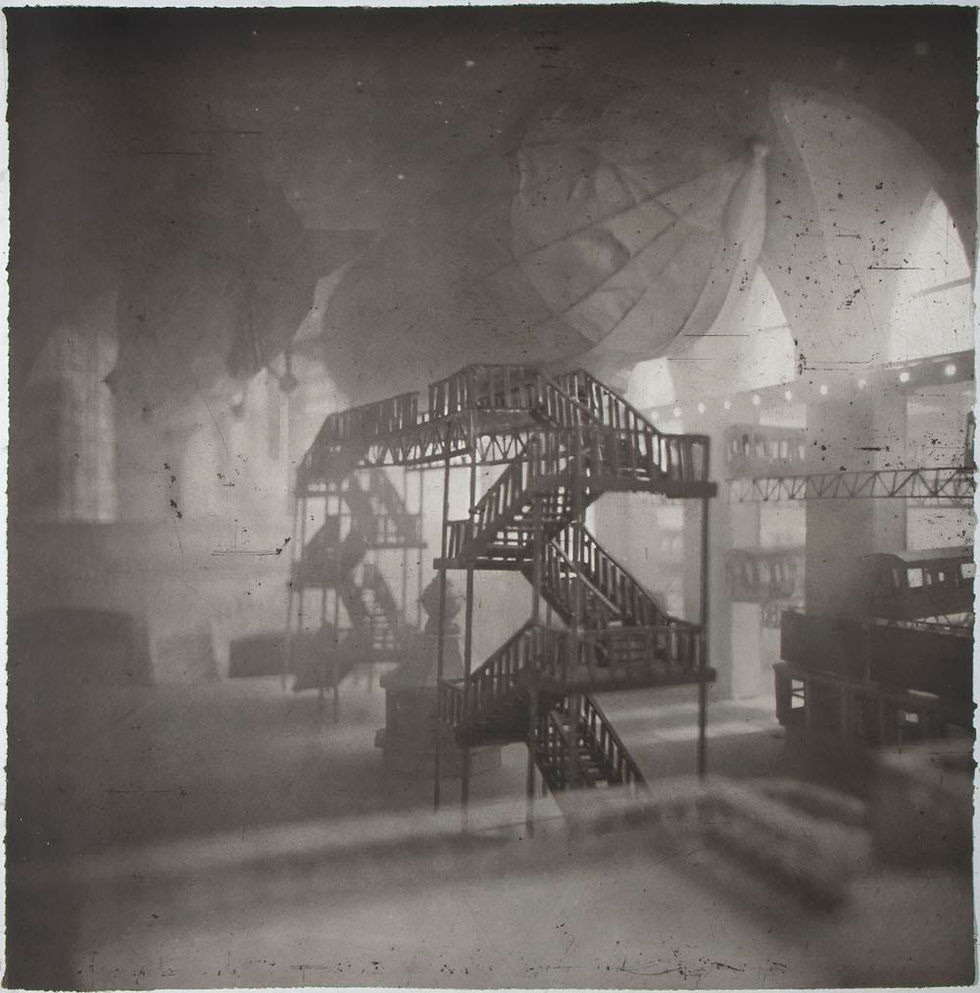
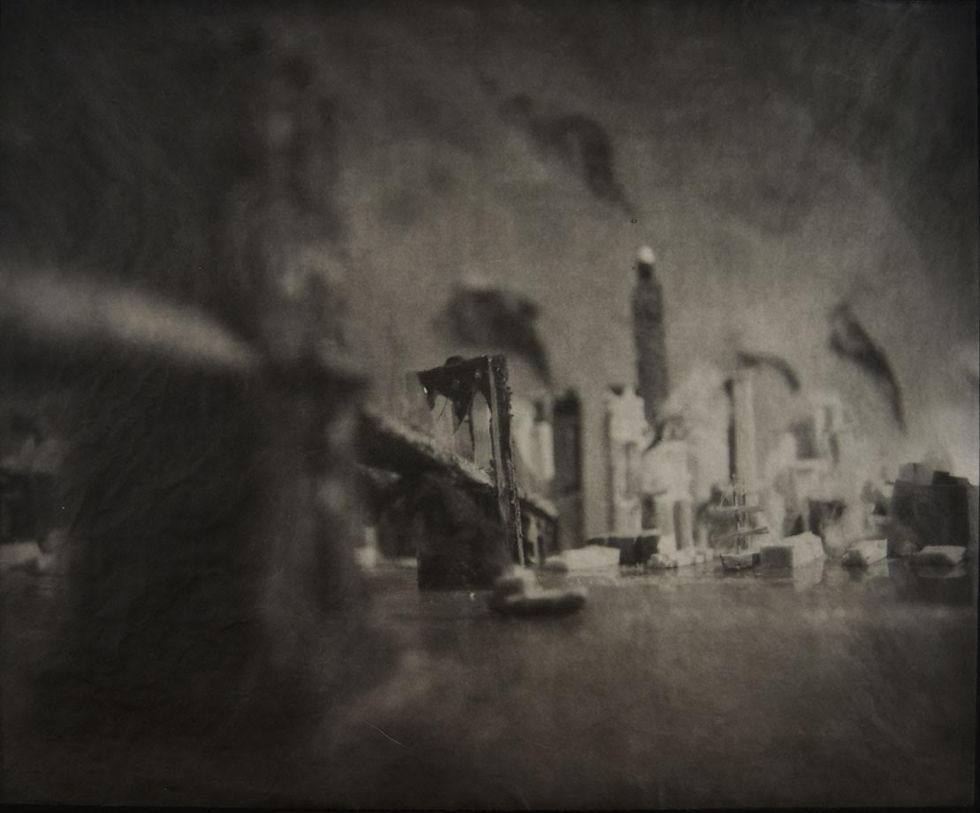
Lothar Osterburg’s vision is somewhat like a dream because he embellishes landmarks he recalls with fictional elements. His working process is an intricate system of first constructing sets in three dimensions, then photographing these built scenarios, and then transforming the photograph into a highly refined photogravure print.
Other artists like James Casebere and Laurie Simmons are known for creating sets and then photographing them, but Osterburg takes the photo to another level of refinement. His images, always black and white, are subtle compositions, each with a myriad of gray tones, creating the atmosphere of looking not at a place but at a memory.
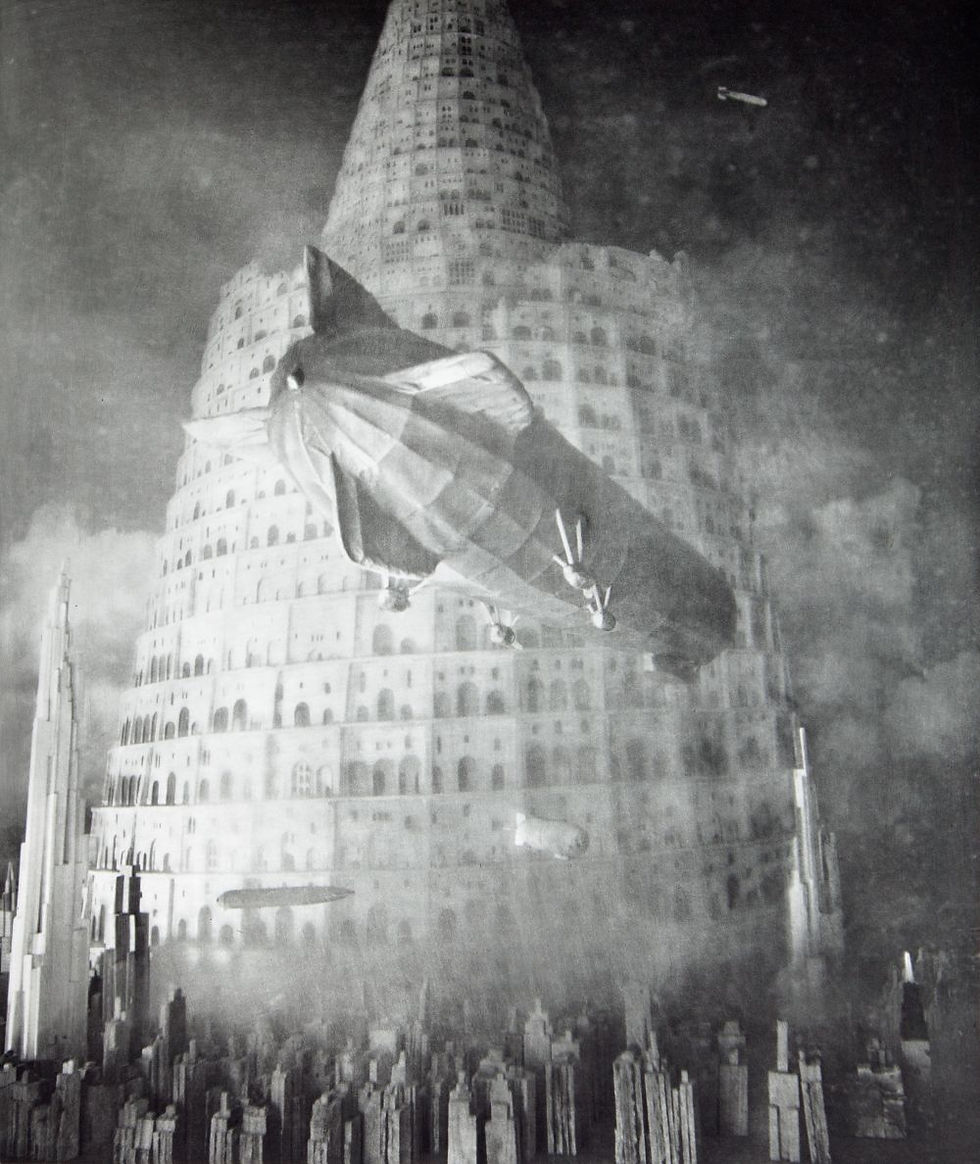
He is fascinated with cities, both how they were built in the past and how they appear in the present. He is also fascinated with all forms of transportation, such as ships, cars, trains, and even zeppelins. He explores architecture, from modern skylines to the Tower of Babel and the works of Piranesi. The past, as Osterburg explains, is a way to understand the present: to see who we are and what we have created.
He arrived from his native Braunschweig, Germany, in 1987. San Francisco was his first home in the United States, where he lived in a combined studio and apartment. Trained as a lithographer, he took his first job as a printmaker at Crown Point Press, founded and managed by the late Kathan Brown. There, Osterburg worked on the photogravure process with such artists as Christian Boltanski and John Baldessari.
About his early days, he explained in an interview a few years back, “Luckily, I was laid off in the big art recession in 1993. It opened up opportunities because I moved to New York and opened my own studio.”
In another interview, he said, “This country has been really open to me, instead of just giving to their own. You have to fight for it, and the competition is high, but I think the great strength of the United States is historically the diversity and the constant influx of people from all around the world coming in and adding new twists and new ideas and new energy.”
This sense of new twists and new energy has led Osterburg to invent on a full scale. He builds intricate sculpture installations and transforms those structures into handsome photogravure prints in multiple editions.
Once based in Brooklyn and now living in upstate New York, he created a signature work with a view of the Brooklyn Bridge, as if he could see it from his studio window. His other works are also a synthesis of imagery that is both fact and fiction: a cityscape of brownstones and tall buildings where taxi cabs line up, subway trains travel by, and zeppelins float overhead.
It is an amalgam of things found in New York and things imagined to be part of the city, too. Even without a single human figure, these extraordinary tableaux have the power and drama of grand opera.
In 2017, he created a large installation, Reaching for the Sky, focused on the legend of the Tower of Babel at the College of Saint Rose in Albany, New York. Here, he explored the biblical narrative that explains the origin of different languages and the scattering of humanity across the earth.
“From my perspective,” Osterburg has explained, “this was not a punishment, but a gift of God, a gift of diversity. By placing the tower into a fictional New York City, I celebrate the immigrants from all over the world that have made New York City into one of the most vibrant cities, a place where all the languages of the world are spoken, where all the scattered people come back together and create amazing things because of their differences.”
His recent exhibition in his native Germany, “Cabinet of Wonders. Lothar Osterburg back from Brooklyn,” at the Herzog Anton Ulrich Museum (HAUM), presented a kind of survey of his visual ideas and thought process through a series of photogravures along with an extraordinary sculpture.
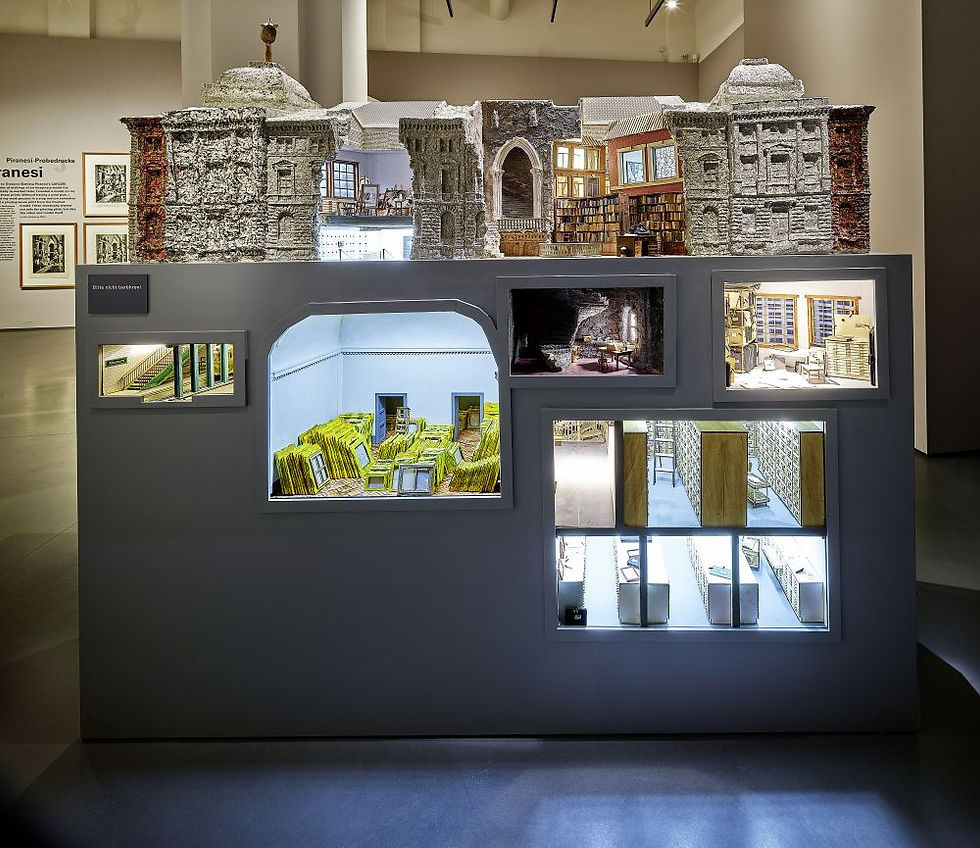
The sculpture, part of “Mein Traum vom HAUM (My Dream of HAUM),” is a replica of the museum itself, a memory in three dimensions, if you will, of his visits as a child. It is constructed of papier-mâché and took over three years to assemble.
The building is embellished with other images that are built into the base of the sculpture, each a memory reconstructed in three dimensions. Some are imagined, and others are based on fact. For example, there is a fictional subway stop called Museum, but New York City’s Interborough Rapid Transit (IRT) system doesn’t travel to Germany!
Another imagined view is the museum’s storage room filled with canvases. At one point, the museum’s wall has been broken through to reveal easels and stools in a large studio where students copy masters as they learn and practice their painting skills. The work is totally autobiographical, it is a memorial in three dimensions to his youth and his exposure to art as a young adult.
As with Osterburg’s work in general, memory plays a crucial role in the final image. He takes what he knows and what he has studied and embellishes it with a fertile imagination, fabricating an image that the viewer can recognize while taking delight in the created fiction.
Read more from Michael Klein
Michael Klein, Owner & Director at Michael Klein Arts, LLC
Michael Klein's expertise lies in his role as a private art dealer and freelance, independent curator for individuals, institutions, and arts organizations. Today, Michael Klein Arts works with a diverse group of artists, estates, galleries, and non-profit institutions, providing management, curatorial, and other consulting services. At the same time, the company serves institutional as well as private collectors, focusing on developing collections of emerging, mid-career, and established artists. The company also organizes traveling exhibitions both in the United States and abroad.