

The Mountain Is You Author Brianna Wiest Talks About Writing, Healing, and Growth
Updated: Mar 3, 2025
Brainz Magazine Exclusive Interview
Brianna Wiest is the author of the books 101 Essays That Will Change The Way You Think, The Mountain Is You, The Pivot Year, The Life That's Waiting and more. Her books have sold millions of copies, regularly appear on global bestseller lists, and are currently being translated into 40+ languages. She has an Honorary Doctorate in Literature.
What first inspired you to write about self-awareness and personal growth? Was there a defining moment that shaped your perspective?
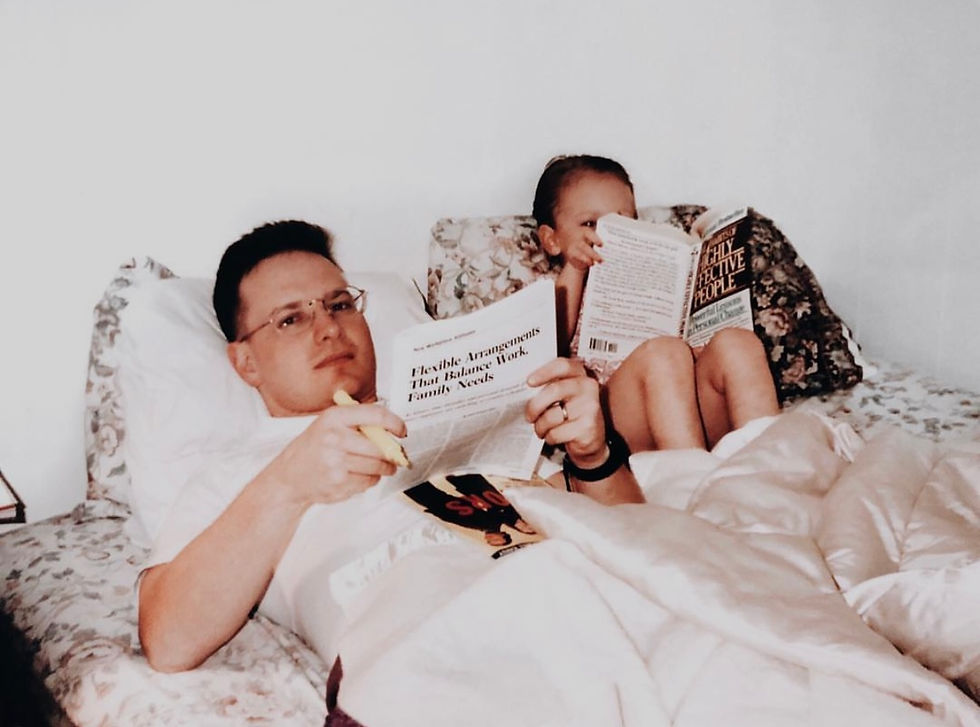
It’s actually something I’ve always loved, which I think is probably an odd and niche interest to have as a child or even as a teenager but that really was the case for me. It may have even begun earlier than that. I’m thinking of this one photo of my dad and me when I was just a toddler. He’s reading an article and I am pretending to read his copy of The 7 Habits of Highly Effective People. It’s definitely something I was exposed to my entire life, but ultimately, also something I came to love on my own.
I have this one specific memory of a high school teacher of mine reading a little passage from a daily devotional before class each morning, and I remember how hearing those words would make my shoulders relax, like I had this embodied response to it. I could physically feel that it made me feel different, it made an adjustment. That intrigued me because I did not know that kind of writing, or literature, existed. The kind that could speak to your real life, that could inspire change in this really personal, literal, direct way. I always loved to read, though. I think there are handfuls of other photos of me falling asleep holding books when I was a kid. I remember having shelves upon shelves of books in my bedroom. I didn’t have a TV. So I read.
However, my real interest in this type of reading — and writing — blossomed after college. It was around the time I began meditating. Back then, this wasn’t as commonplace as it is now. I remember I had downloaded the free trial of the Headspace app when it had just come out, and I believe that I’d do guided meditations for even just a minute or two. It was a really simple and easy way to get started, and it was really the beginning of a whole new chapter of my life. Getting myself into a grounded place effortlessly seemed to move into creative fuel. I’d always get up from meditation and open my journal, and just start to write. Journaling was a tool given to me by a therapist, but I noticed that often, I’d only ever be documenting what I was dissatisfied or disappointed with. I think there’s merit to that and a real value to being able to just express yourself freely and organize your thoughts and feelings. However, I began to ask myself: “What if, instead of writing about what I don’t want, I started writing about what I do?” That was really the start.
From the years of 2013 to 2017, I would visit my local Barnes & Noble often and pick up every new psychology, philosophy, personal growth, finance and business book off the shelf. I’d sit at the café with a small coffee and read them and take notes in a spiral notebook. Buying stacks of books on a whim wasn’t in the budget at the time, and so though I am fairly certain this would be discouraged, I am grateful I was able to learn so much.
I had just graduated from school and was looking to go into publishing, or writing, or even magazine writing. I did work as a journalist for a handful of publications, but I was also writing and sharing my own personal essays at the time. I think that kind of writing was just more alive for me, and the readers could feel it. My heart was in it. It began a whole process of combining the things I’d learned about SEO and writing a good headline and getting people to read a story with the stories that were actually in my head and in my heart. It really was such a culmination of experiences that led me here. I’m often kind of amazed and inspired by how every little thing added up and contributed to where I didn’t even know I was going at the time.
The Mountain Is You has resonated with so many readers. How did the idea for it come about, and what was the most rewarding part of writing it?
That book was a really unique experience. It was a very clear idea that just came to me one day – that unconscious self-sabotage was huge but seldom talked about, and I really felt I had collected both enough personal experience as well as enough information through what I’d read and studied to speak to it. So I sort of devised a thesis. What’s most special to me about the idea for that book is that it came all at once. When I think of my book 101 Essays That Will Change The Way You Think, those pieces were written, published online, and later compiled. The idea wasn’t there at the beginning, it made its way into existence part by part. But Mountain was very different. Simultaneous to having the idea for it, I also had the idea for the cover, and how I wanted it to be laid out, and really how I wanted the reader to feel by the end. It felt very specific and I really had tunnel vision while creating it.
I wrote most of it in Big Sur, California, where I’d been traveling from the east coast for years, and ended up living for a couple of years down the road. The nature metaphors in that book, as well as my book, Ceremony, come from my time there.
The first most rewarding moment was the day I wrote the last line, which I very distinctly remember. I had actually gone through a number of drafts of the book, nearing the end and then looking back and thinking — it’s not quite right. Then I’d take pieces of what I’d done and start again. By the time I got to the end of the final draft, I felt it. The last words are: “one day, the mountain that is in front of you will be so far behind you, it will barely be visible in the distance. But the person you become learning to get over it will stay with you forever. That is the point of the mountain.” It was the final note of such a long journey, not only to create something, but also to walk myself through the overcoming process throughout. Writing that last paragraph was a feeling unlike anything I’ve ever experienced prior and will probably ever experience again, and that’s fine with me. Getting there was a true devotion. It took a lot. I’m okay not to go back again. I felt, and still feel, I did what I needed to do with that one.
However, the most rewarding part now is the stories. The stories from readers all over the world, from such varied backgrounds, some of whom I not only have nothing in common with. Stories of what resonated, what moved them. Mostly, stories of the things they did and changed and accomplished afterwards. There are about a dozen or so people who have The Mountain Is You tattooed on them, either the title, or the mountain image on the cover. One of them is in my own handwriting.
When you’re marketing a book, you’re supposed to identify a target audience, and I thought I had mine. But the actual readership blew my first assumptions out of the water. It’s just all over the place. I find it flattering, but most importantly, I also find it opens me more deeply to the parts of us that have inherent connective tissue between them or are just the same.
It just really makes you realize how not alone you are.
Your words often feel deeply personal yet universal. How do you balance vulnerability in your writing with maintaining boundaries?
I appreciate that because that’s exactly how I want them to feel. For me, there’s been a real shift in how I create over the years, and the distinction point was my willingness to take a step back and actually just create an experience for the reader. Everything I write is autobiographical, even if I’m not using a first-person tense, and even if I’m not directly referencing myself. The impetus for it, the inspiration, all came from some kind of origin experience I have had, and so I think think that’s where I try to make it feel both sincere and from the heart, while also open-ended enough that you could step in and see it through your own eyes, apply it to your own lived experience, and whatever that means or looks like to you at this moment.
What does your creative process look like, and how do you stay authentic while keeping your ideas fresh?
My creative process has changed a lot over the years, I’ve let some things go and developed other practices that have supported me as time has gone on. In the beginning, I was very regimented about my work. I would wake up in the morning and write first thing. I have found that most of us think of creativity as a limited resource — as though if we act fully on one good idea, we’ll use up our capacity and short-change ourselves — but I’ve found it to be more like a skill that improves with use. The more I have done, the easier it has become.
Mostly, I realize that clarity going into the work is most important for me. Yes, there’s a time to play around and try new things and expand, even if you don’t know where it will all end up or what it could become. But to me, that’s kind of the rehearsal space. When I sit down to really do something with my whole chest, I have to know where I’m going with it first. If I can have clarity on the concept or at least what it is I am trying to communicate, or how I want the reader to feel by the end of it, I have a way easier time getting it there.
The nice thing about being human is that we’re always learning and evolving, I don’t think we’re ever finished and we really shouldn’t be. The only finish line would be death. So lessons come to us in waves and chapters. We learn one thing, then we learn it again at a deeper level. We see something one way, then our perspective changes and we see it another. All of it contributes to a greater understanding if we decide we’re going to interpret it that way. I really try to. I want to be softened by life, I want the years to bring me into a more complete wholeness, not the opposite way around. Life is exhausting, and it’s not over until it is. It’s easy to become jaded. I see it more and more as I get older. But I think hope is also a muscle. It gets easier to lean on the more we strengthen it. And we strengthen it the more we pay attention to it.
I am always trying to develop my technical skills to more accurately create the vision I am holding, to see if I can create within the physical world what’s already alive in my interior one. It's a life-long process, and I’m learning more every day.
In such a noisy world, what practices do you rely on to stay grounded and focused as a writer?
A few moments of morning meditation are really essential for me. Even if I can only squeeze them in here and there, I really try to always take a little bit of time to still the waters of the mind, so to say. I notice it absolutely has an effect on how the rest of the day goes. It almost connects me back to the center, and from that place, I have a lot easier of time navigating everything else.
Nature, walking, and being outside are very important to me and always have been. I always say that nature is the invisible character in everything that I write. But I also find that staying digitally connected to people who inspire me, and finding new people who inspire me, fuels and soothes me as well. I think our phones are a tool that we can either use to encourage self-defeat or self-evolution. I try to use it well.
If you could give your younger self one piece of advice about writing or life, what would it be?
I would say that if you have to force it, that’s a clue to step back and reevaluate where you’re trying to go, or what you’re trying to say. It doesn’t mean you drop your practice, your craft or your ambition altogether. But that is what a lot of young artists (and people, for that matter) arrive at when they become discouraged by the inevitable valleys and challenges life has in store for us. We think it’s life trying to tell us to give up when it’s actually life trying to remind us of the ways in which we are not fully in alignment. You’ll know it when you get there because your operating system will be centered in a sense of peacefulness. You aren’t so much reaching as you are using what’s around you, and turning it into everything you ever wanted it to be. Your true dreams are quieter than you realize, and it takes a lot of refinement and personal growth to release the noise of expectation and follow your own true path. Don’t stop until you’re there.
Order Brianna's books, sign up here for the mailing list, follow her on Instagram, Facebook, or X, and visit her Website.







