Copenhagen’s Quiet Revolution in Modern Furniture Design
Written by Alexandra Bronckaers, Independent Journalist
Alexandra Bronckaers is an independent journalist covering fashion, beauty tech, and culture. Her work is sharp, insightful, and influential.

Step inside a Copenhagen apartment and it quickly becomes clear that Danish furniture is not quite like furniture anywhere else. Here, a chair is never simply a chair. It must be beautiful, certainly, but also comfortable, purposeful, impeccably made, and capable of moving through decades without ever appearing tethered to a particular moment in time. Wood is everywhere. The lines feel effortless. Light moves freely through the room. Nothing is overtly demonstrative. Yet, behind this apparent simplicity lies one of the most influential design stories of the 20th century.
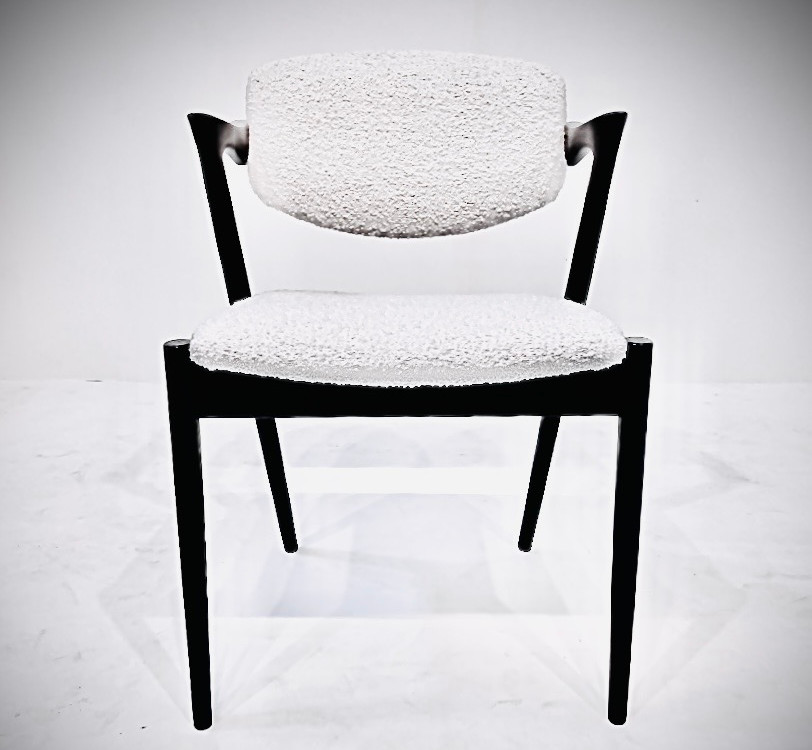
Today, we call it Danish Modern, a term that has become almost a brand unto itself, sometimes used to the point of exhaustion, to describe the elegantly restrained furniture now populating galleries, hotels, restaurants, and the pages of the world's leading interiors magazines. But long before it became an international aesthetic, and an increasingly coveted segment of the vintage market, Danish furniture was the expression of a particular time, a particular country, and a particular philosophy of everyday life. Its modern story begins well before its golden age.
Before the 1950s, a revolution takes shape
In the opening decades of the 20th century, European design was undergoing a profound transformation. In Germany, the Bauhaus was challenging ornament and attempting to reconcile artistic creation with industrial production. Functionalism was reshaping architecture. Forms were becoming simpler. Denmark observed these changes but did not imitate them.
The country had an exceptionally strong craft tradition. Cabinetmakers still occupied a central place in its design culture, and furniture remained intimately connected to an understanding of materials. While some European modernists were already dreaming in steel, glass, and mass production, the Danes continued to look at wood, to touch an armrest, study a joint, and consider the relationship between a material and the human hand. It was precisely this encounter between modernity and tradition that would establish their singularity.
Beginning in the 1920s, Kaare Klint, architect and professor at the Royal Danish Academy of Fine Arts in Copenhagen, played a defining role. His objective was not to invent spectacular new forms but to study the proportions of the human body, the rituals of domestic life, and the furniture of the past in order to distill each to its essence. It was an almost scientific approach to comfort and function.
Around this philosophy, a generation began to emerge that was less interested in breaking with history than in stripping it of everything it considered unnecessary. Modern Danish furniture was taking shape.
The 1950s: The golden age
After World War II, everything accelerated. Europe was rebuilding. Lifestyles were changing. Homes were becoming more modern. The heavily furnished bourgeois interiors of an earlier era increasingly felt at odds with a society drawn toward greater simplicity. Denmark found itself perfectly positioned for the moment.
An extraordinary generation of designers came into its own, Hans J. Wegner, Finn Juhl, Arne Jacobsen, Børge Mogensen, Poul Kjærholm, among others. Their personalities and their work could hardly have been more distinct, yet they shared one fundamental conviction, form should never be separated from use.
Wegner approached the chair with something close to obsession, ultimately designing hundreds of them. Finn Juhl introduced freer, at times almost sculptural forms. Mogensen pursued a robust simplicity intended for everyday life. Kjærholm brought steel into this world without abandoning its exacting craft sensibility. Jacobsen, an architect first, conceived entire environments in which architecture, furniture, and objects existed in continuous dialogue. Yet, what was happening in Copenhagen extended far beyond a handful of celebrated names.
An entire ecosystem surrounded them, architects, craftsmen, manufacturers, schools, professional exhibitions. The close collaborations between designers and master cabinetmakers allowed experimentation with joinery, curves, backs, armrests, and the tension of leather to reach an extraordinary level of refinement. The sophistication was often invisible. That may be the true luxury of Danish furniture, the ability to make effort disappear.
A chair might look as though it had been drawn in a few effortless strokes, when in reality its development required an extraordinary understanding of both material and the human body.
Wood as a manifesto
Teak, oak, beech, rosewood, wood became one of the defining languages of this distinctly Nordic modernity. It brought something to modernism that the international movement had, at times, left behind, warmth.
Danish design was never entirely austere. Its lines were rational but rarely cold. Angles softened. Legs became finer. Backs followed the contours of the body. The objective was less immediate visual impact than a certain sense of equilibrium.
This philosophy also reflected a distinctly Scandinavian relationship with the home. In a country where winter days are short and natural light is precious, the interior occupies a particular place in daily life. A home should feel protective without becoming oppressive, comfortable without becoming ostentatious. Long before the word hygge became a global marketing device, that attention to domestic space was already deeply embedded in Danish culture, and furniture was one of its principal protagonists.
When America discovered Danish Modern
During the 1950s and 1960s, this aesthetic began to move well beyond Denmark's borders. The United States became fascinated by European furniture that felt at once unmistakably modern and remarkably easy to live with. The term Danish Modern entered the vocabulary, and the success was extraordinary.
In postwar American interiors, particularly those shaped by modernist architecture, Scandinavian furniture found a natural home. Its light silhouettes sat effortlessly alongside expansive glass walls and the open-plan spaces of a new generation of houses. Denmark, a small country of only a few million people, became one of the world's epicenters of design.
But the success already contained a contradiction. Pieces born from an extraordinarily sophisticated dialogue between designer and craftsman were becoming international products. Demand grew. Manufacturing evolved. Industry gradually assumed a larger role. What had begun in cabinetmakers' workshops now had to answer to the market.
The retreat
No aesthetic revolution remains fashionable forever. By the 1970s, the landscape was changing. Plastics were gaining ground, colors were becoming bolder, and Italy was asserting a far more theatrical vision of design. Consumer habits were shifting as well.
Affordable furniture manufactured on a massive scale gradually transformed our relationship with domestic objects. A table or chair was no longer necessarily expected to survive several generations.
Some historic Danish design suddenly appeared almost too restrained. Certain pieces remained in production, others disappeared from catalogs. Furniture that collectors now pursue obsessively could, for a time, still be found on the secondary market without attracting much attention at all. Danish Modern entered a period of relative discretion, but it would not last.
The extraordinary return of vintage
Since the end of the 20th century, and with particular intensity over the past two decades, the direction has reversed. Danish furniture from the 1940s, 1950s, and 1960s has become highly collectible.
Specialist galleries have proliferated from Copenhagen to Paris, London, New York, Los Angeles, and Tokyo. Auction houses dedicate sales to 20th-century design. Certain rare pieces now command prices that would probably have astonished the people who designed them. The phenomenon extends far beyond the collecting world.
Teak has returned to residential interiors. Low credenzas have reappeared. Armchairs with exposed structures have displaced oversized upholstered seating. Younger generations are discovering objects made fifty, sixty, sometimes seventy years before they were born. Why such a remarkable return? Fashion moves in cycles, certainly. But that alone does not explain it.
In an era defined by rapid production and disposability, historic Danish furniture represents almost precisely what contemporary culture fears it has lost, material integrity, craftsmanship, repairability, permanence. Vintage introduces another dimension. Choosing an existing piece rather than manufacturing a new one responds to an environmental concern that has become impossible to ignore. There is a certain irony in it, furniture conceived in the middle of the 20th century suddenly feels remarkably attuned to the questions of the 21st.
The perils of success
This rediscovery, however, has its reverse side. Celebrated so extensively, Scandinavian design has become a globally recognizable aesthetic and therefore an easily imitated one.
Tapered legs, pale woods, softened edges, a handful of visual cues are now enough to manufacture something that reads as “Scandinavian.” But appearance was never the point.
What distinguished the great Danish pieces was not simply their silhouette. It was the coherence between drawing, material, construction, and function. There is an enormous difference between looking like Danish furniture and being conceived like Danish furniture.
The vintage market itself can blur that distinction. Reissues proliferate, provenance becomes increasingly important, signatures are pursued, and speculation turns certain pieces into trophies. The furniture that once rejected ostentation can, paradoxically, become a status symbol.
After the masters
The more interesting mistake, however, would be to imagine that the story ended in 1960. It did not.
Contemporary Denmark has a new generation of designers and manufacturers working beneath the long, and occasionally intimidating, shadow of that legacy. Following Wegner, Juhl, or Jacobsen is not necessarily a gift. How does one invent when the work of one's predecessors is still being manufactured, photographed, collected, and desired around the world?
Today, the answers increasingly involve new materials, more resource-efficient manufacturing processes, recycling, modularity, and a far deeper consideration of environmental impact. The challenge is no longer simply to design a beautiful chair. It is to ask what that chair will be made from, how long it can remain in use, how it can be repaired, and what will happen to it when it no longer can.
In a sense, this new generation is returning to the founding principles of Danish design, beginning with use rather than effect.
A revolution that never needed to shout
Perhaps that is why Danish furniture continues to resonate. It never truly attempted to revolutionize our interiors through grand gestures or provocative manifestos. Its revolution was quieter, the belief that an everyday object deserves the same degree of consideration as a monument.
That a chair should respect the person who sits in it. That a material has its own constraints, and that understanding them is more intelligent than disguising them. That an object can be modern without quickly becoming dated.
Nearly a century after Kaare Klint's early investigations, and more than seventy years after the golden age of Danish Modern, those ideas feel almost radically contemporary. In Copenhagen, the furniture revolution never made very much noise. It simply moved into our living rooms.
Visit my website for more info!
Read more from Alexandra Bronckaers
Alexandra Bronckaers, Independent Journalist
Alexandra Bronckaers is a widely recognized independent journalist, former editor-in-chief and publisher, with 30+ years of expertise across fashion, beauty-tech, art, culture and lifestyle. Her work blends sharp analysis with modern storytelling, exploring innovation, creative shifts and industry transformation. Working internationally, she highlights the leaders, creators, disruptors and cultural forces reshaping our era.